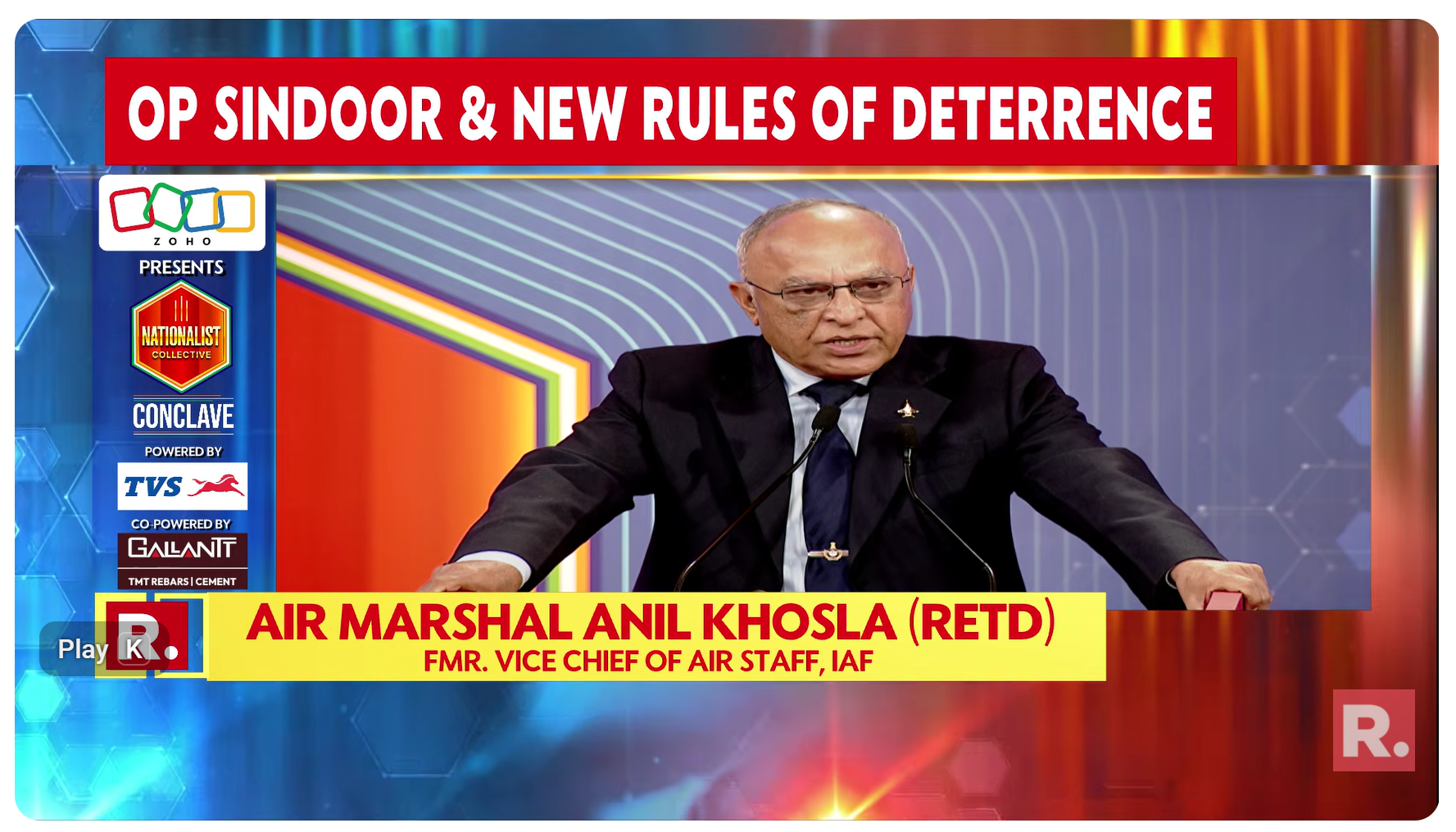
The Nationalist Collective Conclave is a global forum organised by Republic Media Network. Originally conceptualised in January 2021, the movement bills itself as the first and only non-political global forum dedicated to uniting “unapologetic” Indian nationalists worldwide. The conclave bypasses standard political party lines to discuss national defence, strategic sovereignty, cultural revival, and India’s economic future.
Ninth edition of the coclave was held on 13 Jun 26.
I was invited to deliver the keynote address.
Talked about
National Security
Future Trajectory of the Nation
Responsibility of Every Citizen
Please do drop in a few encouraging words or add value to the subject.
For regular updates, please register your email here:-
Information and data included in the blog are for educational & non-commercial purposes only and have been carefully adapted, excerpted, or edited from reliable and accurate sources. All copyrighted material belongs to the respective owners and is provided only for wider dissemination.
India occupies a position that no other major power currently shares. It faces two nuclear-armed neighbours simultaneously, both with active and unresolved territorial disputes, and both with a demonstrated history of military and strategic collusion against Indian interests.
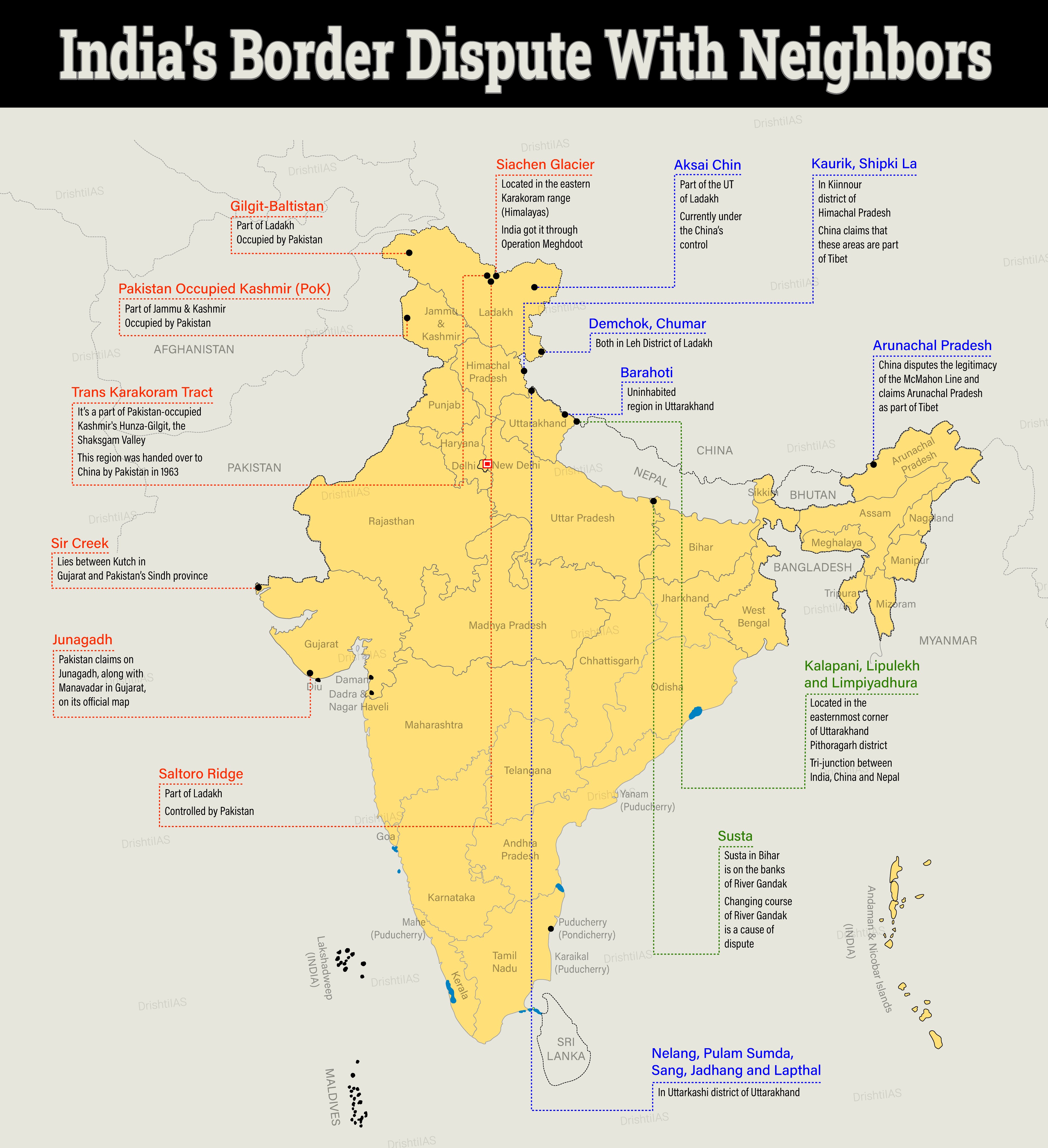
Geographically Challenging Reality. The geographic scope alone establishes why this is a problem unlike any other facing a major power today. Roughly 3,488 kilometres of the undemarcated Line of Actual Control with Tibet runs through Ladakh, the Middle Sector, and Arunachal Pradesh. A further 3,323 kilometres face Pakistan on the Western Front, comprising the 740-kilometre Line of Control in Kashmir and the International Border extending into Punjab, Rajasthan, and Gujarat, including the Sir Creek sector. These two frontiers could not be more dissimilar in terrain or character. The LAC runs through some of the most inhospitable high-altitude terrain on earth, including glaciated passes, oxygen-starved ridgelines, and winter temperatures that fall below minus forty. In these places, infrastructure development and troop acclimatisation themselves become strategic assets in ways that few other borders in the world require.
Troublesome Lines. The geopolitical landscape of the Indian subcontinent is defined by several critical borders and lines of control, born from colonial legacy, fast-moving historical crises, and shifting tactical realities.
India-Pakistan Borders
The Radcliffe Line. Drawn in 1947 by Sir Cyril Radcliffe, Chairman of the Boundary Commissions, to partition British India into India and Pakistan. It originally demarcated the international borders on both flanks of India: the Western Front (with what is now Pakistan) across Punjab, Rajasthan, and Gujarat, and the eastern front (with East Pakistan, now Bangladesh). It remains the legally recognised International Border (IB) between the three sovereign nations.
Line of Control (LoC). Originating as the Ceasefire Line (CFL) following the 1947–48 Indo-Pak War, it was formally designated and renamed as the Line of Control under the Shimla Agreement of 1972. Spanning roughly 740 km, it cuts through the disputed region of Jammu and Kashmir. A de facto military control line, not an international boundary. It terminates northwards at grid coordinate NJ9842, leaving the treacherous terrain beyond it undemarcated at the time.
Actual Ground Position Line (AGPL). Established following India’s pre-emptive deployment in Operation Meghdoot (1984) to secure the heights of the Siachen Glacier. Extending roughly 110 km from grid coordinate NJ9842 to the Indira Col, it tracks the ridgeline of the Saltoro Range. It delineates the current military positions of Indian and Pakistani troops, with India holding the dominant high-ground features of the glacier.
Sir Creek. A long-standing maritime and marshland dispute over a 96 km strip of water in the Rann of Kutch marshlands between Gujarat and Sindh. The disagreement hinges on the interpretation of early 20th-century resolutions. Pakistan claims the eastern bank of the creek, while India advocates for the Thalweg Principle, an international law standard that places the boundary along the centerline of the deep-water navigable channel. An undemarcated maritime boundary affects the determination of each country’s Exclusive Economic Zone (EEZ) in the Arabian Sea.
India-China Borders
The McMahon Line. Negotiated by Sir Henry McMahon at the Simla Convention of 1914 between Great Britain and Tibet. It forms the legal boundary of the Eastern Sector, running along the highest crest of the Himalayas to separate northeastern India (Arunachal Pradesh) from Tibet. India recognises it as the official International Border. China rejects its legality, claiming that Tibet lacked the treaty-making sovereignty to sign the convention, and labels the region “South Tibet.”
Line of Actual Control (LAC). Context: A concept first introduced by Chinese Premier Zhou Enlai in 1959, which crystallised on the ground following the 1962 Sino-Indian War. The LAC is split into three main operational sectors. In the Western Sector, it separates Ladakh from Aksai Chin (which is under illegal Chinese occupation). In the Middle Sector, it borders Uttarakhand and Himachal Pradesh. In the Eastern Sector, it runs roughly parallel to the McMahon Line. Unlike the LoC with Pakistan, the LAC is not mutually agreed upon on a map, leading to overlapping perceptions of where the line actually lies. These differing perceptions frequently cause localised standoffs during patrols.
Historical Lines in the Western Sector (Ladakh/Aksai Chin). To understand the historical friction over Aksai Chin, two colonial-era lines are key:
Johnson-Ardagh Line (1865). Proposed by civil servant W.H. Johnson and later supported by Major John Ardagh, this boundary placed Aksai Chin firmly within the princely state of Jammu and Kashmir. This remains the basis for India’s official territorial claim.
Macartney-MacDonald Line (1899). A subsequent, more conservative compromise was proposed by Britain to China, which placed Aksai Chin under Chinese sovereignty to create a buffer against Russian expansion. China has neither formally accepted nor rejected it, but it aligns closely with the modern LAC in the region.
Pakistan: The Asymmetric and Proxy-Driven Challenge
Pakistan’s strategic posture toward India has remained doctrinally consistent for decades. An inability to compete conventionally is compensated for through asymmetric and sub-conventional means. Resorting to terrorism, proxy warfare, and increasingly, information operations. The roots of the dispute lie in the unresolved status of Jammu and Kashmir since Partition. The relationship has produced four major conflicts: in 1947–48, 1965, 1971, and the Kargil War of 1999, alongside decades of cross-border terrorism that include the 2001 Parliament attack, the 2008 Mumbai attacks, the 2019 Pulwama attack (followed by Balakot Strike), and the 2025 Phalgam attack, resulting in Operation Sindoor.
Pakistan’s conventional weakness, taken in isolation, would argue for a steady erosion of its capacity to threaten India over time. What arrests that natural erosion is Chinese material support, which keeps Pakistan’s conventional and technological edge artificially current. The supply of fighter aircraft, frigates, air defence systems and weapons from China, combined with deep intelligence cooperation between the two states, ensures that even a fiscally constrained Pakistani military remains a credible threat. Any assessment of Pakistani military capability that ignores this Chinese subsidy will systematically underestimate the actual threat that Pakistan poses and misjudge the trajectory of that threat over time.
China: The Long-Horizon Salami Slicer
China presents a fundamentally different kind of strategic problem. It is not asymmetric and proxy-driven as Pakistan’s challenge is. It is pursuing a long-horizon strategy of incremental territorial assertion along the Line of Actual Control. An approach commonly termed salami slicing. Where Pakistan’s challenge is measured in months and operational cycles, China’s is measured in years and even decades. A road built today, a village established this year, and a patrol pattern normalised over eighteen months are the actual instruments of Chinese strategy on the LAC. These steps are individually deniable and internationally ambiguous. However, the cumulative effect of each is a shift in ground realities in China’s favour, that too, without triggering the threshold of response that a direct military incursion would invite.
The dispute with China dates to the 1962 war. It remains concentrated in two principal sectors: the Western Sector, where China controls Aksai Chin, and the Eastern Sector, where China claims roughly 90,000 square kilometres of Arunachal Pradesh as South Tibet. China periodically renames locations across Arunachal Pradesh on its official maps. It is a low-cost, high-visibility instrument of psychological and legal pressure that incurs no military cost but is designed to normalise its claims in the international record over time. India’s consistent and unwavering rejection of these renaming exercises matters precisely because silence on this point would itself be read as acquiescence.
The 2017 Doklam standoff and the 2020 Galwan Valley clash marked a genuine inflexion point in how India approaches this frontier. It was the first fatal clash on this border since 1975. For the first time in decades, India faced a sustained, high-altitude, multi-divisional military confrontation requiring permanent infrastructure and force posture changes, not simply diplomatic management. Galwan in particular forced a strategic reassessment that had been deferred for too long. Tens of thousands of troops were moved into forward positions on both sides, defence expenditure on the northern front rose sharply, and India’s force posture shifted from a largely defensive, protocol-based approach to one that explicitly anticipates contestation as the normal state of affairs along this border. The subsequent restoration of patrolling arrangements in certain friction areas is a welcome development. However, it is not a return to the earlier state. On both sides, forward infrastructure has been consolidated, force levels have been increased, and the earlier frameworks of mutual restraint have been revised.
Infrastructure. India has made substantial progress in border infrastructure development over the past decade. Roads, tunnels, forward airfields, and logistics nodes that were absent or inadequate in 2020 are now being built at a pace that would have seemed implausible a decade ago. The Atal Tunnel, the under-construction Zojila Tunnel, the doubling of road connectivity to Daulat Beg Oldi, and the expansion of advanced landing grounds across the northeast represent a genuine shift in the strategic geography of the LAC. That shift, however, must be assessed honestly against China’s own head start. China has spent two decades building a dense network of military-grade roads, railheads, and forward logistics infrastructure on its side of the LAC, an investment with no peacetime equivalent in the Indian inventory until recently. The gap has narrowed, while India is addressing the reach, China has moved ahead and is concentrating on speed. Closing the gap entirely will require sustained financial and institutional commitment over the coming decade, rather than at the current pace.
Water. China’s upstream dam-building on the Brahmaputra (Yarlung Tsangpo) on the Tibetan plateau adds a further dimension that is strategically underweighted in most public discussion. Beijing’s plans for a mega-dam in the Great Bend region, which would dwarf any hydroelectric project currently in existence, give China potential leverage over downstream water security for tens of millions of Indians in Assam and the wider northeastern region. This is the one area where China can exercise pressure on India without a single soldier crossing the LAC. The water dimension does not require a military response. Still, it does require a diplomatic, legal, and technical one. India needs to build the institutional infrastructure needed to contest this front.
Beyond Borders. China’s broader regional behaviour indicates its intent along the LAC. A power pursuing expansive maritime claims in the South China Sea, sustained pressure on Taiwan, and a growing naval presence in the Indian Ocean Region is unlikely to treat its territorial claims against India as a special exception to an otherwise more restrained posture. Chinese naval activity in the Indian Ocean includes port access and influence in Sri Lanka, Pakistan’s Gwadar, and Djibouti, as well as surveillance vessels transiting near Indian waters during sensitive periods. It demonstrates that China’s challenge to India is not confined to the Himalayan land border. The continental and maritime dimensions of Chinese pressure are connected in Beijing’s strategic calculus, even if they are frequently disaggregated in Indian policy discourse.
The Collusive Threat
The concept of the collusive threat is not theoretical for India. It has been a planning reality that has shaped Indian military doctrine for over a decade, and recent years have only sharpened its relevance. The China-Pakistan Economic Corridor is more than an infrastructure project. It is a strategic binding mechanism, locking Chinese economic interests into Pakistani territorial integrity and giving Beijing a material stake in Pakistan’s capacity to sustain pressure on India. Chinese technology transfer across multiple domains (space, cyber, missile, and nuclear) has progressively elevated Pakistani capabilities beyond what Pakistan’s own defence industrial base could sustain. The relationship is not an alliance of equals. Still, there is a genuine strategic convergence on the India question, and India would be imprudent to assume it will fracture under pressure at the moment it matters most.
The practical implication for Indian force planning is that the two-front scenario cannot be treated as a planning contingency to be modelled and set aside. It must dictate the structure, positioning, and readiness of Indian forces in peacetime. Tackling the collusive threat demands a high degree of integration and a multi-domain, multi-front approach. The Air Force’s squadron strength, currently running at approximately thirty to thirty-three operational squadrons against a sanctioned strength of forty-two, represents the most acute capability gap in this picture. Air power is the one domain in which India can project decisive force across both frontiers simultaneously, and the attrition of that capability below sanctioned levels is a strategic liability that cannot be deferred indefinitely without consequence.
The Cognitive Front
National resilience against information warfare and internal fragmentation deserves a priority equal to physical border security. Both China and Pakistan have invested significantly in the capacity to target India’s internal coherence. They resort to disinformation, the manufacture of communal tension, manipulation of social media narratives, and support for disruptive domestic actors. This is a cognitive front without a physical reference, and for that reason, it is chronically underweighted in strategic planning that still thinks primarily in terms of territory and platforms. A nation that can be persuaded to doubt its own institutions, distrust its own armed forces, or is fractured along internal lines requires no physical invasion to be strategically weakened. India’s internal cohesion is itself a strategic asset, and its erosion is itself a strategic objective for its adversaries.
The architecture required to protect that cohesion is different from the architecture required to defend a physical border. It involves media literacy, institutional credibility, civil-military trust, and a political culture that does not amplify adversarial narratives for domestic advantage. These are not, by any means, the concerns of a defence establishment, but they fall within any serious conception of national security in an era when information is as operationally significant as firepower.
Strategic Clarity as the Foundation of Security
India’s strategic challenge is structurally unique. No other democracy faces two nuclear-armed, territorially revisionist neighbours who are themselves in a relationship of active strategic convergence. Managing that challenge requires sustained investment across every domain, including physical infrastructure, military capability, intelligence, technology, and the resilience of the national fabric itself. It requires a doctrine that treats the China-Pakistan axis as a single, integrated problem rather than two parallel files. And it requires an institutional culture willing to speak honestly about gaps, timelines, and risks, rather than resolving uncomfortable assessments into premature reassurance.
Operation Sindoor offered a data point, not a verdict. It demonstrated operational proficiency under one set of conditions. The conditions under which India will next be tested will not be chosen by India, and they may not be as manageable as those of May 2025. The margin for complacency is precisely zero. Strategic clarity, sustained effort, and institutional honesty are not optional features of a credible security posture. They are its foundation.
Please Add Value to the write-up with your views on the subject.
For regular updates, please register your email here:-
Information and data included in the blog are for educational & non-commercial purposes only and have been carefully adapted, excerpted, or edited from reliable and accurate sources. All copyrighted material belongs to the respective owners and is provided only for wider dissemination.
Centre for the Study of Drone and Robotics. (2024, October). The road to Galwan: Crisis at the Line of Actual Control and China’s motivations [Strategic report].
Parliamentary Standing Committee on Defence, Government of India. (2024, December 17). Report on Indian Air Force combat fleet strength [Parliamentary panel report].
Manohar Parrikar Institute for Defence Studies and Analyses. (2020). India’s China challenge: A fifty-year perspective [Monograph series]. MP-IDSA. https://www.idsa.in
Information and data included in the blog are for educational & non-commercial purposes only and have been carefully adapted, excerpted, or edited from reliable and accurate sources. All copyrighted material belongs to the respective owners and is provided only for wider dissemination.