Pics Courtesy Internet
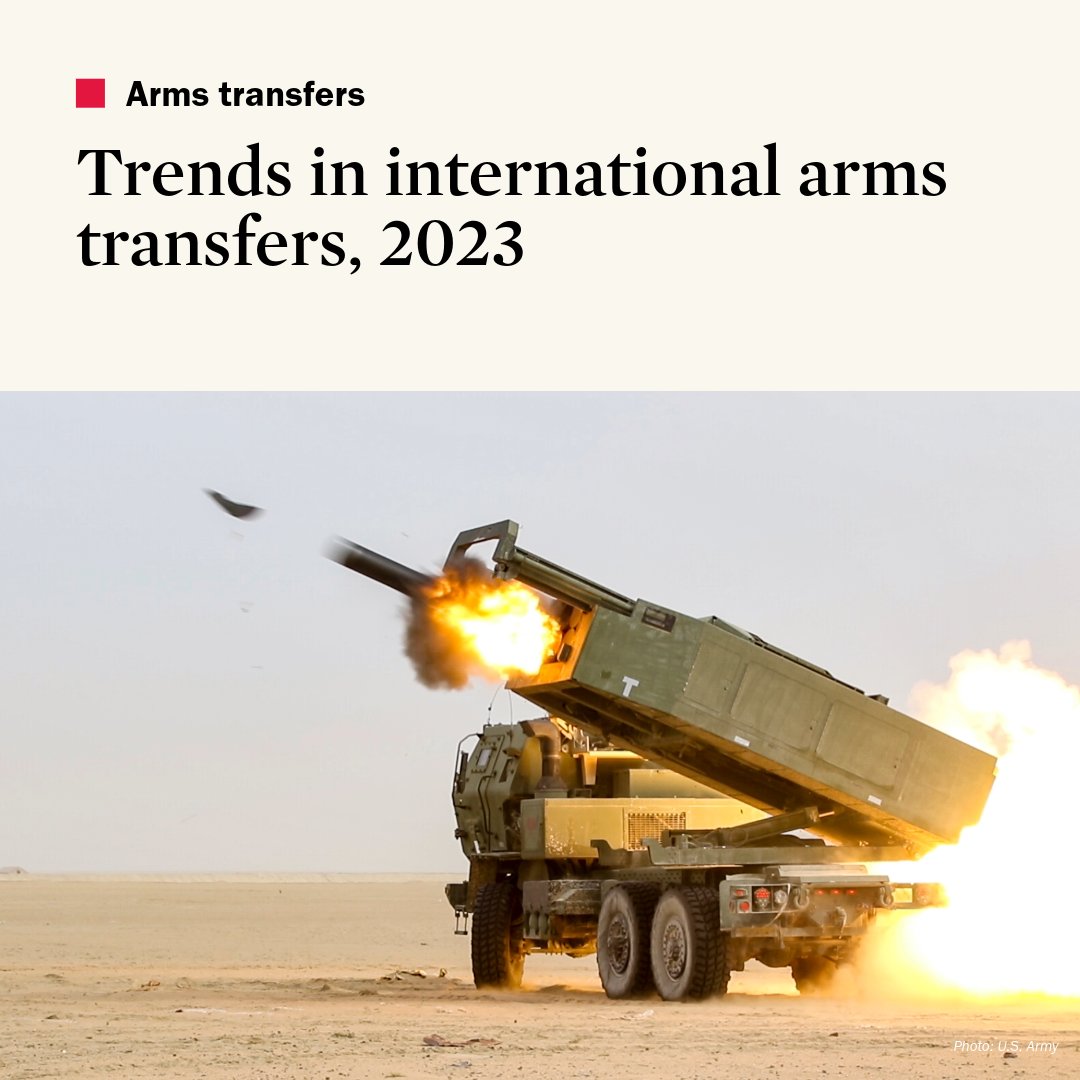
Stockholm International Peace Research Institute (SIPRI), recently published its fact sheet about trends in international arms transfer covering the last five-year period i.e. 2014-23 and compared it with data from the previous five years of 2014-18. The gist of it is as follows:-
The global volume of international arms transfers decreased marginally, by 3.3 per cent.
Imports of major arms by states in Europe increased by 94 per cent between 2014–18 and 2019–23.
There were overall decreases in arms transfers to all other regions, but states in Asia and Oceania and the Middle East continued to import arms in much larger volumes than those in Europe.
Nine of the 10 biggest arms importers in 2019–23, including the top 3 of India, Saudi Arabia and Qatar, were in Asia and Oceania or the Middle East.
Ukraine became the fourth biggest arms importer globally after it received transfers of major arms from over 30 states in 2022–23.
Arms exports by the United States, the world’s largest arms supplier, rose by 17 per cent between 2014–18 and 2019–23, while those by Russia fell by more than half (–53 per cent).
France’s arms exports grew by 47 per cent and it moved just ahead of Russia to become the world’s second-largest arms supplier.
THE EXPORTERS (2019–23)
SIPRI has identified 66 states as exporters of major arms in 2019–23.
The five largest exporters of arms during that period—the USA, France, Russia, China and Germany—accounted for 75 per cent of all arms exports.
US and French arms exports rose between 2014–18 and 2019–23, while Russian, Chinese and German arms exports fell.
The USA and states in Western Europe together accounted for 72 per cent of all arms exports in 2019–23, compared with 62 per cent in 2014–18.
USA
The USA’s arms exports grew by 17 per cent between 2014–18 and 2019–23 and its share of total global arms exports rose from 34 per cent to 42 per cent.
The USA delivered major arms to 107 states in 2019–23, which was more than the next two biggest exporters combined.
The volume of arms exported by the USA in 2019–23 was 282 per cent higher than that of France, the second biggest arms exporter globally.
In 2019–23 the largest share of US arms exports went to states in the Middle East (38 per cent).
US arms exports to states in Asia and Oceania increased by 14 per cent overall between 2014–18 and 2019–23, with the region account- ing for 31 per cent of all US arms exports in 2019–23.
Three states in the region were among the 10 largest recipients of US arms in 2019–23: Japan accounted for 9.5 per cent of all US arms exports, Australia for 7.1 per cent and South Korea for 5.3 per cent.
A total of 28 per cent of US arms exports went to states in Europe in 2019–23, which was up from 11 per cent in 2014–18. US arms exports to the region increased by just over 200 per cent between the two periods. Ukraine accounted for 4.7 per cent of all US arms exports and 17 per cent of those to Europe.
Deliveries of combat aircraft typically make up a significant part of the USA’s total arms exports. It delivered 420 combat aircraft in 2019–23. Of these, 249 were advanced F-35 aircraft, which were delivered to a total of 10 states and accounted for 24 per cent of all US arms exports. The USA has many pending arms export deliveries, including a total of 1071 combat aircraft, of which 785 are F-35s.
France
France narrowly overtook Russia to become the world’s second largest exporter of major arms in 2019–23.
France delivered major arms to 64 states in 2019–23, but India was by far the largest recipient, accounting for 29 per cent of French arms exports.
The bulk of France’s arms exports in 2019–23 went to states in Asia and Oceania (42 per cent of arms exports) and the Middle East (34 per cent).
France has been trying to expand its arms sales to other European states for many years; however, its exports to European states in 2019–23 accounted for only 9.1 per cent of its total arms exports. More than half of its European arms exports (53 per cent) went to Greece, mostly made up of transfers of 17 Rafale combat aircraft.
A sharp rise in deliveries of Rafale combat aircraft accounted for most of the growth in French arms exports in 2019–23. France exported 23 Rafales in 2014–18. This increased to 94 in 2019–23, representing just under one third (31 per cent) of French arms exports in the period. A further 193 Rafales were on order for export as at the end of 2023. However, most of the aircraft France has already delivered (96 out of 117) and those on order (178 out of 193) are for states outside Europe—Egypt, India, Indonesia, Qatar and the United Arab Emirates.
This highlights the challenge France still faces in selling its major arms to European states, especially in the context of the strong competition from the USA. Notably, 8 out of the 10 European states that preselected or ordered combat aircraft in 2019–23 opted for US F-16s or F-35s, with only Croatia and Greece opting for the Rafale.
Russia
Russia’s arms exports fell by 53 per cent between 2014–18 and 2019–23 and it accounted for 11 per cent of total global arms exports. It delivered major arms to 41 states in 2019–23.
In 2019 the annual volume of Russian arms exports was at a similar level to that in each of the preceding 20 years. However, the export volumes in 2020, 2021 and 2022 were at much lower levels than in 2019, and in 2023 the volume was 52 per cent lower than in 2022. Another indication of the decline of Russia as a global supplier of arms is that whereas 31 states received major arms from Russia in 2019, only 14 did in 2022 and that number fell to 12 in 2023.
States in Asia and Oceania received 68 per cent of total Russian arms exports in 2019–23, while Middle Eastern and African states received 13 per cent and 10 per cent respectively.
Just under two-thirds of Russian arms exports went to three states in 2019–23: India (34 per cent), China (21 per cent) and Egypt (7.5 per cent).
India was also the largest recipient of Russian arms in 2014–18, but exports to India decreased by 34 per cent between 2014–18 and 2019–23, while exports to China decreased by 39 per cent and to Egypt by 54 per cent.
Algeria and Vietnam were the third and fourth largest recipients of Russian arms in 2014–18; however, exports to Algeria (–83 per cent) and Vietnam (–91 per cent) dropped significantly between the two periods.
The low volume of pending deliveries of major arms from Russia suggests that Russian arms exports are likely to remain well below the level reached in 2014–18, for at least the short term.
China
China accounted for 5.8 per cent of total global arms exports in 2019–23. Its arms exports decreased by 5.3 per cent between 2014–18 and 2019–23.
The bulk of Chinese arms exports (85 per cent) went to states in Asia and Oceania, followed by states in Africa (9.9 per cent). China delivered major arms to 40 states in 2019–23, but well over half of its arms exports (61 per cent) went to just one state—Pakistan.
Others
-
-
- Germany. Arms exports by Germany made up 5.6 per cent of the global total in 2019–23. They were 14 per cent lower than in 2014–18. States in the Middle East received the largest share of all German arms exports in 2019–23 (39 per cent), followed by states in Asia and Oceania (28 per cent) and Europe (25 per cent).
-
-
-
- Italy accounted for 4.3 per cent of the world’s arms exports in 2019–23. Its arms exports were 86 per cent higher in 2019–23 than in 2014–18. A total of 71 per cent of Italian arms exports went to the Middle East.
-
-
-
- The 4 other suppliers making up the top 10 arms exporters in 2019–23 were the United Kingdom, Spain, Israel and South Korea. Arms exports by the UK (–14 per cent), Spain (–3.3 per cent) and Israel (–25 per cent) all decreased between 2014–18 and 2019–23, while arms exports by South Korea increased by 12 per cent.
-
THE IMPORTERS (2019–23)
SIPRI has identified 170 states as importers of major arms in 2019–23. The top five arms importers—India, Saudi Arabia, Qatar, Ukraine and Pakistan— received 35 per cent of all arms imports in the period.
States in Asia and Oceania accounted for 37 per cent of all arms imports in 2019–23, followed by states in the Middle East (30 per cent), Europe (21 per cent), the Americas (5.7 per cent) and Africa (4.3 per cent).
Asia and Oceania
Arms imports by states in Asia and Oceania decreased by 12 per cent between 2014–18 and 2019–23, mainly because of a sharp drop in Chinese arms imports.
However, it remained the region with the highest volume of arms imports and 6 of the world’s 10 largest arms importers in 2019–23 were in Asia and Oceania: India, Pakistan, Japan, Australia, South Korea and China.
The main suppliers to the region were the USA, with a 34 per cent share of regional imports, Russia (19 per cent) and China (13 per cent).
India
India’s tensions with Pakistan and China largely drive its arms imports.
India’s arms imports increased by 4.7 per cent between 2014–18 and 2019–23, making it the world’s biggest arms importer in 2019–23 with a 9.8 per cent share of all arms imports.
Russia remained India’s main supplier, but its share of Indian arms imports has shrunk from 76 per cent in 2009–13 to 58 per cent in 2014–18 and then to 36 per cent in 2019–23.
India has instead looked to Western suppliers, most notably France and the USA, and its own arms industry to meet its demand for major arms. This shift is also visible in India’s new orders, many of which are placed with Western suppliers, and its arms procurement plans, which seemingly do not include any Russian options.
Pakistan. Arms imports by Pakistan grew by 43 per cent between 2014–18 and 2019–23 and accounted for 4.3 per cent of the world total, making it the fifth largest arms importer globally. Pakistan continued to strengthen its arms procurement relations with China: 82 per cent of its arms imports came from China in 2019–23, as against 69 per cent in 2014–18, and 51 per cent in 2009–13.
Africa
Imports of major arms by African states fell by 52 per cent between 2014–18 and 2019–23, which was mainly due to decreases in the arms imports of the two largest importers in the region, Algeria (–77 per cent) and Morocco (–46 per cent).
The main suppliers to Africa in 2019–23 were Russia, accounting for 24 per cent of African imports of major arms, the USA (16 per cent), China (13 per cent) and France (10 per cent).
East Asia, Oceania and South East Asia
Arms imports by states in East Asia (–6.1 per cent), Oceania (–10 per cent) and South East Asia (–43 per cent) decreased between 2014–18 and 2019–23.
China. China’s arms imports fell by 44 per cent and accounted for 2.9 per cent of the global total in 2019–23. Most Chinese arms imports (77 per cent) came from Russia. The drop in Chinese imports is due to China’s growing ability to design and produce its own major arms. Its arms imports will probably decrease further as it develops this capacity.
Japan and South Korea are expanding their military capabilities, mainly because of tensions with China and North Korea. Japan (+155 per cent) and South Korea (+6.5 per cent) increased their arms imports between 2014–18 and 2019–23. The USA is the main supplier to both states, accounting for 97 per cent of Japan’s arms imports and 72 per cent of South Korea’s. The two states are investing heavily in long-range strike capabilities. The USA supplied 29 combat aircraft to Japan and 34 to South Korea in 2019–23. Japan also ordered 400 long-range land-attack missiles from the USA in 2023 (see box 2). These will, for the first time, give Japan the capability to reach targets deep inside China or North Korea.
Taiwan’s arms imports dropped by 69 per cent between 2014–18 and 2019–23 despite heightened tensions with China. However, major deliveries are planned to take place over the next five years, including deliveries of 66 combat aircraft, 108 tanks and 460 anti-ship missiles. All these planned deliveries are from the USA, which supplied over 99 per cent of Taiwanese arms imports in 2019–23.
Australia was the eighth largest arms importer in 2019–23 after its arms imports dropped by 21 per cent. However, in 2023 it reached an agreement with the UK and the USA to import at least six nuclear-powered submarines.
Arms imports by South East Asian states fell by 43 per cent between 2014–18 and 2019–23. However, tensions, mainly with China, continue to drive arms acquisitions by many states in the subregion. For example, arms imports by the Philippines (+105 per cent) and by Singapore (+17 per cent) increased between the two periods. In addition, Indonesia, and Malaysia.
Europe
Arms imports by states in Europe were 94 per cent higher in 2019–23 than in 2014–18.
Ukraine received 23 per cent of the region’s arms imports in 2019–23. It was, by far, the largest arms importer in Europe and the fourth largest in the world.
The UK, which accounted for 11 per cent of European arms imports, and the Netherlands (9.0 per cent) were the next biggest arms importers in the region.
A total of 55 per cent of European arms imports came from the USA in 2019–23, compared with 35 per cent in 2014–18. The next largest suppliers to the region were Germany and France, which accounted for 6.4 per cent and 4.6 per cent of European arms imports respectively.
West and Central European States. Russia’s initial invasion of Ukraine in 2014 increased the demand for arms in West and Central European states. For example, by the end of 2023, these states had a total of 791 combat aircraft and combat helicopters on order for import. After it launched the full-scale invasion in 2022, Russia began a campaign of missile attacks against Ukraine. In response, many West and Central European states supplied air defence systems to Ukraine and several placed new import orders for them or accelerated existing procurement processes. In 2023 Poland ordered 12 air defence systems from the USA, and Germany ordered a single but particularly high-value system from Israel. In 2022–23 Austria, Estonia, Latvia and Slovenia ordered air defence systems from Germany, while Finland and Slovakia ordered Israeli systems, and Lithuania and the Netherlands ordered Norwegian systems. In addition, some states ordered missiles for domestically produced systems or to arm newly acquired imports or their existing systems. For example, in 2023 Poland and Norway ordered missiles from the UK and the USA, respectively, for their new systems, while Germany ordered 500 missiles and Romania 200, all from the USA, for their existing systems.
The Middle East. Arms imports by states in the Middle East were 12 per cent lower in 2019–23 than in 2014–18. Three of the top 10 arms importers in 2019–23 were in the Middle East: Saudi Arabia, Qatar and Egypt. The USA accounted for 52 per cent of Middle Eastern arms imports. The next biggest suppliers were France (12 per cent), Italy (10 per cent) and Germany (7.1 per cent).
The Gulf Region. Saudi Arabia was the world’s second-largest arms importer in 2019–23, with an 8.4 per cent share of all arms imports. Its arms imports fell by 28 per cent after peaking at their highest point ever in 2014–18. The USA supplied 75 per cent of Saudi Arabian arms imports in 2019–23, which included the delivery of 67 combat aircraft and hundreds of land-attack missiles.
Qatar was the third largest arms importer in the world, with a global share of 7.6 per cent, as its arms imports increased by 396 per cent between 2014–18 and 2019–23. Its main suppliers in 2019–23 were the USA, which accounted for 45 per cent of Qatari arms imports, France (25 per cent) and Italy (15 per cent). Qatar’s arms imports in the period included 36 combat aircraft from France, 36 from the USA and 25 from the UK, as well as 4 frigates from Italy. Iran’s arms imports have been at a very low level relative to those of other arms importers in the Gulf region since around 1993. In 2023 Iran placed by far its largest import order for major arms in 20 years, for 24 combat aircraft from Russia.
Israel. Between 2014–18 and 2019–23, arms imports by Israel rose marginally (+5.1 per cent). The USA accounted for 69 per cent and Germany for 30 per cent of Israeli arms imports. Imported weapons, in particular combat aircraft received from the USA over several decades, have played a major role in Israel’s military actions against Hamas and Hezbollah. At the end of 2023 the USA rapidly delivered thousands of guided bombs and missiles to Israel, but the total volume of Israeli arms imports from the USA in 2023 was almost the same as in 2022. By the end of 2023, pending deliveries of major arms to Israel included 61 combat aircraft from the USA and 4 submarines from Germany.
Arms imports and the war in Ukraine
At least 30 states supplied major arms to Ukraine after the full-scale Russian invasion in February 2022, mostly as military aid, meaning that Ukraine was by some distance the world’s largest arms importer in the year 2023.
The USA supplied 39 per cent of Ukrainian arms imports in 2019–23, followed by Germany (14 per cent) and Poland (13 per cent).
To broaden Ukraine’s military capabilities, suppliers began to deliver long-range systems in 2023. For example, Poland and Slovakia donated 27 surplus combat aircraft, and France and the UK supplied missiles with a range of 300 kilometres. During the year, Belgium, Denmark, the Netherlands and Norway also started to prepare for the delivery of over 50 surplus combat aircraft.
Russia relies primarily on its industry for its major arms. However, in 2022–23 it imported flying bombs from Iran and ballistic missiles from North Korea, the latter in violation of a United Nations arms embargo on North Korea.
Suggestions and value additions are most welcome
For regular updates, please register here
References and credits
SIPRI
To all the online sites and channels.
Disclaimer:
Information and data included in the blog are for educational & non-commercial purposes only and have been carefully adapted, excerpted, or edited from sources deemed reliable and accurate. All copyrighted material belongs to respective owners and is provided only for purposes of wider dissemination.