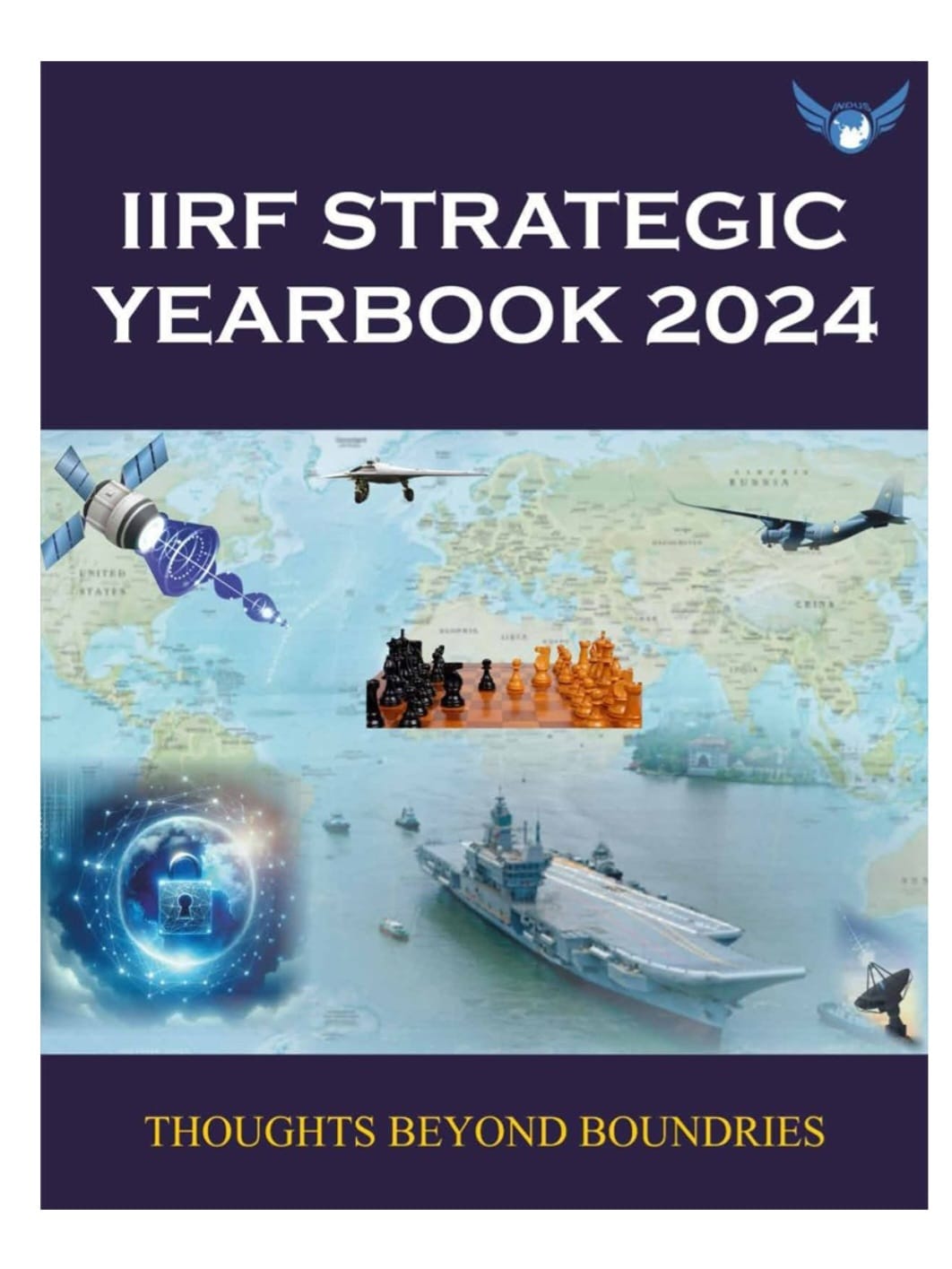
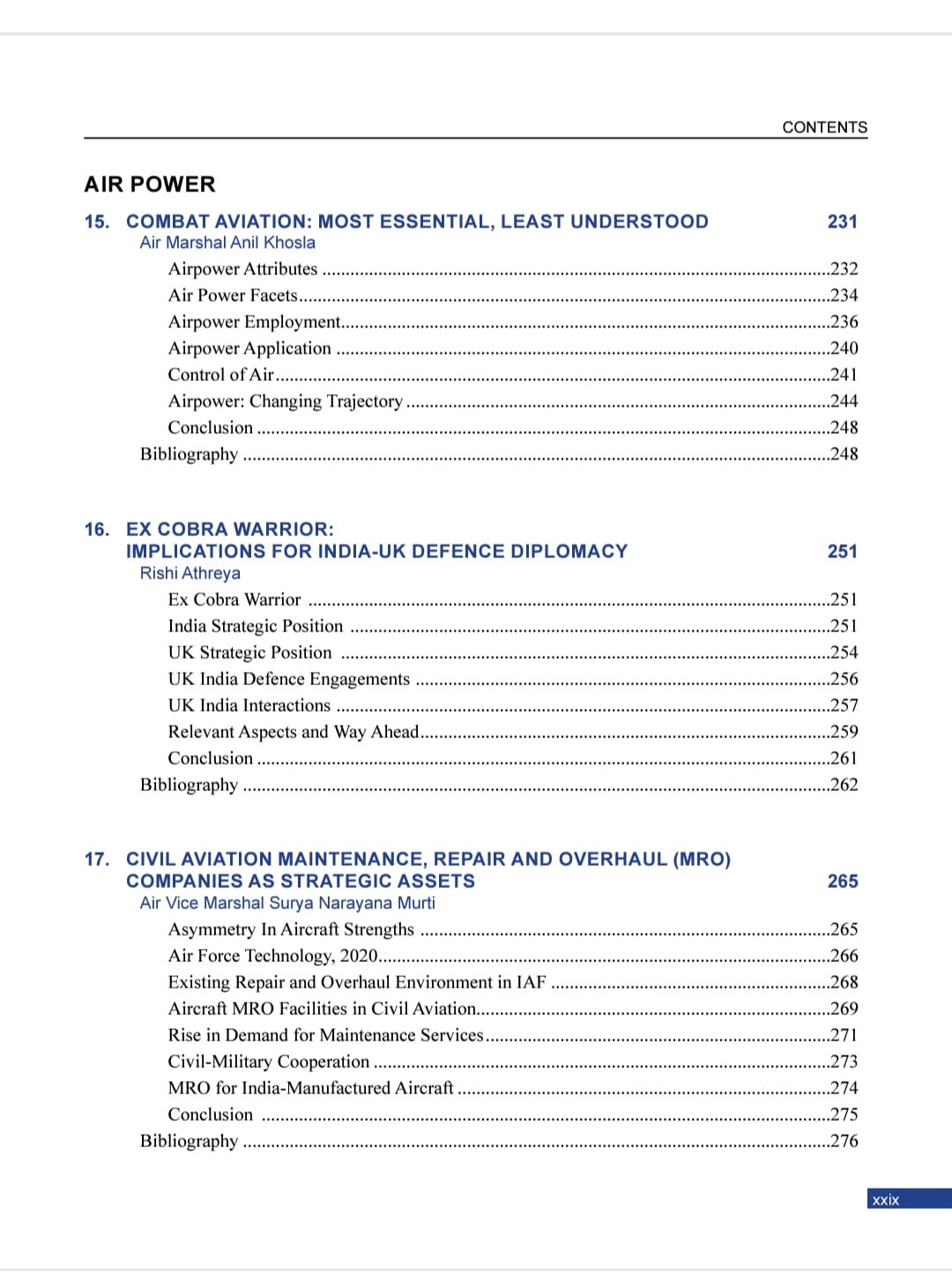
My Article published in the Indus International Research Foundation Year Book 2024.
“Air power is not only a fascinating subject, but its theory and practice also constitute a very demanding profession, and even a lifetime’s study and devotion is inadequate to unravel its mystique or fully understand its imperatives.”
– Air Cmde Jasjit Singh
Air power is a revolutionary force that transformed the fundamental nature of war in less than a century. The concept of air power is often considered one of the most essential elements in modern military operations, but it can also be the least understood aspect for various reasons. Aviation technology advances open up many new possibilities for air power applications. Developing, maintaining, and operating a modern air force is resource-intensive. Balancing budget constraints with the need for cutting-edge technology and capabilities is a complex task. The effective integration of air power with surface forces can be challenging. Joint operations require seamless communication, coordination, and a shared understanding of each other’s roles, tasks, and core competencies. These complexities make it challenging to understand the potential of air power and the nuances of its application for both the practitioners of air power and those affected directly or indirectly by it. Douhet, Mitchell, and Trenchard, the three airpower prophets from military aviation’s earliest years, articulated their airpower theories that shaped military aviation for decades. While it is good always to remember the basics, it is worthwhile to revisit and review them, especially with the ongoing and urgent debate about proposed organisational changes.
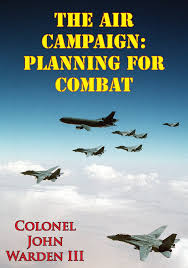
John Warden. John Warden was born in Texas in 1943. He earned a master’s degree in political science from Texas Tech University, was appointed to the Air Force Academy from Pennsylvania, and graduated in the class of 1965. He conducted a combat tour in OV-10s with the First Air Cavalry Division in Vietnam and a tour in F-4Ds. While at the National War College, Warden wrote a thesis on air operations planning at the theatre level of war. After that, he was assigned as F-15 wing commander at Bitburg, Germany. He remained in that grade when he returned to the Pentagon to head CHECKMATE, an office serving under the Air Force deputy chief of staff for plans and operations concerned with long-range planning. Warden was serving in that capacity at the onset of the Gulf War. After the Gulf War, Colonel Warden was transferred to Maxwell Air Force Base, where he became the Air Command and Staff College (ACSC) commandant. He stirred up that institution greatly, reorienting its study to focus on the operational strategy level of war and air planning at that level. Warden retired from the USAF in 1995. Warden wrote the book “The Air Campaign: Planning for Combat”, which focused on a European war. He seemed to be much more concerned with airpower than with flying aeroplanes.
Core Ideas and Beliefs. John Warden’s core ideas and beliefs, the bedrock of his airpower strategy, continue to reverberate in the field of airpower strategy. His belief in the vital role of air campaign planning, once air superiority is assured, has shaped the way airpower is used in support of other arms or independently to achieve decisive effects. His profound assumptions and beliefs, encapsulated in the following statements, have left an indelible mark on the discourse in the field of airpower strategy:-
Human behaviour is complex and unpredictable, whereas material effects of military action are more predictable.
Victory is and always has been achieved in the mind of the enemy commander—everything must be directed toward that end.
John Warden’s belief in the potency of the offensive in air war is a testament to his strategic mindset. He firmly believed that the offensive is the more potent form of air war, a belief that continues to resonate in airpower strategy.
Theories & Views
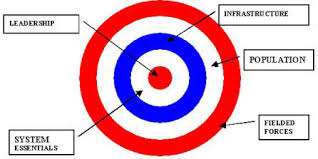
Five Ring Theory. According to Warden, the centres of gravity are arranged in five rings. At the centre are leadership targets, followed by means of production, infrastructure, population, and field forces in the outer perimeter. Fewer centers of gravity (COG) exist in the middle than on the periphery, but they tend to be much more decisive than those on the outer rings. In general, it is preferable to attack the rings from the centre and then move outwards. However, attacking COG in the outer rings can yield a more immediate impact than an attack on the ones at the centre. He advocated that targeting the objectives in all the rings in parallel, rather than sequentially, tends to be even more decisive than attacking only one ring or starting with the outer ring and proceeding inward through each ring in turn.
Targeting. According to Warden, the enemy’s capability should be prioritised because human behaviour and material damage are unpredictable. Warden believed that targeting the enemy’s physical capability (as opposed to his psychological objectives) should be done considering that the military objectives must serve the political objectives.
Joint Operations. Warden’s views on joint operations, an essential aspect of his airpower strategy, instil confidence. He suggests that jointness does not necessarily mean equal portions of the action for all services. He asserts that sometimes airpower should be applied to support the land and sea forces, sometimes it should be supported by them, and sometimes it can be decisive if used independently. He explicitly asserts that single-service operations have been and will continue to be practical sometimes. To him, the other armed forces can function in either a supporting or a supported role, depending on the circumstances. Warden sees occasions when they conceivably will be irrelevant because airpower alone can win some campaigns, a testament to the practicality and effectiveness of his strategy.
Air Superiority. As with the other air power theorists, command of the air remains the Warden’s priority for all operations in the air or on the surface, though it sometimes may be achieved in parallel attacks rather than sequential. In his book “The Air Campaign”, Warden admits that sometimes only a local or temporary air superiority may be possible—and sufficient. Like Douhet, Warden believed the least efficient place for achieving air dominance was in the air. Sometimes, an air attack can serve more than one role. For example, destroying finished petroleum supplies can advance an air superiority campaign as it aids the interdiction effort.
Air Campaigns. Colonel Warden repeatedly suggests that simultaneous operations against all the varieties of target sets can offer significant benefits. The warden’s preference for the offensive largely depends on denying the enemy the ability to react. That denial depends on the size and character of the force and the ability to do so early in the campaign. Like most preceding airmen, John Warden argues that air interdiction by any other name is still preferable to close air support because it allows more targets to be killed at less cost.
Force Structure. Warden adheres to the traditional ideal that airpower should be organised under the centralised command of an airman. The airman should report only to the CINC.
Technology. Warden shows a particular fondness for high-tech solutions. Fundamental to his appeal for the parallel attack is the assumption that the coming of precision-guided munitions (PGM) and stealth make possible the fulfilment of many of the older theorists’ claims that the destruction of a given target required a far smaller strike force than previously, and with stealth no supporting aircraft is needed. At least for now, the stealth bombers can get through with acceptable losses. Now bombers with PGM can get results as fast as Douhet had dreamed. A target can be removed with far fewer bombs than in earlier eras. PGM makes strategic attacks all the more feasible and even makes parallel attacks possible. It grants a modification of the principle of mass, for it allows sending far fewer attackers to a given target and permits the attack of many more targets.
Relevant Excerpts from his book “The Air Campaign”
Levels of War. War is the most complex human endeavour. It is baffling and intriguing. It is also demanding and requires careful thought and excellent execution. The commander’s compelling task is to translate national war objectives into tactical plans at the operational level. The four levels of war are grand, strategic, operational, and tactical. The ambiguity increases as you go up the ladder. Mastery of the operational level strategy is a key to winning wars. It is an art to identify the enemy’s Centre of Gravity (COG – a point where the enemy is vulnerable and where the application of force is most decisive). An air force inferior in numbers must fight better and smarter.
Offensive / Defensive Approach. An offensive approach has many advantages. It retains the initiative while putting pressure on the enemy by taking the war in the enemy’s territory. In this approach, all the assets are used, yielding positive results if successful. On the other hand, in the defensive approach, the initiative is with the enemy, some of the assets may lie idle and at best, it yields neutral results. Adopting the approach depends upon factors like political will, objectives, doctrinal guidance, own vis-à-vis enemy capability, and the force disparity (numerical and qualitative superiority are significant factors). Enemy SWOT analysis and intelligence analysis are essential to deciding on the approach (Consider factors like Aircraft numbers and quality, weapons, training, network, combat support platforms, sensors, ability to absorb losses, vulnerabilities, etc.). A periodic review is required to decide on continuing the adopted approach.
Air Superiority. Air superiority is necessary because air and ground campaigns cannot succeed unless a certain degree of air superiority is achieved. One way to achieve it is by destroying enemy aircraft. Destroying enemy aircraft in the air is the most complex and costly approach (it is easier to destroy them on the ground). However, destroying the enemy aircraft is not the only way to achieve it; it can also be achieved by attacking the enemy bases, fuel and human resources (crew and pilots), production houses and supply chains, and enemy command and control centres. Repeated heavyweight attacks are required to achieve it.
Interdiction / Battlefield Strikes. Interdiction is as old and essential as war—airpower has added a new dimension. It is a powerful, essential, and effective tool for commanders and planners. Airpower should not be seen as airborne artillery. It should generally be used for targets beyond the range of ground weapons. Art is to decide what to and where to interdict between the source and the destination. Distant Interdiction is most decisive but effective with a time lag, intermediate Interdiction is effective with a lesser time lag, and close Interdiction is effective immediately and generally necessary during crises.
Relevant Air Power Application and Air Campaign Planning Principles.
Anticipate and predict enemy reactions and plans. Study and categorise the enemy psyche (rational, irrational, fanatic, rigid, flexible, independent, innovative, and determined).
Audacity does not always lead to positive results—avoid the tendency to plunge into any and every fray. If enemy AD is strong – avoid it till you can punch holes in it and create blind zones. If air combat capability is better than draw the enemy out.
It is difficult to predict the duration and intensity of war. The intensity of war generally depends on the value and interest of the side in what they are fighting for. War effort comes in surges and spurts. Accordingly, the approach could be to continuously engage in a war of attrition or to hit unexpectedly and wait.
Air assets are always scarce—it is not possible to defend everything. Scarce air resources are optimally utilised when shared and not kept idle on the ground—the under-command tendency should be avoided. Scarce air resources cannot be everywhere or precede every surface operation.
An asset not used is an asset wasted – a sortie not flown is a sortie wasted. At the same time, a sortie saved is worth more than a sortie rashly flown. The loss ratio is a function of the force ratio.
Air operations are conducted over larger spaces and at a faster pace than surface operations. Air power should not be considered subordinate (supporting arm) to surface operations. The air element of surface forces should be used according to the tenets of surface operations. Unambiguous and thorough doctrinal understanding is essential.
Operational commanders should avoid tactical decisions – have faith in executors, and concentrate on operational orchestration.
Concentration of forces, mass, numbers, weight of attack and force structure are essential for inflicting prohibitive damage to the enemy. The choice of platform depends on the degree of air control and enemy air defence capability and weapons. In contested airspace, fixed-wing combat support aircraft, helicopters, and unmanned platforms (Drones) are highly vulnerable.
Airpower can carry out parallel operations (campaigns). The percentage of effort allotted to each campaign must be decided and dynamically reviewed periodically, depending on the changing situation.
Bad weather can be a spoilsport—choose the campaign/operational window carefully (the same is true for the enemy). Fog of war, uncertainty in war and friction of war are realities to be dealt with.
Deception (mystify and mislead) is very important to achieve surprise.
In conclusion, Warden’s air power theories represent a transformative approach to military strategy, emphasising the strategic use of air power to achieve decisive and rapid results. Warden’s theories underscore the importance of targeting the enemy’s strategic centers of gravity. His conceptual framework, most notably articulated through the Five Rings model, identifies critical enemy systems—leadership, organic essentials, infrastructure, population, and fielded military forces—as critical targets to disrupt the enemy’s capacity to wage war effectively. Warden’s emphasis on strategic targeting has influenced contemporary military doctrines and operational planning, as seen in conflicts such as the Gulf War and subsequent operations where air power played a pivotal role. Overall, Warden’s air power theories provide a robust framework for understanding and applying air power in modern military operations, highlighting the strategic, operational, and tactical dimensions of employing air forces effectively to achieve national security objectives. The principles he advocated continue to shape the evolution of air strategy, underscoring the evolving nature of warfare in the 21st century.
MAJOR Brian P. O’Neill, “The Four Forces Airpower Theory” A Monograph, United States Army Command and General Staff College
Fort Leavenworth, Kansas, May 2011.
David R. Mets, “The Air Campaign John Warden and the Classical Airpower Theorists”, Air University Press Maxwell Air Force Base, Alabama, April 1999.
David S. Fadok, “John Boyd and John Warden Air Power’s Quest for Strategic Paralysis”, USAF School of Advanced Airpower Studies Air University Press Maxwell Air Force Base, Alabama, February 1995.
Warden, John A III, “The Enemy as a System”, Airpower Journal 9, no. 1 (Spring 1995), 40–55.
Disclaimer:
Information and data included in the blog are for educational & non-commercial purposes only and have been carefully adapted, excerpted, or edited from reliable and accurate sources. All copyrighted material belongs to respective owners and is provided only for wider dissemination.
Decades ago, ballistic missile defence was developed to intercept predictable targets outside the atmosphere. Since then, the missile threat spectrum has broadened, becoming more endo-atmospheric and manoeuvrable. Hypersonic weapons, a new breed of threat, combine the speed and range of ballistic missiles with a cruise missile’s low-altitude and manoeuvrable flight profile. Defending against hypersonic missiles is not just necessary; it’s a complex and formidable challenge that demands new designs, capabilities, and operational concepts.
While finding a technologically possible and fiscally affordable solution isn’t easy, it’s crucial to recognise that existing defence frameworks, despite not explicitly designed for hypersonic threats, hold significant potential to counter them. This potential should inspire a new way of thinking and a different approach from those employed for legacy ballistic and cruise missile defence systems. The characteristics that make hypersonic missiles attractive may also be the key to defeating them. Instead of thinking about hypersonic defence as an adjunct to the legacy ballistic missile defence, it will be better to learn from it and develop new defence capabilities, with a mix of active and passive measures, to meet the new challenges.
Attributes & Challenges
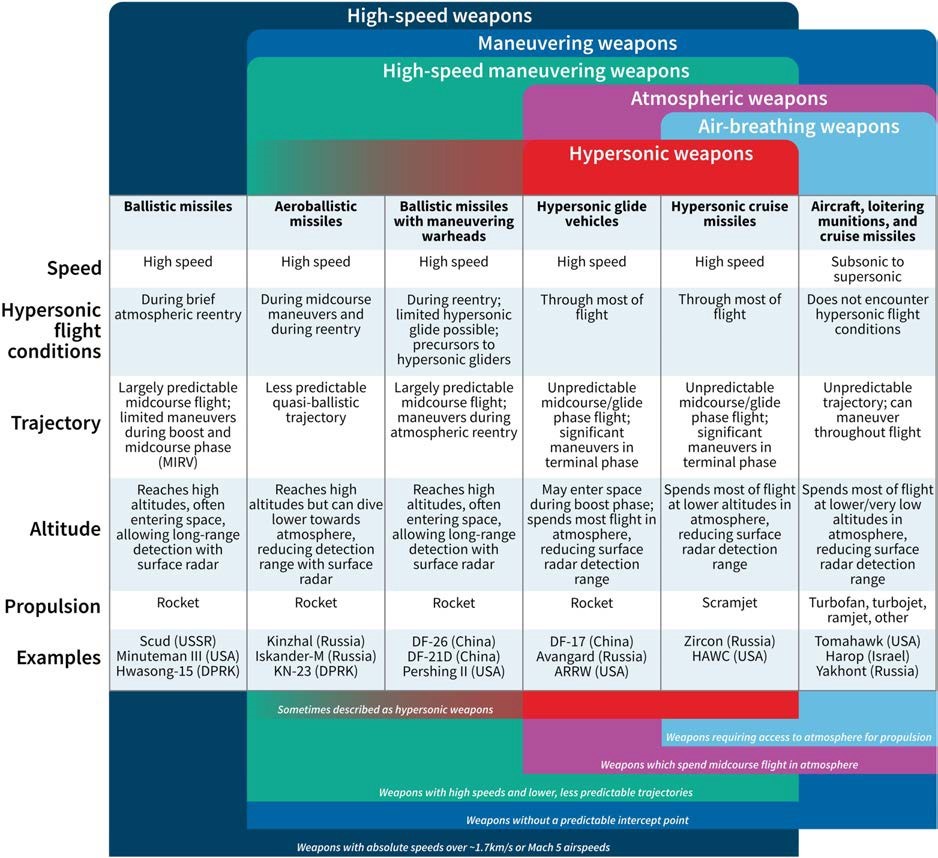
Hypersonic weapons, with their staggering speed over Mach 5, or five times the speed of sound, are a force to be reckoned with. They are not just fast; they are agile. While they are often categorised into two types—hypersonic glide vehicles and hypersonic cruise missiles—this classification fails to capture the true diversity of the hypersonic missile threat spectrum. It’s not just about speed. Long-range ballistic missiles can reach similar or greater speeds as they re-enter the atmosphere. What sets hypersonic weapons apart is their ability to sustain these speeds at altitudes below those of most ballistic missiles and, most importantly, their manoeuvrability. They operate at altitudes below 100 km, where space is often said to begin, and typically around 20 to 60 km, above the ceilings of most aircraft and cruise missiles. This unique combination of high speed, lower altitude, and manoeuvrability makes it incredibly difficult to predict the trajectories of hypersonic weapons, especially with terrestrial sensors, posing a significant challenge to the existing defence systems.
Source: CSIS Missile Defense Project.
At speeds around Mach 5, flying objects encounter thermal and aerodynamic phenomena distinct from those experienced in supersonic and exo-atmospheric flight. These phenomena involve extreme temperatures and aero-thermal interactions on the vehicle surface. Of particular importance are the remarkable amounts of flow friction and viscous dissipation encountered by the hypersonic vehicle, which leads to substantial temperature increases, the dissociation and ionisation of surrounding gases, and the formation of plasmas. Hypersonic weapons must survive this environment for a sustained period, which poses a unique and significant challenge.
Vulnerabilities
The phenomena of sustained hypersonic flight offer specific vulnerabilities. Some of the same characteristics that make advanced hypersonic missiles desirable present opportunities that could be exploited. Each feature that gives hypersonic weapons an advantage comes with a cost. Extended flight through the atmosphere may expose them to new failure modes.
Their ability to manoeuvre comes at the cost of expending energy and range.
Hypersonic weapons experience challenging aero-thermal conditions that strain the limits of current guidance, control, and materials technologies.
After Re-entering the atmosphere, the hypersonic glide vehicle experiences extreme pressures, vibrations, and temperatures. The vehicle’s surrounding atmosphere dissociates into a plasma in such an environment, reacting violently with the airframe’s surface.
Ensuring reliable performance in this environment often requires exotic materials and highly integrated designs, especially for higher speeds.
Minor alterations in the basic shape or weight distribution in a hypersonic vehicle’s airframe, for instance, can have downstream effects on thermal and propulsion system performance and accuracy.
Hypersonic systems are challenging to design and operate partly because their performance variables are closely coupled.
Defence Is Possible
Hypersonic missiles are not invincible. They are not the ultimate threat. Hypersonic missile defence is not only possible, but it’s also within reach. However, achieving it requires a fresh perspective on existing defence designs and a willingness to approach the problem differently. Hypersonic weapons have certain limitations that ballistic and cruise missiles do not. By targeting the specific characteristics of hypersonic flight, one can break the problem into manageable portions. Just as ballistic missile defence was oriented around the predictability of a ballistic trajectory, the hypersonic defence can also be tailored to the vulnerabilities of the hypersonic flight regime, offering a glimmer of hope in the face of this evolving threat.
The characteristic challenges of hypersonic flight raise intriguing possibilities for a defence system. By definition, hypersonic gliders expend energy while performing manoeuvres. A defence design that encourages manoeuvres early can often exploit those actions’ cost. Moreover, the severe conditions of hypersonic flight—the risk of boundary layer transition and the need for shock wave management—create vulnerabilities that different kill mechanisms can exploit. Minor impacts or perturbations may disrupt hypersonic weapons to their structure or surrounding airflow.
Defence System Architecture
These systems must employ multiple defeat mechanisms, such as kinetic effectors, electronic warfare, and various classes and types of directed-energy systems.
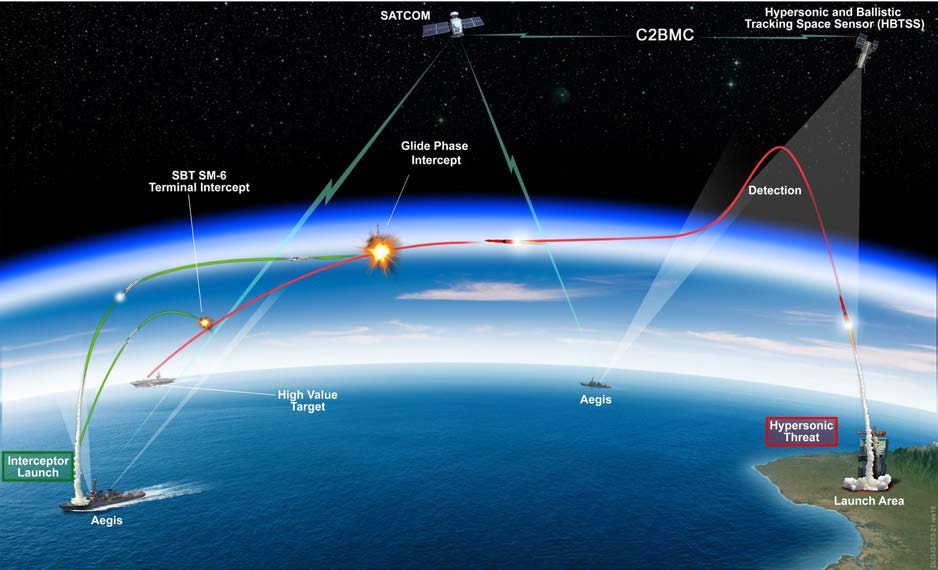
Space-Based Sensors. A vital element for a hypersonic defence program is a resilient and persistent space sensor layer capable of observing, classifying, and tracking missile threats of all types, azimuths, and trajectories. Elevated sensors are necessary to resolve surface-based systems’ range and mobility challenges. Space-based sensors would enable a “launch to impact” tracking capability. Such a capability would be critical for disrupting or defeating hypersonic weapons early in flight, where interception is easier and follow-up shots are possible. The information from those sensors must be fused into a single picture to identify how many missiles have been launched, where they are, and where they are going, all necessary information for defeating them.
Interception. The second most crucial element is the glide-phase interception. Engaging hypersonic threats earlier in flight will be necessary for area defence rather than point defence. A comprehensive, integrated and layered approach would be beneficial. Direct hit interceptors would have to be supplemented and integrated with wide area measures, including high-powered microwave systems and other means to target vulnerabilities of the hypersonic flight regime. Loitering airborne platforms carrying interceptors, sensors, or alternative kill mechanisms could also increase a defensive system’s range. Kinetic interceptors benefit from being launched at higher altitudes, conserving the disproportionate amount of fuel needed to accelerate from the surface and through the thicker lower atmosphere. Multiple aircraft or unmanned platforms would be required to maintain continuous coverage.
Twenty-First Century Flak. Defence against highly manoeuvring hypersonic missiles may require wide-area defences. Here, “layered defence” differs from the legacy concept of a linear interception sequence. Other layers or kill mechanisms do not merely catch what a previous layer missed but cumulatively stack together to degrade a given threat. Instead of relying only on a fast, single-purpose interceptor with a highly agile kill vehicle, interceptors with alternative payloads may be able to present hypersonic weapons with multiple challenges together. One such possibility is a twenty-first-century version of “dust defence.” Missiles or airborne platforms could dispense particulate matter to disrupt or destroy hypersonic weapons. At hypersonic velocities, missile impact against atmospheric dust, rain, and other particles can encounter bullet-like kinetic energies, triggering unpredictable aerodynamic, thermal, and structural disruptions.
Directed Energy Weapons. Directed-energy systems offer another alternative to tackle hypersonic attacks. Unlike kinetic weapons, directed-energy weapons may offer large magazine capacities, significantly lower cost per shot, and more straightforward guidance requirements. Although limited mainly by their direct line of sight, directed-energy systems may be suited for augmenting terminal defences or basing close to adversary launch positions. The prospect of using lasers for hypersonic defence has been the subject of considerable debate. Recent technical advances promise significant beam power increases with smaller size, weight, and power demands.
High-powered Microwave (HPM). These weapons represent another directed-energy option for hypersonic defence. High-powered microwave weapons could exploit vulnerabilities in hypersonic weapons’ communications systems and radiation shielding to achieve mission kill. Depending on the extent of damage, a microwave weapon could achieve complete or partial mission kill, disrupting a vehicle’s ability to navigate, arm its warhead, or maintain level flight. Microwave radiation can enter a hypersonic weapon through antennae operating at the same frequency as other unshielded vehicle elements, damaging internal electronics. HPMs are less sensitive to weather conditions than lasers and do not require sophisticated aiming or optical compensation systems. Sensor data that is less precise than that needed for kinetic interceptor fire control could be enough to cue HPMs. Given their considerably shorter range, HPMs may benefit from different platforms and basing modes. For the hypersonic defence mission, HPMs might be deployed on loitering unmanned aircraft as a non-kinetic obstacle. Alternatively, an HPM payload could be delivered to the general vicinity of an incoming target by an interceptor booster or other platform.
Modular Payloads. A comprehensive approach to hypersonic defence might include an interceptor or other platform capable of accommodating multiple payload types, such as blast fragmentation, particle dispensing, direct hit weapon, directed energy, or electromagnetic systems. A standard booster system with various warhead types would create doubt about which modalities an attacker needs to overcome and from where.
Passive Defence and Deception. Active defence alone cannot contend with the expected volume of the hypersonic, cruise, and advanced ballistic missiles. The passive defence must also play an increased role in a comprehensive approach to countering advanced hypersonic threats. Forward-deployed forces must, above all, frustrate adversary targeting. In the near term, existing bases could use dispersal, decoys, camouflage, and other forms of deception to confound hypersonic weapons’ terminal guidance systems.
Evolutionary Approach
The experiences gained from legacy air and missile defences can be leveraged. These include terrestrial radar tracking, space-based sensing and communication, low-latency networking, and battle management modernisation. Hypersonic defences can and should emerge from an evolution of existing frameworks rather than as a new, standalone solution. Given its global reach and integrated development, today’s Ballistic Missile Defence System (BMDS) is the most promising major defence acquisition program to adapt to the hypersonic defence challenge.
However, converting the BMDS into the Hypersonic Missile Defence System (HMDS) will require considerable architectural and cultural change. The “scale and urgency of change required” should not be underestimated. By adopting a system-of-systems approach, fielding space sensors and improved interceptors, and employing other imaginative ways to target the unique characteristics of hypersonic flight, the problem of hypersonic defence will be recognisable as a complex but increasingly tractable form of air defence.
Conclusion
Hypersonic weapons are not silver bullets. A single silver-bullet solution will not meet the challenge of defending against the full spectrum of hypersonic missile threats. Countering hypersonic missiles will require a comprehensive approach, including offensive and defensive methods to deter them. An effective hypersonic defence must include space sensors and a glide-phase interceptor, but it should not stop there. Numerous efforts pursued in tandem across a comprehensive architecture will be necessary to meet the challenge. Alternative kill mechanisms and area weapons would be required. Cyber and electronic warfare may significantly defeat hypersonic threats of all types. Fielding hypersonic defences will require an integrated, layered system-of-systems approach, new sensing and interceptor capabilities, different operational concepts, and doctrinal and organisational changes. Existing doctrine and organisational structure may not be adequate to address the cross-domain threat posed by these high-speed manoeuvring weapons.
Tom Karako and Masao Dahlgren, “Complex Air Defense Countering the Hypersonic Missile Threat” A Report of the Center for Strategic and International Studies (CSIS) Missile Defence Project Feb 2022.
Rylie White, “An Emerging Threat: The Impact of Hypersonic Weapons on National Security, Crisis Instability, and Deterrence Strategy”, Potomac Institute for Policy Studies.
David Roza, “Why Hypersonic Missiles’ Greatest Strength Also Makes Them Vulnerable”, Air and Space Forces Magazine, Dec 2023.
Col Mandeep Singh, “Countering Hypersonics”, Indian Defence Review, Jan 2024.
Disclaimer:
Information and data included in the blog are for educational & non-commercial purposes only and have been carefully adapted, excerpted, or edited from reliable and accurate sources. All copyrighted material belongs to respective owners and is provided only for wider dissemination.