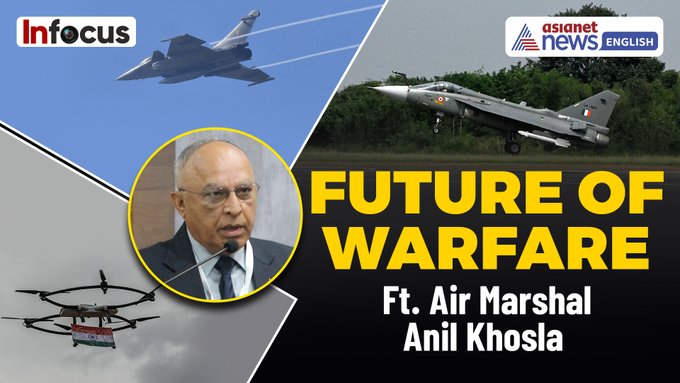
Had a very lively chat with Anmol. We talked about a variety of topics, ranging from personal life to life in the air force. The chat included aspects related to motivation, stress management, decision making, air power, deterrence, new domains of war, Info warfare and a whole lot of other issues. One of the best podcasts.
Link to the podcast:-
Comments, views and suggestions are most welcome.
For regular updates, please register your email here:-
Information and data included in the blog are for educational & non-commercial purposes only and have been carefully adapted, excerpted, or edited from reliable and accurate sources. All copyrighted material belongs to respective owners and is provided only for wider dissemination.
Information and data included in the blog are for educational & non-commercial purposes only and have been carefully adapted, excerpted, or edited from reliable and accurate sources. All copyrighted material belongs to the respective owners and is provided only for broader dissemination.
This article is a compilation of news excerpts of the event.
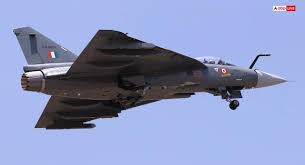
On October 17, 2025, India’s aerospace ambitions soared to new heights as the Tejas Mk1A, the country’s indigenously developed Light Combat Aircraft (LCA), completed its maiden flight from Hindustan Aeronautics Limited’s (HAL) Nashik production facility in Maharashtra. This landmark event, inaugurated by Defence Minister Rajnath Singh, marked not only the successful test flight of the first Tejas Mk1A built entirely at Nashik but also the formal launch of HAL’s third dedicated production line for the aircraft, alongside a second line for the HTT-40 basic trainer aircraft. The skies above Ozar Airport buzzed with pride as the Tejas Mk1A, accompanied by a flypast featuring the HTT-40 and Su-30MKI, received a ceremonial water cannon salute, symbolising a pivotal moment in India’s journey toward self-reliance in defence manufacturing.
The Tejas Mk1A is a 4.5-generation multi-role fighter jet, designed by the Aeronautical Development Agency (ADA) and manufactured by HAL. It represents a significant leap forward from its predecessor, the Tejas Mk1, with enhanced avionics, an advanced EL/M-2052 Active Electronically Scanned Array (AESA) radar, an electronic warfare suite, air-to-air refuelling capabilities, and integration with indigenous weapons like the Astra missile and laser-guided bombs. With over 64% indigenous content, the aircraft is a cornerstone of India’s ‘Atmanirbhar Bharat’ (Self-Reliant India) initiative, aimed at reducing dependence on foreign defence imports and bolstering the Indian Air Force’s (IAF) operational capabilities.
The maiden flight from Nashik underscores HAL’s efforts to scale up production to meet the IAF’s pressing needs. The IAF currently operates 29 squadrons against a sanctioned strength of 42, with ageing MiG-21s being phased out. The Tejas Mk1A is positioned to fill this gap, offering superior air superiority, ground attack, and maritime strike capabilities. HAL Chairman DK Sunil emphasised the aircraft’s significance, stating, “The Tejas Mk1A’s advanced electronics and avionics make it a 4.5-generation powerhouse, vastly superior to the MiG-21 Bison it replaces.”
The Nashik production line, established in April 2023 at a cost of over ₹150 crore, is a state-of-the-art facility designed to complement HAL’s two existing lines in Bengaluru, which together produce 16 Tejas Mk1A jets annually. The Nashik line starts with a capacity of 8 aircraft per year, with plans to scale up to 10 within two years through additional assembly jigs and advanced tooling. This expansion brings HAL’s total production capacity to 24 jets per year, with ambitions to exceed 30 through partnerships with private sector players like VEM Technologies (fuselages) and Larsen & Toubro (wings).
The Nashik facility’s inauguration was a spectacle of national pride. The flypast, featuring the sleek Tejas Mk1A alongside the rugged HTT-40 trainer and the formidable Su-30MKI, showcased HAL’s integrated production capabilities. The water cannon salute, a traditional gesture reserved for significant aviation milestones, added a touch of grandeur to the occasion, resonating deeply with defence enthusiasts and the public alike.
The journey to this milestone was not without challenges. The Nashik facility, launched in 2023, initially targeted its first aircraft rollout by May 2025. However, supply chain disruptions and technical refinements pushed the timeline forward. Key milestones included:
April 2023: Nashik facility inaugurated, with a focus on rear fuselage assembly and integration.
March 2025: First rear fuselage delivered; rollout delayed to April due to avionics integration tweaks.
May 2025: Adjusted plans aimed for a June rollout, but supply chain hurdles persisted.
June 2025: Delivery target set for end-June, with mid-July maiden flight plans postponed.
August 2025: Cabinet Committee on Security approved an additional 97 Tejas Mk1A jets, valued at ₹66,500 crore, bringing the total order to 180 (83 initial + 97 new).
September 2025: Contract signed for ₹62,370 crore; GE F404 engine deliveries resumed, with 12 expected in 2025-26.
October 17, 2025: Maiden flight achieved, with ongoing trials for weapons and radar integration.
These milestones reflect HAL’s resilience in overcoming logistical and technical hurdles, including delays in GE F404-IN20 engine supplies from the United States. With 99 engines contracted in 2021, HAL has had to rotate engines for testing due to supply constraints. Nevertheless, the successful flight on October 17 signals that production is stabilising, with formal IAF induction expected soon, pending validation of key integrations like the Astra missile and ELTA radar.
The Tejas Mk1A is a game-changer for the IAF, which has long grappled with squadron shortages and reliance on ageing Soviet-era aircraft. The aircraft’s versatility—capable of air-to-air combat, ground strikes, and maritime operations—makes it a critical asset in modern warfare. Its AESA radar enhances situational awareness, while the electronic warfare suite provides robust defence against enemy threats. The integration of indigenous Astra missiles and laser-guided bombs further strengthens India’s strategic autonomy, reducing reliance on foreign weaponry.
The IAF’s order of 180 Tejas Mk1A jets, valued at over ₹128,870 crore, reflects the government’s commitment to modernising its air force. The Nashik facility’s role in ramping up production is crucial, with HAL targeting 16-24 deliveries in 2025-26 and full-scale output of 24-30 jets annually from 2026-27. This pace is essential to replace retiring MiG-21s and maintain operational readiness against regional threats.
Despite the triumph of the maiden flight, challenges remain. Engine supply delays from General Electric have been a persistent bottleneck, forcing HAL to manage with limited units. The validation of critical systems, such as the AESA radar and weapons integration, is ongoing, with formal induction into the IAF expected within months. Additionally, HAL must navigate supply chain complexities and ensure quality control as it scales up production across multiple facilities.
Looking ahead, the Tejas Mk1A serves as a bridge to more advanced platforms like the Tejas Mk2 and the Advanced Medium Combat Aircraft (AMCA), India’s fifth-generation stealth fighter under development. The success of the Nashik facility also paves the way for greater private sector involvement, with companies like VEM Technologies and L&T playing pivotal roles in component manufacturing. This collaborative model could set a precedent for future defence projects, aligning with India’s vision of a robust domestic defence ecosystem.
The maiden flight of the Tejas Mk1A from Nashik is more than a technical achievement; it is a testament to India’s growing prowess in aerospace and defence innovation. The event has sparked widespread enthusiasm, capturing the public’s imagination. Videos of the flypast and water cannon salute have gone viral, accompanied by comments praising the aircraft’s sleek design and HAL’s dedication to self-reliance.
Defence Minister Rajnath Singh, addressing the gathering, called the Tejas Mk1A “a shining example of India’s resolve to build a strong, self-reliant defence ecosystem.” The aircraft’s success reinforces India’s position as an emerging global player in aerospace, capable of designing, building, and deploying advanced fighter jets to meet its strategic needs.
The successful maiden flight of the Tejas Mk1A from Nashik on October 17, 2025, marks a defining moment in India’s defence journey. With its advanced capabilities, indigenous design, and growing production capacity, the Tejas Mk1A is poised to strengthen the IAF and reduce reliance on foreign imports. As HAL overcomes challenges and scales up output, the aircraft will serve as a cornerstone of India’s air defence strategy, paving the way for future innovations like the Mk2 and AMCA. This milestone, celebrated with a flypast and national pride, underscores India’s unwavering commitment to ‘Atmanirbhar Bharat’ and its ascent as a global aerospace power.
Please Add Value to the write-up with your views on the subject.
For regular updates, please register your email here:-
Information and data included in the blog are for educational & non-commercial purposes only and have been carefully adapted, excerpted, or edited from reliable and accurate sources. All copyrighted material belongs to respective owners and is provided only for wider dissemination.
References:-
Aramane, G. (2023, April 5). Foundation stone laid for HAL’s third production line for Tejas Mk1A at Nashik. The Economic Times.
Aviation A2Z. (2025, August 21). India approves $7.1 billion for 97 new fighter jets for its air force. Aviation A2Z.
Business Standard. (2025, August 20). Final nod for ₹62,000 crore deal to procure 97 more Tejas Mk1A jets. Business Standard.
Defence News India. (2025, October 2025). Nashik facility overcomes delays to roll out first Tejas Mk1A. Defence News India.
ET Now. (2025, September 25). Defence Ministry signs contract for 97 Tejas aircraft with THIS company worth Rs 62,370 crore – DETAILS. ET Now.
Eurasian Times. (2025, September 25). LCA Tejas: India signs $7B deal for 97 ‘Made In India’ Mk-1A fighter jets that will replace MiG-21 aircraft. Eurasian Times.
Free Press Journal. (2025, October 17). Tejas Mk-1A takes maiden flight from Nashik, indigenous-built fighter jet to boost IAF’s capabilities after formal induction; WATCH. Free Press Journal.
HAL India. (2025, October 17). HAL Nashik facility achieves first Tejas Mk1A flight [Press release]. Hindustan Aeronautics Limited.
Hindustan Times. (2025, October 17). HAL’s Nashik line boosts Tejas Mk1A production; IAF eyes 24 jets annually. Hindustan Times.
India Today. (2025, October 15). Tejas Mk1A maiden flight delays due to engine supply issues. HAL production update. India Today.
Indian Express. (2025, October 17). Tejas Mk1A maiden flight marks milestone for Atmanirbhar Bharat. The Indian Express.
Mathrubhumi. (2025, September 25). HAL secures ₹62,370 cr contract to supply 97 Tejas Mk-1A jets to IAF. Mathrubhumi English.
Ministry of Defence, Government of India. (2025, October 17). Tejas Mk1A maiden flight strengthens India’s defence ecosystem [Statement]. Ministry of Defence.
New Indian Express. (2025, August 20). CCS approves Rs 67,000 crore project for production of 97 improved Tejas Mk1A jets. The New Indian Express.
Overt Defence. (2025, August 28). India approves $7.4 billion HAL Tejas Mk1A fighter jet deal. Overt Defence.
Republic World. (2025, October 10). Big day, HAL’s Light Combat Aircraft Tejas Mk1A to take maiden flight on October 17. Republic World.
The Hindu. (2025, October 17). LCA Tejas Mk1A, manufactured in the Nashik plant of HAL, completes maiden flight. The Hindu.
The Hindu. (2025, August 20). Cabinet panel on security clears project to procure 97 LCA Mark 1A fighter jets for IAF. The Hindu.
The Times of India. (2025, October 17). First Tejas-Mk1A from Nashik completes maiden flight; gets water cannon salute — Watch. The Times of India.
The Week. (2025, September 25). Mega LCA Tejas Mk1A deal signed: Indian Air Force to add 97 fighters to its fleet from 2028. The Week.
Times Now [@TimesNow]. (2025, October 17). Tejas Mk1A Gets Water Cannon Salute After Maiden Test Flight In Nashik. [Post]. X.
Zona Militar. (2025, September 25). India confirmed the purchase of 97 new LCA Tejas Mk1A fighter jets to replace its MiG-21s, which will soon be retired. Zona Militar.