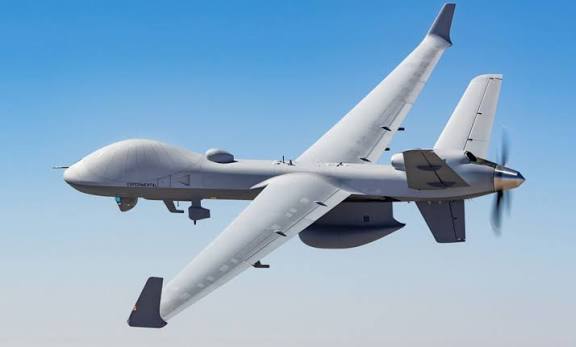
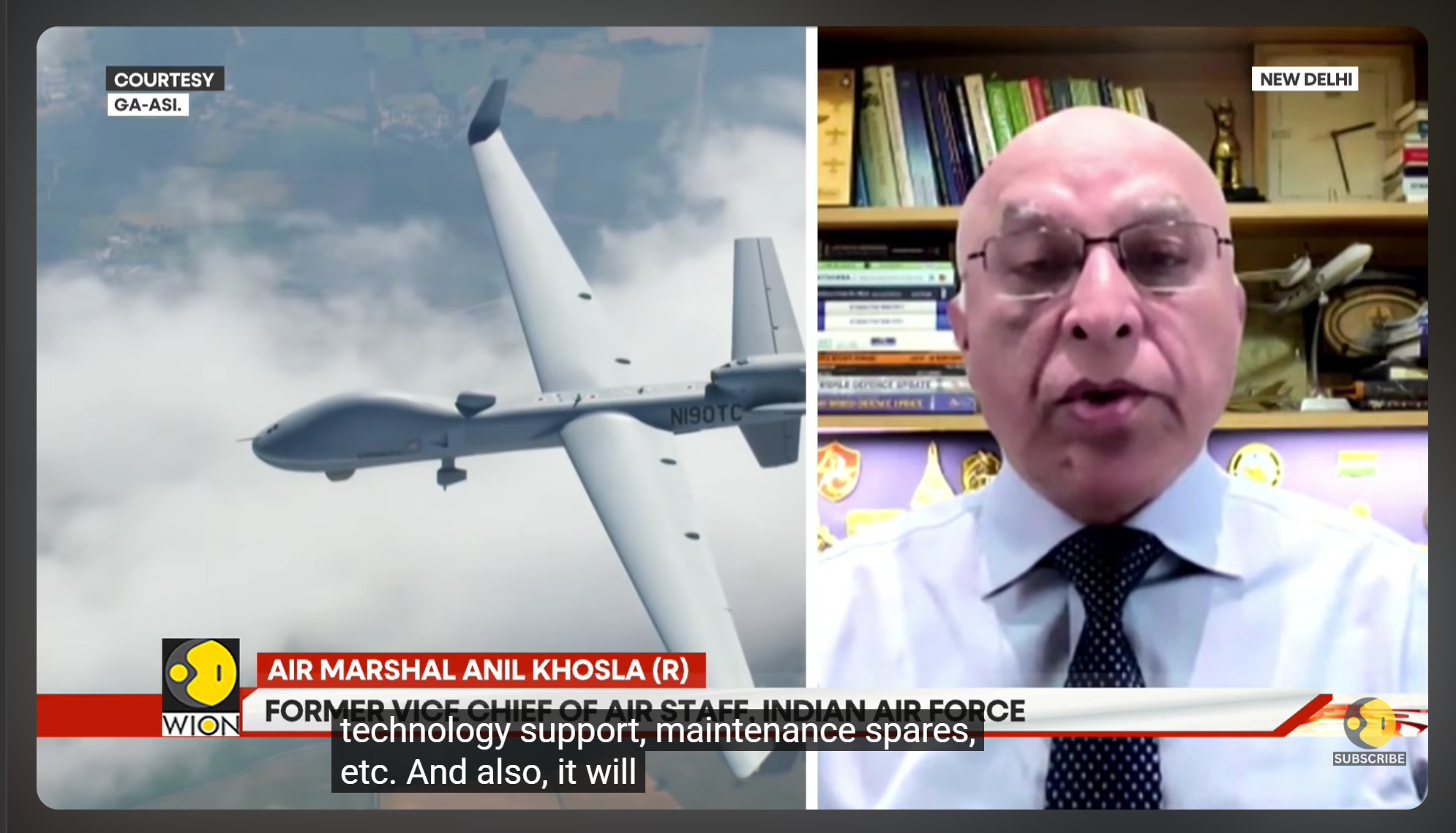
India has operated leased SeaGuardians since 2020. India leased them because the Navy needed persistent ISR capability while the much larger procurement moved through the system. The Indian Navy has found them useful and has flown them for thousands of hours.
The new lease contract has reportedly been signed on17 August 2026. It includes a 30-month lease for two MQ-9B Sea Guardian drones from General Atomics Aeronautical Systems. The contract is valued at approximately ₹1,943 crore.
On the face of it, ₹1,943 crore for two MQ-9B SeaGuardians for only 30 months looks extremely expensive. The ₹1,943 crore price tag is not a basic rental fee for two airframes. It represents a Company-Owned, Company-Operated (COCO) capability package. The value proposition includes sensors, communications, ground-control infrastructure, technical support, maintenance, operators/support personnel, availability, etc.
Complete Operational Burden. General Atomics (GA-ASI) provides the entire ecosystem (possibly including Ground Control Stations (GCS), satellite communication bandwidth, continuous payload integration, spare parts, and on-site engineering support).
Assured Flight-Hours. The cost includes availability of a guaranteed number of operational flight hours. The manufacturer would bear the cost associated with airframe degradation, maintenance cycles, component failures, and logistics overhead.
Specialised Payload Rent. The lease includes high-end, mission-specific sensor suites (360-degree maritime surface search radars, synthetic aperture radars (SAR), electro-optical/infrared (EO/IR) balls, and signals intelligence (SIGINT) packages).
The lease would buy time and capability. India entered into the agreement in October 2024 for 31 MQ-9Bs (specifically 15 SeaGuardians and 16 SkyGuardians). India’s acquisition of 31 aircraft does not mean they will become operational right away; reports indicate the first deliveries will not take place until late 2028 or early 2029. Since we need the capability right now, there will be a gap of several years. To sum up, the purchase is the long-term solution, while the lease is a short-term remedy.
There’s another way of looking at it. The lease would be a training and transition bridge. The new lease could allow personnel, maintenance teams, operators and mission planners to continue building experience while the larger fleet is inducted. It would allow operational availability, training, experience, maintenance support, sensors, contractor support, insurance/replacement risk, and immediate access. Rather than a redundant expense, the lease would serve as a high-readiness bridge. It would provide immediate maritime surveillance capacity while laying the tactical groundwork for the larger fleet’s arrival.
In short, the two newly leased Sea Guardians are not a standalone act but a deliberate interim measure that keeps the Navy’s IOR surveillance posture strong and operationally continuous while the larger, permanent 31-aircraft tri-service fleet is manufactured and delivered.
The bigger picture
The drones complement, rather than replace, the P-8I fleet. India’s surveillance architecture is increasingly layered:
MQ-9B SeaGuardian: long-endurance unmanned surveillance, able to remain on station for extended periods.
P-8I Poseidon: manned long-range maritime patrol aircraft with sophisticated radar and anti-submarine warfare capabilities.
Satellites: wide-area, space-based observation.
Coastal and island-based sensors/radars: persistent monitoring closer to shore and around strategic maritime chokepoints.
Other naval assets: ships, submarines and aircraft that can investigate or act on information generated by the surveillance network.
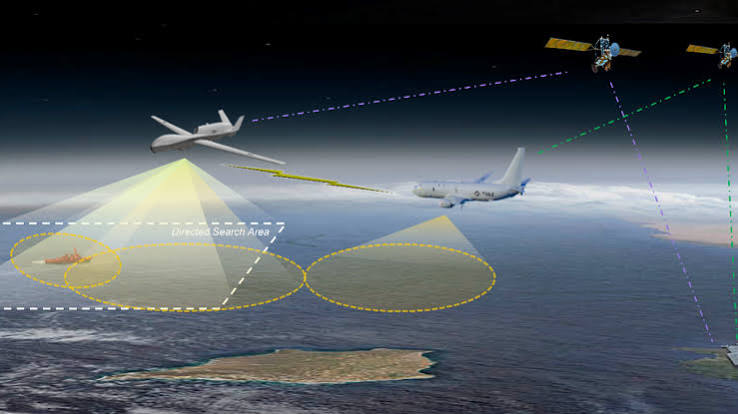
A layered network:
Satellites → see broadly ↓ MQ-9Bs → stay over an area for a long time. ↓ P-8Is → investigate and conduct sophisticated maritime/ASW missions. ↓ Ships/submarines → physically respond.
The MQ-9B lease fits into that picture as the tactical, tasking-responsive layer of a system whose outer layers are space-based sensing and coastal radar, and whose command layer is the fusion-centre network.
Information and data included in the blog are for educational & non-commercial purposes only and have been carefully adapted, excerpted, or edited from reliable and accurate sources. All copyrighted material belongs to the respective owners and is provided only for wider dissemination.
On 05 Aug 26, Boeing and Northrop conducted a lab demo test teaming the manned P-8A Poseidon maritime patrol aircraft and the unmanned MQ-4C Triton high-altitude long-endurance (HALE) ISR platform.
The P-8A operator sent machine-readable/machine-actionable mission tasking to a simulated Triton. The Triton then autonomously planned and executed the mission (e.g., transit to an area, collect intelligence with its sensors), processed data onboard via AI algorithms, and returned processed intelligence to the Poseidon.
The demo showed the first automated collaboration using an open systems architecture and the Universal Command and Control Interface. The announcement’s emphasis on universal standard interfaces is significant. Rather than using proprietary, platform-specific software, standard interfaces allow different systems to exchange information more easily.
Even though the P-8A and MQ-4C are both surveillance platforms, they have very different strengths.
P-8A Poseidon. Manned, multi-mission platform optimised for anti-submarine warfare (ASW), anti-surface warfare, response/agility (including lower-altitude operations), high-resolution imagery, weapons delivery, and rapid prosecution of contacts. Its crews operate in a dynamic tactical environment.
MQ-4C Triton. Unmanned HALE platform for persistent, wide-area maritime domain awareness. It has long endurance of more than 24 hours, and operates at high altitude (50,000+ feet). It has broad sensor coverage including multi-int radar, EO/IR, SIGINT.
Key Benefits for Operators
The key idea in teaming them up is about letting each do what it does best. Instead of both independently searching the same ocean, the Triton can automatically detect and cue the Poseidon. It reduces the workload on human operators.
It would reduce operator workload, speed up decision-making, enable more flexible and responsive manned-unmanned teaming, and leverage their complementary strengths for broader, more efficient maritime ISR and related missions. Key benefits would be: –
Reduced Workload and Cognitive Burden. The demonstration focuses on automating tasking, planning, execution, and the use of onboard AI. As a result, P-8 operators will no longer have to manually coordinate all the individual aspects or depend on ground stations when making routine intelligence requests or assigning tasks. Instead, they will be able to concentrate on higher-level mission management, tactical decisions, and using the fused picture, rather than closely monitoring the unmanned asset. This reduces the operator’s workload and speeds up the intelligence cycle.
Faster, More Responsive Decision-Making and Targeting. Direct machine-to-machine exchange delivers processed maritime intelligence much faster. This supports quicker cueing for follow-on actions. In contested or time-sensitive environments, this improves the overall kill chain decision speed.
Direct In-Flight Tasking and Greater Tactical Flexibility. Currently, Tritons are typically controlled from distant ground stations. The demo establishes a foundation for P-8 crews to issue tasking and receive results in flight (via realistic links such as satellite relay) without routing everything through the ground control station. This extends the Poseidon’s effective reach, allows dynamic retasking based on the manned aircraft’s real-time situational awareness, and improves the composite battlespace picture under the control of the airborne crew.
Better Use of Complementary Capabilities Without Redundancy. Triton handles the long-endurance, broad-area “look” mission persistently. Poseidon handles responsive, close-in, multi-mission work (including ASW that Triton does not perform). Automated teaming lets them operate more seamlessly as a unit rather than operating in relative isolation or with slower human-mediated coordination. Shared standards also ease training synergies (some operators cross-qualify) and common operating pictures.
Broader Interoperability and Future Scalability at Lower Cost/Risk. Use of universal/open standards rather than proprietary links allows collaboration with other platforms. This makes integration easier and more cost-effective, and also supports evolutionary upgrades on existing fleets.
Summary
By combining the two surveillance platforms, the team created a more closely integrated system. The operators gain in efficiency (because there is less manual coordination), in speed (since the intelligence and decisions can be made more quickly), in reach and flexibility (through direct control from the air) and in effectiveness (due to the continuous coverage and the ability to carry out a variety of missions in a responsive manner). This is especially valuable in the case of large areas of responsibility over seawater where both persistence and rapid response are essential. The demonstration carried out in the laboratory represents an initial stage in the way these capabilities can be put into operational use.
Please Add Value to the write-up with your views on the subject.
For regular updates, please register your email here:-
Information and data included in the blog are for educational & non-commercial purposes only and have been carefully adapted, excerpted, or edited from reliable and accurate sources. All copyrighted material belongs to the respective owners and is provided only for wider dissemination.
The Defence Acquisition Council’s approval of a ₹52,000 crore package in July 2026, which includes Acceptance of Necessity for Fixed-Wing High-Altitude Pseudo-Satellite platforms for the Indian Air Force, closes in on a surveillance gap that has troubled Indian planners for the better part of a decade. The gap sits between what a satellite can offer and what a drone can sustain, and it is this middle band that the FW-HAPS programme is designed to occupy.
HAPS
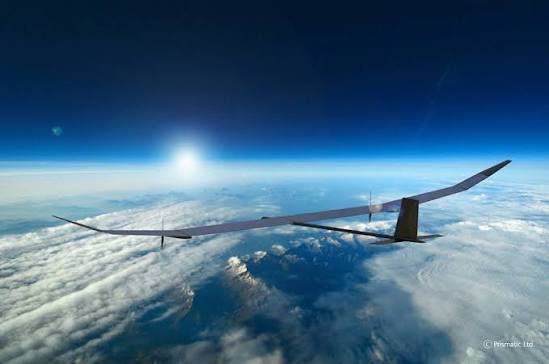
High-Altitude Pseudo-Satellites are unmanned, fixed-wing aircraft built to operate in the stratosphere, typically between 18 and 20 kilometres. It is roughly double the cruising altitude of a commercial airliner, and comfortably above both civil air traffic and the weather systems that constrain conventional aviation. They are not satellites in any orbital sense. Rather than circling the earth every ninety minutes as a low-earth-orbit satellite does, a HAPS holds station over a single point on the ground, watching it continuously; the term “pseudo-satellite” describes function, not physics.
That persistence is the entire argument for the platform. A satellite crosses a given stretch of border only a handful of times a day, and an adversary choosing when to move will choose the interval between passes. A conventional drone can loiter for a day or two before it needs fuel and a fresh crew. A HAPS can remain on station for weeks or months, low enough to return sharper imagery and a stronger signal than any satellite. It returns to Earth at the end of a mission rather than being abandoned in orbit or lost to re-entry. It also means its sensor payload can be swapped between sorties, something no satellite operator has ever had the luxury of doing.
These platforms can be classified under two broad configurations. Lighter-than-air platforms such as balloons and airships, and heavier-than-air fixed-wing designs of the kind India is pursuing. Fixed-wing solar variants have gained ground globally because they hold station more reliably against variable stratospheric winds.
Necessity
India’s land borders run to more than 15,000 kilometres across neighbours as varied as China, Pakistan, Nepal, Bhutan, Bangladesh and Myanmar, much of it through terrain that makes continuous observation difficult by any conventional means. The terrain at these borders includes the high Himalaya, the Rajasthan desert, the forests of the northeast, and the valleys of Jammu and Kashmir. Ground patrols cover limited sectors, satellites revisit a location on a fixed schedule, Manned aircraft are too costly to sustain over long periods, and Drones need to land back for refuelling. HAPS close this gap.
Operational Roles
Continuous border surveillance is the most direct military application of HAPS. It can hold station over a sensitive sector for months at a stretch. This allows commanders to read patterns of activity rather than isolated sightings. During periods of heightened tension, it can give early warning of troop concentrations or unusual logistic movement.
As an ISR platform, HAPS carry sensor payloads tailored to the mission — infrared for continuous day-night coverage, radar to see through cloud cover and poor weather — and because they operate far closer to the ground than an orbital platform, the imagery they return is correspondingly sharper without sacrificing persistence. This combination is what makes the platform useful across roles that would otherwise need separate assets: border security, maritime surveillance and counter-terrorism support.
The communications-relay role matters as much for the Indian context as the ISR role does. A HAPS at 20 kilometres functions as an airborne tower capable of relaying voice, video and encrypted data across terrain where ground infrastructure struggles — the Himalayan ranges block radio signals and expose ground stations to extreme weather, and a platform stationed above the region sidesteps both problems, linking forward units, command centres and other surveillance assets into a single network. That role grows more important as network-centric warfare depends on intelligence gathered by one platform reaching every authorised user without delay.
Disaster response is the fourth military-relevant role, and one with obvious civilian overlap. India’s exposure to floods, cyclones, earthquakes and forest fires regularly knocks out communication networks precisely when they are needed most; a HAPS already on station, or one repositioned quickly, can re-establish emergency connectivity and secure links for rescue teams while relaying real-time imagery to emergency management agencies.
Beyond defence, the same platform lends itself to rural broadband, precision agriculture, environmental and fisheries monitoring, and infrastructure inspection. These applications will also matter for how the programme is funded and sustained, even though defence is what is driving its development.
The Global Approach
India is entering a field where other nations have a head start. The United Kingdom (Airbus) has flown the Zephyr. This solar-powered stratospheric aircraft has demonstrated multi-week endurance carrying surveillance and communications payloads. The United States has pursued several HAPS concepts across its defence agencies and private industry, oriented toward intelligence collection, missile warning and battlefield networking. China has invested heavily in solar-powered high-altitude platforms as part of a wider aerospace modernisation effort, a natural extension of its own extensive border and maritime surveillance requirements. Japan and South Korea are pursuing stratospheric aircraft chiefly for communications, disaster response and environmental monitoring. Against this field, India’s programme is a late but not a laggard entry, provided the timeline holds.
India’s Programme
CSIR-NAL in Bengaluru has led India’s indigenous HAPS development, with the explicit aim of building a sovereign capability rather than depending on foreign satellites or foreign drone technology for a mission this sensitive. A subscale demonstrator with a twelve-metre wingspan and a twenty-two-kilogram takeoff weight has flown multiple sorties at DRDO’s Aeronautical Test Range in Challakere, Karnataka, accumulating dozens of flight hours and, in one test, more than eight hours of endurance at altitudes up to 25,000 feet. These trials validated the core technologies the full-scale aircraft will depend on (solar integration, battery management, flight control and propulsion). The full-scale platform would operate at 20 to 23 kilometres with endurance measured in weeks to months. The stratospheric flight is slated for around 2027. The DAC’s approval, for a ₹52,000 crore package cleared in July 2026, greenlights both continued development and procurement of operational platforms for the Indian Air Force.
Concluding Thoughts
The Fixed-Wing High-Altitude Pseudo-Satellite programme represents more than the acquisition of another surveillance platform. It reflects a broader shift in India’s approach to persistent intelligence, resilience and strategic autonomy. In an era where information superiority often determines operational success, the ability to maintain an unbroken watch over sensitive borders and maritime approaches is becoming as valuable as traditional firepower. HAPS occupy the critical space between satellites and conventional aircraft, providing persistence without the prohibitive costs of continuous manned operations or the limitations of orbital revisit cycles. Their dual-use potential further strengthens the investment case, extending benefits beyond defence into disaster management, communications, environmental monitoring and digital connectivity. Yet the programme’s ultimate success will depend not merely on proving that the aircraft can remain aloft for months, but on integrating them seamlessly into India’s wider intelligence, surveillance, reconnaissance and command-and-control architecture. Indigenous development through CSIR-NAL and DRDO also offers an opportunity to nurture a domestic ecosystem in advanced materials, solar technologies, batteries and autonomous flight systems, reducing dependence on foreign suppliers in a strategically sensitive domain. If the planned timelines are achieved and operational capability follows as envisaged, India’s HAPS programme could emerge not simply as a new airborne asset, but as a defining component of the nation’s future aerospace and security architecture.
Please Add Value to the write-up with your views on the subject.
For regular updates, please register your email here:-
Information and data included in the blog are for educational & non-commercial purposes only and have been carefully adapted, excerpted, or edited from reliable and accurate sources. All copyrighted material belongs to the respective owners and is provided only for wider dissemination.
References: –
Bisht, I. S. (2026, July 13). India approves high-altitude pseudo satellite to fill surveillance gap. The Defence Post.