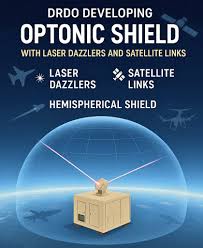
This article is based on news about Optonic Shield in secondary sources (Couldn’t find any official announcement by DRDO).
Reportedly, India’s Defence Research and Development Organisation (DRDO) is leading the way with a new defence system called Optonic Shield, which will revolutionise the nature of battles and security of essential assets. This indigenous system is likely to combine laser dazzlers, satellite communication, multifaceted electro-optical sensors and electronic warfare suites to create a hemispherical security shield. With the application of non-lethal DEWs, real-time intelligence sharing and AI-based analytical response, Optonic Shield will essentially respond to evolved threats like drones, missiles and swarm attacks.
Battlefield Transformation: Kinetic to Directed-Energy Dominance. The Optonic Shield basically would change the character of warfare by moving from traditional kinetic interceptors—guns and missiles—to a directed-energy response. It would have its core characteristics in the form of high-power laser dazzlers, which non-lethally blind or incapacitate optical sensors and guidance systems, providing a low-cost-per-shot solution with no limits to ammunition. This is especially critical in combating asymmetric threats, where low-cost UAVs and swarm UAVs, seen in recent wars, bypass conventional defences. The system’s capacity for extended engagements eliminates the numerical advantage of swarms, minimising attrition weariness on the defensive forces.
Hemispherical Coverage. Multispectral EO/IR sensors and satellite data links will provide full 360-degree panoramic situational awareness with no blind spots. Real-time coordination via secure satellite link also would enable immediate engagement, designation, and node integration. This is required for quick reaction to fast flying threats like hypersonic missiles or stealth drones, where conventional radars are often not able to track well. The Optonic Shield’s electro-optical tracking or glare detection and laser warning receivers make potential engagements possible at the speed of light, which improves accuracy while reducing overall reaction time.
Capability Enhancement. The Optonic Shield would enhance India’s deterrence by putting it alongside top countries like the US, China, Russia, and Israel in DEW capability. Its electronic warfare equipment would neutralise low-observable threats like stealth aircraft or guided munitions, enhancing defences against regional rivals with growing drone and missile capabilities. Imagery intelligence (IMINT) functions further enhance situational awareness, supporting dynamic response to threats in high-tempo, multi-domain operations.
Securing Critical Infrastructure. The Optonic Shield would provide coverage to essential assets with a paradigm shift from perimeter security to end-to-end aerial domes. High-value targets like airports, refineries, power stations, and energy installations, susceptible to drone penetration and saboteur attack, would get protection from the system. System’s 360-degree protection and laser dazzlers would disable hostile UAVs without endangering aircraft or passengers. EO/IR sensors would enable precise targeting in urban environments, where kinetic weapons could cause significant collateral damage. Satellite interface with air traffic control and national networks would facilitate quick threat remediation, as experienced in possible scenarios such as drone swarms interfering with flights. Data centers, which store critical digital content, are subject to hybrid threats from cyber and physical drone attacks. Jamming of communication and satellite signals, along with networked infrastructure, would work in tandem with cybersecurity features for complete protection. In urban and sensitive environments such as large-scale events, low collateral is necessary to maintain public safety, while operators make use of panoramic displays for effective monitoring.
Strategic Implications. The Optonic Shield represents local ingenuity, minimising foreign system dependence and support for national strategic autonomy priorities. Its modularity and scalability would enable customised deployments between borders, coasts, and metropolises. There are also deeper implications with denial-based deterrence; this could cause adversary states to reconsider their strategy of asymmetric warfare. The future versions may also leverage next-generation AI in the aspects of threat assessments and interfacing with missile defence, electronic warfare, or cyber domains.
Challenges and Limitations. Despite the promise of the Optonic Shield, challenges remain. Elements of the environment, such as rain, fog, or dust, multiply the laser beam; performance tests in India’s environment might be arduous. Beam control systems are in the process of development; however, it would be fair to say that a fair bit of innovation will be needed. High power requirements cause generation and cooling problems, especially for mobile platforms, making extended wartime operations difficult. Enemies may use countermeasures such as anti-laser paint or smoke screens that would force continuous advances in multi-spectral sensors and jamming technology. The timeline for deployment is another challenge. Complete Optonic Shield deployment, particularly satellite or aerial variants, could take years and involve a huge outlay. The reliance on satellites is indeed risky, with vulnerabilities to anti-satellite (ASAT) weapons from adversaries. Efficacy in real-life scenarios against hypersonics or stealth has to be demonstrated.
Conclusion. As the DRDO advances the Optonic Shield, India will be at the forefront of future defence. The Optonic Shield would be an indigenous multi-layered, non-lethal system with complex real-world connections which radically change the way hybrid threats are defended against in both combat and homeland environments. By continuing to pivot to new solutions and protect India’s economic and strategic interests, India will entrench itself as a world-leader in warfare capabilities, and the Optonic Shield will usher India into the age of dynamic, responsive defence.
Please Add Value to the write-up with your views on the subject.
For regular updates, please register your email here:-
Information and data included in the blog are for educational & non-commercial purposes only and have been carefully adapted, excerpted, or edited from reliable and accurate sources. All copyrighted material belongs to respective owners and is provided only for wider dissemination.
The march of computing power from the mechanical Wright Flyer of 1903 to the AI-powered, quantum-enabled systems of today has revolutionised aviation by heightening efficiency, automation, and connectivity.
Artificial intelligence (AI) is well embedded in aircraft operations, while quantum computing (QC) is still experimental but set to change design and logistics.
But these developments bring with them profound safety and security threats, and need to be addressed with strong mitigation measures.
Development of Computing Power in Aircraft
Pre-Computing Period (1903–1950s): Mechanical and Analogue Systems
1903 (Wright Flyer). No computing; manual operation through mechanical linkages and simple analogue instruments (e.g., compass, altimeter). Pilots relied on visual indicators.
1930s–1940s. Early commercial aircraft (e.g., Douglas DC-3) employed analogue instruments and ground radio beacons for navigation, with no computational processing.
Late 1940s. Analogue computers, such as gyroscopic autopilots in fighter aircraft, employed vacuum tubes for simple stabilisation.
Early Digital Computing (1950s–1970s): Analogue to Digital Shift
1950s. Analogue computers had stabilised but were heavy and restrictive.
1960s. Transistors allowed for digital avionics in military aircraft (e.g., F-4 Phantom) for simple navigation and radar. Commercial aircraft (e.g., Boeing 707) were still analogue-dominated.
Late 1960s–1970s. Integrated circuits (ICs), which borrowed from the Apollo Guidance Computer, featured limited digital processing on aircraft such as the Concorde (1969) with analogue fly-by-wire.
Digital Revolution (1980s–1990s): Fly-by-Wire and Glass Cockpits
1980s. Microprocessors created digital fly-by-wire (FBW) for the Airbus A320 (1987), utilising redundant processors (e.g., Intel 8086) to eliminate mechanical controls.
Glass Cockpits. Aircraft such as the Boeing 767 (1982) combined flight, navigation, and engine information on CRT screens.
Flight Management Systems (FMS). In the 1980s (e.g., Honeywell FMS), these utilised 16-bit processors to automate fuel management and navigation, lessening pilot workload.
Advanced Computing (1990s–2010s): Integration and Automation
1990s. PowerPC processors and GPS navigation in aircraft such as the Boeing 777 (1995) improved autopilot, diagnostics, and navigation.
Integrated Modular Avionics (IMA). The Airbus A380 (2005) integrated functions into centralised processors, enhancing efficiency.
Safety Systems. TCAS and EGPWS employed 32-bit processors (about hundreds of MIPS) for real-time collision avoidance and terrain clearance.
Current Period (2010s–2025): High-Performance Computing and AI
2010s. Multi-core processors (e.g., Intel/ARM) in planes like the Boeing 787 and Airbus A350 provided real-time weather analysis, predictive maintenance, and flight optimisation.
ADS-B (2020). Mandatory GPS-based position broadcasting necessitated high processing for traffic management.
Integration with AI. In 2025, AI systems (e.g., DARPA’s ALIAS, Boeing’s Loyal Wingman) will digest terabytes of sensor data for predictive maintenance, anomaly detection, and semi-autonomous flight.
Connectivity. High-bandwidth onboard servers are used to handle operational and passenger data.
Future Trends (2025 and beyond)
Quantum Computing. Research looks into QC for air traffic control and aerodynamics, with potential by the 2030s.
Sustainable Systems. Electric/hybrid aeroplanes (e.g., Airbus E-Fan X) use advanced battery management with real-time computing.
Autonomous Flight. AI-based systems with GPU/TPU accelerators handle petabytes of information for complete autonomous flight.
Influences of AI and Quantum Computing on Civil Aviation
Artificial Intelligence (AI)
Predictive maintenance. AI enables the evaluation of sensor data to predict failures, which increases reliability and reduces expenses.
Flight optimisation. AI improves fuel consumption by 10% and emissions by optimising routes and managing outages.
Autonomous Flight and Pilot Support. AI autopilot and co-pilot technologies take care of standard functions and optimise emergency responses, decreasing pilot workload.
Airport Performance. AI optimises check-in, baggage handling, and air traffic control, enhancing passenger journeys.
Design Innovation. Generative AI shortens aerodynamic and material design cycles.
Market Expansion. The AI aviation market is expected to expand at a 22.6% CAGR by 2030.
Quantum Computing (QC)
Advanced Simulations. QC optimises computational fluid dynamics (CFD) and structural analysis for light, efficient airframes.
Sustainable Aviation. QC simulates new materials and fuels for hybrid/electric propulsion.
Future Potential. NASA and Boeing studies suggest QC advantages by the 2030s, in spite of existing error-rate limitations.
Effects of Computing Progression
Efficiency. FMS and route optimisation save billions in fuel costs each year.
Automation. Automated takeoffs, landings, and cruise allow for a single pilot, or sometimes autonomous flight, particularly in the case of military aviation.
Maintenance. Predictive maintenance, which relies on AI for the analysis of data, helps to reduce costs and delays.
Connectivity. Global data routed in near real-time enhances operations and passenger services.
Safety. With redundancy and real-time analysis (for example, TCAS, EGPWS), the accident rate has decreased more than 80% since the late 1970s.
Key Air Force AI Applications
Autonomous Combat Drones and Loyal Wingmen: AI-controlled UAVs, such as the U.S. Skyborg, Russia’s Okhotnik-B, and India’s CATS Warrior, conduct autonomous targeting, reconnaissance, and electronic warfare. Loyal wingmen (e.g., Boeing’s MQ-28 Ghost Bat) assist manned aircraft, minimising dangers to pilots.
AI-Assisted Air Combat. AI systems, as indicated in DARPA’s AlphaDogfight Trials, outcompete human pilots in dogfights through quick decision-making and optimal tactics.
AI Co-Pilot Systems. AI helps pilots with instant threat analysis, flight route optimisation, and weapons control, as in the U.S. Air Force’s ACE program.
Predictive Maintenance and Logistics. Artificial intelligence systems like CBM+ allow for the prediction of equipment failure, which reduces downtime and optimises allocation of resources, leading to improved fleet readiness and lower costs.
Air Defence Systems. AI allows for improved target detection and target engagement in air defence systems like Israel’s Iron Dome and Russia’s S-500 systems, allowing for a faster response to threats that are detected.
Electronic Warfare (EW). AI jams hostile radar independently, learns about threats, and defends assets against cyber and electromagnetic attacks.
Mission Planning. AI processes battlefield information to produce optimal plans, dynamically realigns plans, and incorporates multi-source intelligence for data-driven decision-making.
Swarm Warfare. Swarms of drones controlled by AI overwhelm defences, perform ISR, and jamming, with nations such as the U.S., China, and India developing this capability.
Benefits.
Better Decision Making. AI manages sizeable amounts of data for real-time intelligence and speed of reaction.
Reduction in Pilot Workload. Automators allow pilots to engage in tactically focused functions versus technically focused functions.
Improvement in Combat Effect. AI and drones enhance targeting.
Reduction in Collateral Damage. UAVs fly missions with high risk, ultimately reducing civilian casualties.
Creating levels of logistics. Predictive maintenance continues to reduce both operational downtime and costs.
Challenges & Ethical Issues
Autonomy versus Control. Fully autonomous systems raise a question of who is responsible.
Cybersecurity and Operational Risk. AI systems can be hacked and/or manipulated.
Bias and Mistakes. Incorrect target identification may result in unwanted collateral civilian casualties.
International Arms Race. The Race for sophisticated AI weapons systems potentially destabilises international security.
Prospects in the Future
Greater Autonomy. UCAVs will function independently in high-risk operations.
Hypersonic Weapons. AI will improve missile accuracy and velocity.
Quantum Integration. Artificial intelligence and quantum computing will transform data processing used in predictive analytics and threat detection.
Counter-AI Warfare. Armed forces will devise methods for nullifying adversary AI capabilities.
Ethical Regulation. Strong guidelines must be put in place to deal with ethical and strategic issues.
Security and Safety Risks to Aviation
Security Risks
Data Poisoning and Adversarial Attacks: AI inputs can maliciously be manipulated and affect flight controls, navigation, or airport functionality.
System Vulnerabilities. Ageing infrastructure can be susceptible to AI-based cyberattacks (e.g., ADS-B hijacking) and needs strong firewalls and intrusion detection.
Generative AI Threats. AI might be used to create deceptive data or evade security.
Encryption Threats. QC algorithms (e.g., Shor’s) might compromise public-key cryptography (RSA, ECC), endangering data breaches or spoofed signals in avionics and communications.
Harvest Now, Decrypt Later. Threats may carry encrypted flight data for later decryption, compromising flight plans and military communications.
Complex Attack Surfaces. Multiple layers of interconnected networks and avionics increase threats that are capable of quantum attacks.
Safety Risks
Algorithmic Errors. AI bias or misinterpretation can lead to incorrect commands for autopilot or navigation decisions, resulting in accidents.
Over-Reliance. AI reliance may negatively impact pilot proficiency; however, in-flight analysis can strengthen safety.
Transparency. Black box AI channels pilot interpretation and overt truth.
Semi-Autonomous Systems. The likelihood of a failure of autonomous operations in rare cases is significant.
Simulation Errors. QC’s current error rates could lead to defective designs exposed via QC, and lead to unsafe airframes.
Cyber-Driven Safety Critical Hazards. Quantum cyberattacks may disrupt avionics and navigation, leading to failures and unsafe operations.
Navigation Upgrades. Quantum sensors could provide fixes for navigation, but have not been adopted universally.
Mitigation Strategies
Post-Quantum Cryptography (PQC). Shift to quantum-resistant algorithms (e.g., lattice-based cryptography) to protect avionics, communications, and air traffic control. NIST is developing PQC standards.
Quantum Key Distribution (QKD). Use QKD for unbreakable encryption in high-priority systems such as ADS-B.
Resilient AI Governance. Build explainable AI (XAI) frameworks, ongoing validation, and adversarial testing to make it transparent and minimise errors.
Redundant Systems. Keep classical backups to counteract AI or QC failures.
Regulatory Harmonisation. Enhance global aviation standards for AI and QC certification with a priority on safety, interoperability, and training of the workforce.
Security by Design. Implement quantum-resistant architectures, identity-first safeguarding (e.g., biometrics, zero trust), and layered cyber defence in avionics and communications.
Automated with Human in the Loop. Implement AI-enabled automation (such as SOAR) to enhance response time while leveraging a human in the process in order to limit escalation.
Cloud Resilience. We need to balance our distributed cloud configurations and our sovereignty needs, imparting trust with these secure and reliable practices.
Conclusions
The computing capacity of mechanical devices in 1903 transitioned to AI-driven quantum systems by 2025. This change has transformed and continues to transform airline operations, enabling unprecedented levels of safety, efficiency, automation, and connectivity. AI is playing an ever-expanding role by improving The Boeing Root Cause Analysis for Maintenance, efficiencies in flight planning, and improving passenger experiences, with a projected 22.6 % CAGR growth to 2030. Quantum computing is yet largely experimental, but it is expected to have significant impacts on the way we design and logistics in the 2030s. We must study our speed of evolution against the risk and governance required with these technologies. AI has vulnerabilities either as a function of adversarial attacks or software imperfections, while quantum computing has the potential to break our encryption and create weaknesses in avionics and data integrity. There are safety risks we need to contend with, including failures in algorithms and problems in design from quantum technologies. The risk controls in the aviation environment require support for the cybersecurity principles established within ACCON’25, also known as the National Aerospace Cybersecurity Strategic Plan. These controls include Post-Quantum Cryptography (PQC), Quantum Key Distribution (QKD), Explainable AI (XAI), Redundant systems, Security-by.
Please Add Value to the write-up with your views on the subject.
For regular updates, please register your email here:-
Information and data included in the blog are for educational & non-commercial purposes only and have been carefully adapted, excerpted, or edited from reliable and accurate sources. All copyrighted material belongs to respective owners and is provided only for wider dissemination.
References:-
Sawyer, D. R. “Autonomous Weapons and Military Ethics”, Journal of Military Ethics, 14(1), 51-65, 2015.
“History of Flight: Avionics, Passenger Support, and Safety”, Britannica, Published August 1, 2025.
“Examining over 100 years of flight automation and the history of the autopilot”, AeroTime, published April 4, 2025.
5.”Quantum Computing Applications for Flight Trajectory Optimisation.” arXiv, Published April 27, 2023.
“Airbus’ quantum computing challenge may fundamentally change aircraft development.” SAE International, Published January 23, 2019.
“Autonomous Drones Will Not Replace Fighter Pilots, They Will Be Their Wingmen”, Belfer Centre, Published June 1, 2025.
“Addressing the Dual Challenge of AI and Quantum Computing”, arXiv, Published March 19, 2025.
“Cyber Security Implications of Quantum Computing: Shor’s Algorithm and Beyond”, Figshare, Published February 1, 2025.
“Quantum Computing Threat to Cryptography.” Just Security, Published May 28, 2025.
“Adversarial Data Poisoning Attacks on Quantum Machine Learning Systems”, arXiv, Published November 21, 2024.
“Article on Post Quantum Cryptography Impact on the Aviation Industry”, Published March 13, 2025.
“Quantum-Resilient AI Security: Defending National Critical Infrastructure in a Post-Quantum Era” Cyber Defence Magazine, Published July 2, 2025.
“AI in Aviation Cybersecurity: Maximising Opportunities and Mitigating Risks Through Collaborative Risk Analysis”, Cyber Senate, Published October 11, 2024.
“Navigating AI in Aviation: A Roadmap for Risk and Security Management Professionals,” ISACA, Published December 23, 2024.
“The Growing Impact Of AI And Quantum On Cybersecurity”, Forbes, Published July 31, 2025.
Article published on the “Life of Soldier” website.
Victory in war was previously definitive, concrete things—such as taking land or defeating one’s foes. It is now an elusive, frequently disputed concept, influenced by personal perceptions and diverse objectives. It is no longer solely military victory; it is political pandering, economic interference, or psychological brinksmanship.
Such new-style wars as the current India-Pakistan war are proof of this transformation. Wherein both declare victory, enmeshed in competing narratives, regional stability, and international acknowledgement. Victory today no longer simply lies on the battlefield. It can control the narrative, ravage an enemy’s economy, or forge lasting peace. It is worth debating how perceptions, power imbalance, and worldwide pressures make defining and measuring what “winning” actually does in modern hybrid wars difficult.
Historical Background of the Evolution of Victory
Its meaning has evolved through time because it reflects developments in warfare, societal values, and global influences.
Ancient and Medieval (Before the 17th century). Success was typically final, marked by dominance on the battlefield, capture of land, or surrender of the enemy. The Roman conquest of Carthage (Punic Wars, 264–146 BCE) or medieval kingdoms ending up dominating by taking territory over land would be cases in point. Success implied actual acquisition (land, resources) and was quite frequently appended to notions of honour or divine blessing.
Nation-State Era (17th–19th Centuries). With the advent of modern states, the triumph was legalised by treaties and diplomatic recognition (e.g., Treaty of Westphalia, 1648; Treaty of Vienna, 1815). The conflicts had now become based on recognisable winners and losers, reshaping boundaries and establishing a lasting peace.
20th Century – Total Wars. World War I and World War II remade victory as the total destruction of the enemy regimes, typically followed by unconditional surrender (Germany and Japan in 1945, for example). Victory entailed eliminating the enemy’s war-fighting capacity, occupation, and regime change (democratisation of post-World War II Japan, for example).
Cold War Period (1947–1991). The victory was not so much a matter of outright military triumph but rather of control over ideology, economics, and geography. The West and the United States “won” the Cold War by means of economic pressure and the use of proxy wars (e.g., Korea, Vietnam) and not a climactic battle.
Post-Cold War New Wars. Asymmetric and hybrid wars (i.e., insurgencies, cyber war) have blurred the idea of victory. Military supremacy is not invariably translatable to political or social victory, as one has seen with the American interventions in Afghanistan (2001–2021) or Iraq (2003–2011). Weaker actors, like the Taliban or Hamas, may triumph by survival or erosion of superior powers.
Concept of Victory
Victory in contemporary warfare is increasingly a matter of relative vision rather than an absolute fact, defined at different levels. Tactical victory involves triumph in operations or battles, and operational victory is about the attainment of larger campaign goals. Strategic victories are directed towards ultimate political or social ends. The 1971 India-Pakistan War is a classic case of a clean-cut victory, as India achieved unequivocal military and political triumphs, such as the establishment of Bangladesh’s independence. On the other hand, long wars like those in Afghanistan or Ukraine are a case of limited or disputed victory, where one can speak of victory in terms of endurance, deterrence, or diplomatic success but certainly not in terms of outright control. They reflect how the concept of victory is context- and perspective-relative, and conforms to short-term gains, shorter-term, typically imprecise objectives in the complex nature of modern wars.
Types of Victory.
Victory can be categorised in terms of its focal point, although modern conflicts will have them combined.
Military Victory. Defeating the forces of an adversary, e.g., the Gulf War (1991), where coalition troops drove Iraqi troops out of Kuwait.
Political Victory. Successful achievement of strategic objectives, i.e., change of regime or policy changes (e.g., the NATO action in Kosovo, 1999, forcing Serbian retreat).
Economic Victory. Economically debilitating an enemy through sanctions, blockades, or denial of resources (i.e., Union blockade of the American Civil War, 1861–1865).
Psychological/Moral Victory. Shattering the will of an enemy to continue fighting or acquiring international legitimacy (i.e., Vietnam’s stand against the U.S., 1965–1973, despite defeat on the battlefield).
Informational/Cyber Victory. Dominance of narratives or infrastructure destruction in hybrid warfare (i.e., cyberattacks in the Russia-Ukraine conflict, 2022–ongoing).
Challenges in Defining Victory.
Victory is no longer easy to define due to a number of complicating factors.
Subjectivity. Victory is relative depending on who proclaims it. In the Iraq War (2003–2011), America proclaimed victory after Saddam Hussein’s fall, but long-lasting insurgency and instability caused people to question the outcome.
Short-Term vs. Long-Term. Tactical wins (e.g., battles) may not lead to a strategic win. The U.S. won most battles in Vietnam but lost the war politically due to opposition both at home and abroad.
Cultural Context. Different societies value outcomes differently. For others, preserving cultural identity or honour may be worth more than the loss of land (e.g., 19th-century Native American resistance).
Asymmetric Warfare. The weaker side can triumph by enduring or prolonging the fight, weakening stronger enemies (e.g., the Taliban in Afghanistan).
No Formal Endings. Modern wars end unclearly, in stalemate, in negotiations, or “managed conflict” rather than a clear-cut victory.
The India-Pakistan Wars – A Prism of Ambiguous Victories
The Indo-Pakistani wars also make for a fascinating framework for examining the idea of victory since they span from border battles in times of partition to nuclear-capable warfare. Right from their origins in the 1947 Partition of British India, when the two countries came into existence in the wake of communal riots, the wars recognise that both sides conceptualise victory differently depending on what transpires at home, global intervention, and disparate capabilities. Four extensive wars—1947–48, 1965, 1971, and 1999 (Kargil)—and the brief war of 2025 highlight such subjectivity. The First Indo-Pakistani War of 1947–48 erupted over the issue of Kashmir, a princely state whose accession to India or Pakistan was disputed.
1947 War. Pakistani regulars and tribal irregulars moved across the border, taking control of parts of the state, but Indian troops launched a counterattack. There was a UN-mandated ceasefire. The outcome was a standoff: India controlled approximately two-thirds of Kashmir, and the remaining portion was held by Pakistan. India regarded it as a defensive victory, sovereignty intact, while Pakistan could celebrate having taken territory even though they were weaker. Imagination varied; Pakistan’s were of unequal victory, India’s of preventing aggression. This conflict set the precedent: no clear victor, the Line of Control (LoC) as a de facto dividing line.
1965 War. The 1965 War, triggered by Pakistan’s Operation Gibraltar—guerrilla penetration into Kashmir—exploded into full-scale war. War broke out in Kashmir, Punjab, and Rajasthan. India boasted better tanks. The war concluded on a UN-negotiated ceasefire after 17 days, and pre-war borders came back under the Tashkent Agreement. Both declared victory: Pakistan focused on its defence against a superior force, commemorating September 6 as Defence Day, and India referred to having repelled the invasion and causing more damage. Historians consider it to be a draw, but this was employed in domestic propaganda to produce different impressions to illustrate how one could “win” a victory in the arena of information when there was a parity of arms.
1971 War. The 1971 War is the strongest example of a definite victory in this competition. Overwhelmed by Pakistan’s repression of Bengali separatists in East Pakistan (Bangladesh), India reacted with compassion following the refugee influx and frontier fighting. Indian troops, aided by Mukti Bahini guerrillas, encircled Dhaka in a rapid 13-day operation, resulting in the Dec. 16, 1971, surrender of 93,000 Pakistani soldiers—the biggest wartime surrender since World War II. Bangladesh became an independent country, separated from Pakistan’s eastern wing. India achieved military power, political projection, and a psychological boost, fundamentally reshaping South Asia’s geopolitical landscape. Pakistan, however, framed it as a question of geography and superpower intervention (as American and Chinese backing ebbed), highlighting their toughness in the face of defeat. This is an example of a Clausewitzian victory: gaining ascendancy over the adversary through sheer force.
Kargil War. The 1999 Kargil War was a tenuous, mountainous confrontation wherein Pakistani troops, masquerading as militants, held key summits in India’s Kargil district over the winter. India initiated Operation Vijay and Safed Sagar and drove the intruders out with a ground and air assault. Pakistan retreated but refused to acknowledge the regular army’s involvement. India observes July 26 as Kargil Vijay Diwas, declaring a strategic victory. Pakistan alone in the world perceived this as a triumph of morality for putting Kashmir on the international map. World opinion across the board condemned the Pakistani folly by comparing it with previous blunders in 1965 and 1971.
Op Sindoor. The latest Operation Sindoor was a four-day battle last month, which had begun with a terrorist strike at Pahalgam, Kashmir. India conducted punitive raids, destroying terrorist camps. Pakistan retaliated against Indian military and civilian targets. Pakistani provocation was reciprocated by further punitive attacks on several Pakistani airfields, and Pakistan called for a ceasefire. But both sides claimed victory: India claimed military dominance and deterrence restored, with strategists like Tom Cooper proclaiming it a “clear-cut victory.” Pakistan claimed staying power, and most at home who were asked and believed they had won and considered the ceasefire a diplomatic triumph. The war was an emblem of the ambiguity of contemporary victory: tactical advantages were lost in perception battles.
India-Pakistan confrontations have a pattern: India’s larger army wins militarily, but Pakistan claims victory morally through asymmetry and narratives.
Conclusion
Victory in war has changed from decisive battlefield victories and territorial gains to nuanced, multi-dimensional results that combine political stability, psychological impact, and international legitimacy. In networked times, pure success is not typical, as conflicts spill over into ideological, information, and cyberspace. Victory itself remains a relative concept, varying with point of view, timing, and cost-benefit. The India-Pakistan wars, from the 1947 stand-off to the current tensions in 2025, show how differing points of view generate pyrrhic or partial victories. War in the globalised, nuclear world is more about survival, deterrence, and media control than about wins per se. With heightened tensions all over the world, policymakers must understand the relativity of victory in order not to commit mistakes that will create endless loops of war.
Please Add Value to the write-up with your views on the subject.
For regular updates, please register your email here:-
Information and data included in the blog are for educational & non-commercial purposes only and have been carefully adapted, excerpted, or edited from reliable and accurate sources. All copyrighted material belongs to respective owners and is provided only for wider dissemination.
References:-
Arend, Anthony Clark. “The Fog of Victory.” European Journal of International Law, vol. 24, no. 1, 2013, pp. 391–404.
Bhandari, Prakash. “The Victory Paradox: Why Does Everyone Claim Victory in Modern Conflicts? Case of India-Pakistan.” Medium, May 2025,
Biddle, Stephen. Military Power: Explaining Victory and Defeat in Modern Battle. Princeton UP, 2004.
CENJOWS. “Operation Sindoor: Redefining Notion of Victory in the Modern Limited Wars.” CENJOWS, 2025.
Cooper, Tom. “Operation Sindoor: India’s Clear-Cut Victory?” The National Interest, 15 May 2025.
Fatima, Manal. “The 2025 India-Pakistan Conflict: A Diplomatic Perspective.” Atlantic Council, 12 May 2025.
Freedman, Lawrence. Victory in War: Foundations of Modern Strategy. Cambridge UP, 2006.
Indian Defence Review. “India-Pakistan War 1971: Analysis of India’s Military Strategy.” Indian Defence Review, 2025.
Martel, William C. “Theory of Victory.” Parameters, U.S. Army War College, 2007, pp. 23–36.
Raghavan, V. R. “1965: A War with No Winners.” The Hindu, 1 Sept. 2015.
The Citizen. “The Notion of Victory—A Mirage in Modern Conflict.” The Citizen, 2025.
Mattila, J., & Parkinson, S. (2017). Predicting the Architecture of Military ICT Infrastructure. The European Conference on Information Systems Management, (), 188-198.
“What Constitutes Victory in Modern War?” Militaire Spectator, 2018.