
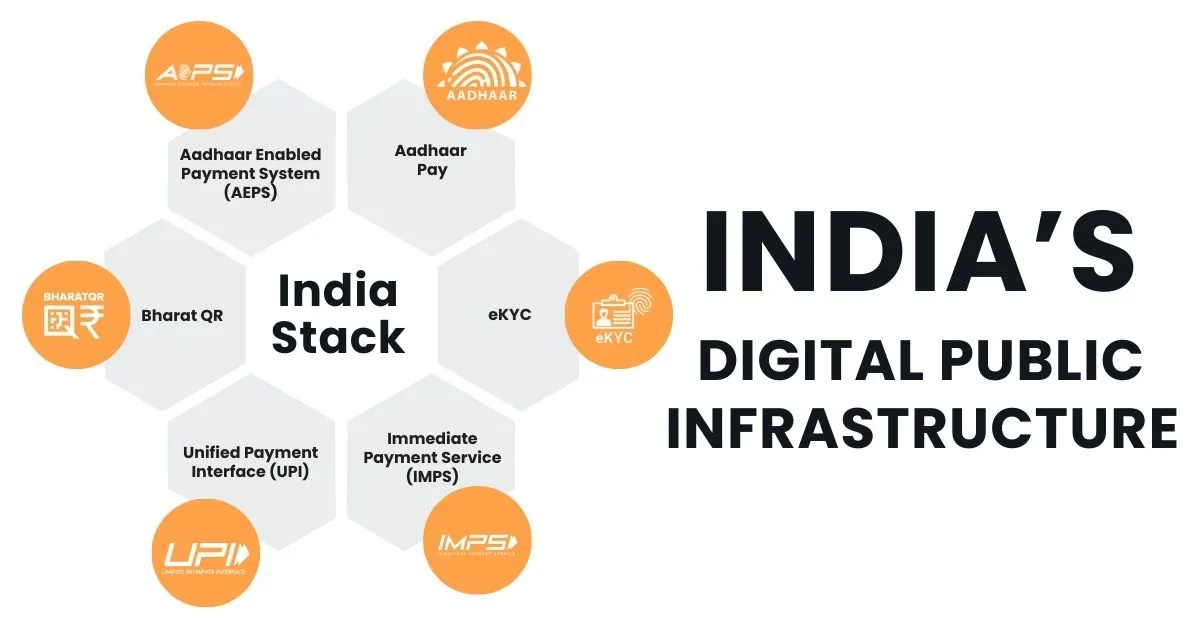
India’s Digital Public Infrastructure (DPI) stack—comprising UPI, Aadhaar, ONDC, and DigiLocker—has emerged as one of the most sophisticated and scalable public digital ecosystems in the world. Built on principles of openness, interoperability, and inclusion, this stack has not only transformed governance and economic participation within India but also positioned the country as a global leader in digital innovation for the public good. The next logical step is for India to actively export and multilateralise this model through initiatives such as DPI4All, enabling other nations to adopt and adapt these systems for their own development.
Pillars of the Layered Architecture. At its core, India’s DPI rests on three interconnected pillars: identity, payments, and consent-based data exchange, with additional layers for commerce and documents.
-
- Aadhaar. Aadhaar, launched in 2009, serves as the foundational identity layer. It has issued over 1.44 billion unique biometric-linked 12-digit numbers, covering virtually the entire population, including remote rural areas. This system enables instant, paperless verification through e-KYC. Aadhaar powers direct benefit transfers (DBT), eliminating ghost beneficiaries and saving the exchequer billions. Monthly authentications exceed 200 crore, integrating seamlessly with banking, taxation, pensions, and more. Unlike fragmented systems elsewhere, Aadhaar’s open APIs foster innovation while maintaining privacy safeguards.
-
- UPI. Building on this identity foundation, the Unified Payments Interface (UPI), operational since 2016 and managed by the National Payments Corporation of India (NPCI), has revolutionised payments. UPI enables instant, interoperable, low- or zero-cost transfers via mobile apps, linking multiple bank accounts through a single virtual address. In January 2026 alone, it processed a record 21.70 billion transactions worth over ₹28.33 lakh crore—averaging nearly 700 million daily. UPI accounts for about 81% of India’s retail digital payments by volume and nearly 49% of global real-time payment transactions, surpassing systems like Visa in scale. Its open architecture allows banks, fintechs, and merchants (over 65 million) to participate equally, driving financial inclusion: India’s banked adult population surged from 35% in 2011 to over 80%. Features like QR code payments, auto-pay, and UPI Lite expand access to micro-transactions as small as ₹10, benefiting street vendors and rural users alike. The IMF has hailed UPI as the world’s largest retail fast payment system.
-
- Digi Locker. Digi Locker complements these by providing a secure, government-backed digital vault for documents. As of early 2026, it boasts over 67.63 crore users and has issued more than 950 crore authenticated documents, including certificates, licenses, and insurance papers. Citizens can access verified records anytime on mobile devices, reducing paperwork, fraud, and administrative delays. Integrated with eSign for electronic signatures, DigiLocker streamlines services in education, employment, and governance, making it a cornerstone of paperless administration.
-
- Open Network for Digital Commerce. ONDC extends the stack into e-commerce, creating an open, interoperable platform that democratises online trade. Unlike closed marketplaces dominated by a few giants, ONDC allows buyers and sellers to connect across apps and networks, levelling the field for small retailers and kirana stores. By late 2025–early 2026, it operated in over 630 cities with hundreds of thousands of sellers, facilitating discovery, ordering, and fulfilment. ONDC reduces dependence on proprietary platforms, lowers costs, and promotes competition, potentially adding significant value to India’s digital economy, which is projected to contribute 20% to GVA by 2029–30. Together with the Data Empowerment and Protection Architecture (DEPA) for consent-based data sharing (via Account Aggregators), these components form a cohesive ecosystem where identity verifies users, payments settle transactions, documents provide proof, and commerce flows freely—all while prioritising user consent and privacy.
Benefits. The sophistication of India’s DPI lies in its design philosophy. What makes this ecosystem particularly powerful is its public-good orientation. Unlike proprietary systems dominated by private corporations, India’s DPI is designed as an open infrastructure upon which both public and private players can innovate. This has led to an explosion of fintech startups, increased financial inclusion, and improved efficiency in welfare delivery. For instance, direct benefit transfers linked with Aadhaar have reduced leakages and ensured subsidies reach intended beneficiaries. UPI has brought millions into the formal financial system, including those previously excluded from traditional banking.
Global Applicability. The global digital landscape is currently bifurcated. On one side is the US model, driven by private monopolies where data is the currency and profit is the sole motive. On the other hand, there is the closed-loop model, where digital tools are used primarily for state surveillance. India offers a “Third Way.” The DPI model is built on publicly owned rails but encourages private-sector competition. It prioritises Inclusion (reaching the unbanked and the disconnected), sovereignty (allowing nations to maintain control over their digital destiny without being beholden to foreign tech giants), and frugality (India’s stack is remarkably cost-effective compared to legacy Western systems). Globally, the significance of India’s DPI model lies in its replicability. Many developing countries face similar challenges: lack of formal identification, inefficient payment systems, and limited access to digital services. By offering a tested and scalable framework, India can help these nations leapfrog traditional development barriers. Already, countries in Africa, Southeast Asia, and Latin America have shown interest in adopting components of India’s DPI stack. UPI is already live in over eight countries, including the UAE, Singapore, Bhutan, Nepal, Sri Lanka, France, Mauritius, and Qatar, enabling cross-border instant payments. India has signed MoUs or agreements on DPI cooperation with 23 countries, including six in Africa, sharing expertise in identity systems, payments, and data frameworks.
DPI4ALL Concept. This is where the concept of DPI4All becomes crucial. Rather than exporting technology in a transactional or bilateral manner, DPI4All envisions a multilateral framework where countries collaborate, share best practices, and co-develop digital public goods. Such an initiative could function under global institutions or as a coalition of willing nations, with India playing a central role as both a provider and a partner.
Advantages. Multilateralising DPI aligns with India’s vision of “Vasudhaiva Kutumbakam” (the world is one family) and its leadership in the Global South. Exporting DPI is not about selling software; it is about exporting a governance philosophy. By multilateralising this model, India can lead a global coalition that establishes standards for digital public goods. This approach offers several strategic advantages:
-
- Soft Power and Diplomacy. By helping a nation build its digital identity or payment system, India builds a generational partnership. Unlike traditional infrastructure projects (roads or ports) that may lead to “debt traps,” digital infrastructure empowers the local economy to grow independently.
-
- Economic Interoperability. If multiple countries adopt UPI-like standards, cross-border remittances—which are currently slow and expensive—could become instantaneous and nearly free. This would revolutionise global trade for small and medium enterprises.
-
- A New Multilateralism. Through DPI4All, India can lead a “Digital Global South” bloc, ensuring that the rules of the future internet are not written solely in Silicon Valley or Brussels, but are inclusive of the needs of the developing world.
Challenges. However, exporting DPI is not without challenges. Each country has unique socio-political contexts, regulatory environments, and technological capacities. A one-size-fits-all approach would not work. India must therefore adopt a flexible, modular strategy that allows countries to pick and customise components according to their needs. Capacity building, technical assistance, and policy support will be critical in this process. Another key consideration is data governance. As digital systems expand, concerns around privacy, surveillance, and data misuse become more pronounced. India must ensure that robust safeguards, including clear consent mechanisms, data minimisation principles, and independent oversight, accompany its DPI exports. This will be essential to build trust both domestically and internationally. Financing is also an important aspect. Many developing countries may lack the resources to build and maintain such infrastructure. India, in partnership with multilateral development banks and global institutions, could help create funding mechanisms—such as grants, concessional loans, or public-private partnerships—to support DPI adoption.
Strategic Outlook. Strategically, exporting DPI aligns with India’s broader geopolitical ambitions. It enhances India’s soft power, strengthens South-South cooperation, and positions the country as a leader in shaping global digital norms. In a world increasingly dominated by competing digital ecosystems—primarily from the US and China—India’s model offers a third path that balances innovation with public interest. Moreover, DPI4All could serve as a platform for addressing global challenges such as financial inclusion, digital inequality, and efficient public service delivery. By enabling countries to build resilient and inclusive digital systems, it contributes directly to the Sustainable Development Goals.
In conclusion, India has achieved in nine years what took the developed world nearly five decades to do. India’s Digital Public Infrastructure is not just a domestic success story but a global public good in the making. By actively exporting and multilateralising this model through DPI4All, India has the opportunity to redefine digital development paradigms worldwide. The focus must remain on openness, inclusivity, and adaptability, ensuring that the benefits of digital transformation are accessible to all nations, not just a privileged few.
Please Add Value to the write-up with your views on the subject.
For regular updates, please register your email here:-
References and credits
To all the online sites and channels.
Pics Courtesy: Internet
Disclaimer:
Information and data included in the blog are for educational & non-commercial purposes only and have been carefully adapted, excerpted, or edited from reliable and accurate sources. All copyrighted material belongs to the respective owners and is provided only for wider dissemination.