

Article published in the Mar 26 edition of “The News Analytics Journal”.
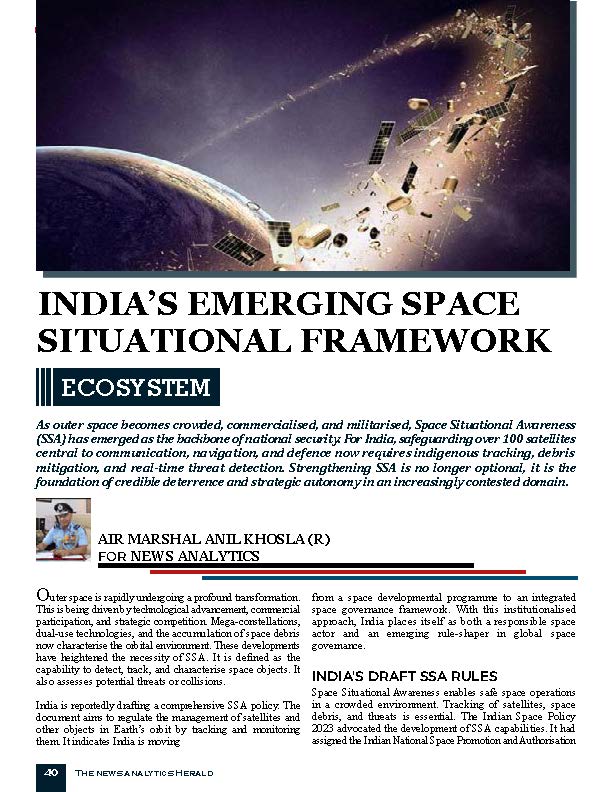
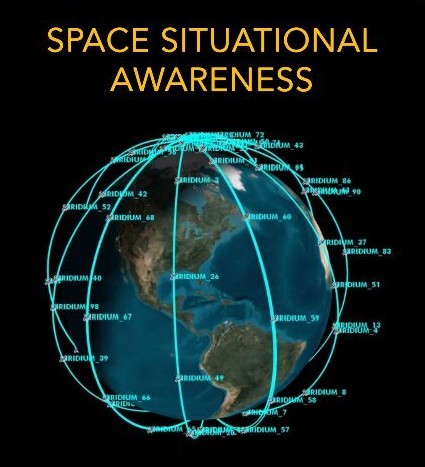
Outer space is rapidly undergoing a profound transformation. This is being driven by technological advancement, commercial participation, and strategic competition. Mega-constellations, dual-use technologies, and the accumulation of space debris now characterise the orbital environment. These developments have heightened the necessity of Space Situational Awareness (SSA). SSA is defined as the capability to detect, track, and characterise space objects. It also assesses potential threats or collisions.
India is reportedly drafting a comprehensive Space Situational Awareness (SSA) policy. The document aims to regulate the management of satellites and other objects in Earth’s orbit by tracking and monitoring them. It indicates India is moving from a space developmental program to an integrated space governance framework. With this institutionalised approach, India places itself as both a responsible space actor and an emerging rule-shaper in global space governance.
India’s Draft SSA Rules
Space Situational Awareness enables safe space operations in a crowded environment. Tracking of satellites, space debris, and threats is essential. The Indian Space Policy 2023 advocated the development of SSA capabilities. It had assigned the Indian National Space Promotion and Authorisation Centre (IN-SPACe) as the key promoter for this task. IN-SPACe has now circulated India’s draft guidelines for industry feedback. The draft document mandates SSA compliance for mission authorisation. It also covers collision avoidance, debris mitigation, tracking, data sharing, cybersecurity, and audits throughout the space mission lifecycle. These rules mandate separate authorisations for space-based, ground-based, and platform sensors. They also mandate strict data governance, including encryption. They include a provision for government access for security purposes. Industry groups have urged a phased rollout, risk-based security, and dialogue to balance innovation and compliance.
Key Components of India’s SSA Framework. Key components of the SSA include the following: –
-
- IS4OM (ISRO System for Safe and Sustainable Space Operations Management). Launched in 2022, it serves as a comprehensive centre for managing space traffic, mitigating debris, and monitoring potential collision threats.
- NETRA (Network for Space Object Tracking and Analysis). A dedicated project for building a network of radar and optical telescopes to track space objects, including debris and asteroids.
- Collision Avoidance and Mitigation. The policy mandates Collision Avoidance Analysis (COLA) for all launch vehicles and active satellites to prevent collisions with debris or other operational assets.
- Data Sharing and Security. The framework emphasises sharing tracking data to enhance close-approach analysis, while introducing strict data governance, security, and logging requirements.
- Regulatory Compliance and Audits. The policy introduces authorisation for operating SSA platforms and includes audits to ensure safety standards are met, allowing the government to take control of infrastructure if needed for national security.
- Debris-Free Space Mission (DFSM). A targeted initiative aiming for debris-free missions by 2030, aligning with global sustainability efforts.
Implications of SSA on India’s Military Space Deterrence.
National Security Imperative. Space Situational Awareness (SSA) would be the backbone of India’s military space deterrence. It would enable early threat detection, asset protection, and credible signalling to rivals. SSA is vital for protecting India’s 100+ satellites from collisions and adversarial actions. The Defence Space Agency (DSA) integrates tri-service efforts in space warfare strategy, SIGINT, and asset protection, with plans to deploy reportedly 52 military satellites by 2029. It would strengthen deterrence in cross-domain conflicts.
Deterrence Enhancement. Robust SSA would enhance deterrence primarily through a strategy of denial. It would discourage kinetic ASAT attacks due to the threat and risk of escalation. India has strategically shifted towards integrating its space surveillance and defence capabilities. This gradual shift has followed the successful anti-satellite (ASAT) test in 2019 (Mission Shakti). It has been done through the Defence Space Agency (DSA) and Project NETRA (Network for Space Objects Tracking and Analysis). This integration aims to address China’s significant space-based advantages by focusing on space situational awareness (SSA) and non-offensive defensive measures.
Mitigation of Strategic Vulnerabilities. Without SSA parity, India risks asymmetric coercion from adversaries. Enhanced SSA would provide security against electronic/cyberattacks, as well as kinetic attacks. It would enable proportionate retaliation if needed.
Cross-Domain Implications. SSA also integrates with terrestrial military deterrence. Protected PNT (positioning, navigation, timing) sustains precision strikes, and ISR feeds IADS (integrated air defence systems). Both systems and capabilities are essential for contemporary warfare. India’s SSA maturation would shift its reactive posture to a proactive one. It would deter militarisation of space while aligning with global norms.
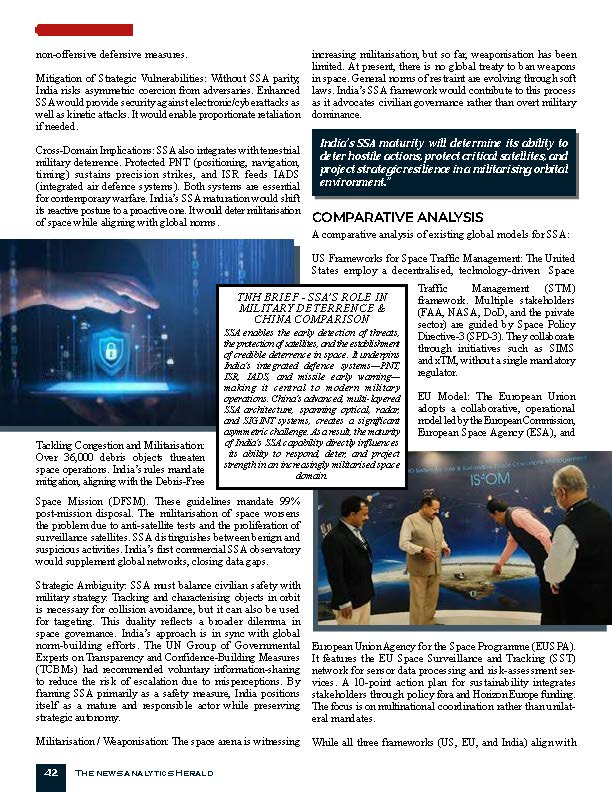
Tackling Congestion and Militarisation. Over 36,000 debris objects threaten space operations. India’s rules mandate mitigation, aligning with the Debris-Free Space Mission (DFSM). These guidelines mandate 99% post-mission disposal. The militarisation of space worsens the problem due to anti-satellite tests and the proliferation of surveillance satellites. SSA distinguishes between benign and suspicious activities. India’s first commercial SSA observatory would supplement global networks, closing data gaps.
Strategic Ambiguity. SSA must balance civilian safety with military strategy. Tracking and characterising objects in space orbit is necessary for collision avoidance. But it can also be used for targeting. This duality reflects a broader dilemma in space governance. India’s approach is in sync with global norm-building efforts. The UN Group of Governmental Experts on Transparency and Confidence-Building Measures (TCBMs) had recommended voluntary information-sharing. This was to reduce the risk of escalation due to misperceptions. By framing SSA primarily as a safety measure, India positions itself as a mature and responsible actor while preserving strategic autonomy.
Militarisation / Weaponisation. The space arena is witnessing increasing militarisation, but so far the weaponisation has been limited. At present, there is no global treaty to ban weapons in space. General norms of restraint are evolving through soft laws. India’s SSA framework would contribute to this process as it advocates civilian governance rather than overt military dominance.
Comparative Analysis
US Frameworks for Space Traffic Management. The United States employs a decentralised, technology-driven Space Traffic Management (STM) framework. Multiple stakeholders (FAA, NASA, DoD, and the private sector) are guided by Space Policy Directive-3 (SPD-3). They collaborate through initiatives like SIMS and xTM, without a single mandatory regulator.
EU Model. The European Union adopts a collaborative, operational model led by the European Commission, European Space Agency (ESA), and European Union Agency for the Space Programme (EUSPA). It features the EU Space Surveillance and Tracking (SST) network for sensor data processing and risk assessment services. A 10-point action plan for sustainability integrates stakeholders through policy fora and Horizon Europe funding. The focus is on multinational coordination rather than unilateral mandates.
While all three frameworks (US, EU, and India) align on international standards such as ISO 24113 and UN debris mitigation guidelines, they all aim to combat orbital congestion. India’s nascent draft prioritises domestic security over private compliance. It differs from the US’s innovation-friendly decentralisation and the EU’s emphasis on shared sensor infrastructure and cross-border services.
Chinese Advantage. India lags China in Space Situational Awareness (SSA) capabilities. India’s space systems, long-range radars, and space telescopes are at a nascent stage. Moreover, their focus is still limited to the region. India also lacks a dedicated SSA constellation. Reliance is placed on multi-role ISRO satellites, which have limited real-time ISR capabilities. In contrast, China operates a multi-layered space infrastructure that has matured over time. China has deployed advanced assets for optical/SAR reconnaissance and high-resolution imaging. It even has the capabilities related to ELINT/SIGINT, and debris/space weather monitoring. These space assets enable all-weather coverage, autonomous collision avoidance, and integrated real-time battlefield awareness. China also maintains a self-reliant catalogue of space objects in LEO/GEO orbits.
Way Forward and Conclusion.
SSA rules secure India’s space endeavours, while deterring militarised escalation. They ultimately ensure a resilient space posture to deal with 21st-century challenges. Phased implementation will ensure competitiveness without compromising security. The role of private players is vital. An innovative approach is required to provide resilient services and capabilities.
Drafting of SSA rules by India is an inflexion point in space governance. The emphasis on transparency and deterrence in these rules ensures a balance between global space governance and strategic autonomy. The rules integrate safety, security, and commercial policy within a single regulatory framework. They also address issues such as space congestion and collision risk. These aspects thereby align India with emerging international norms. India can draft suggested global standards for data sharing and debris control.
Please Add Value to the write-up with your views on the subject.
For regular updates, please register your email here:-
References and credits
To all the online sites and channels.
Pics Courtesy: Internet
Disclaimer:
Information and data included in the blog are for educational & non-commercial purposes only and have been carefully adapted, excerpted, or edited from reliable and accurate sources. All copyrighted material belongs to respective owners and is provided only for wider dissemination.
References: –
- “Reforms in the space sector and the establishment of IN-SPACE”, Department of Space, Government of India, 2020.
- “Statement on Mission Shakti”, Ministry of External Affairs, Government of India, 2019.
- “The emerging role of the Indian space sector”, ICWA, 2024, https://www.icwa.in/show_content.php?lang=1&level=3&ls_id=11107&lid=7045
- “Space debris environment report”, Inter-Agency Space Debris Coordination Committee (IADC), 2023.
- “Indian Space Policy – 2023”, ISRO, 2023, https://www.isro.gov.in/media_isro/pdf/IndianSpacePolicy2023.pdf
- Jakhu, R., & Singh, K, “Space security and global cooperation”, McGill University Press, 2019.
- Kessler, D. J., & Cour-Palais, B. G, “Collision frequency of artificial satellites: The creation of a debris belt”, Journal of Geophysical Research, 83(A6), 2637–2646.
- “Relevance of space situational awareness”, Neuroquantology https://www.neuroquantology.com/media/article_pdfs/2223-2229.pdf
- Outer Space Treaty, Treaty on Principles Governing the Activities of States in the Exploration and Use of Outer Space, including the Moon and Other Celestial Bodies. (1967).
- Tronchetti, F., & Jakhu, R. Commercial spaceflight and international law. Journal of Space Law, 45(2), 305–332. (2021).
- Guidelines for the long-term sustainability of outer space activities. (2019).
- United Nations Group of Governmental Experts (GGE). Report on transparency and confidence-building measures in outer space activities (A/68/189). (2013).
- Weeden, B., & Samson, V. Global counterspace capabilities. Secure World Foundation. (2019).
- World Economic Forum. (2026). Clear orbit, secure future. https://www.weforum.org/publications/clear-orbit-secure-future-a-call-to-action-on-space-debris/