
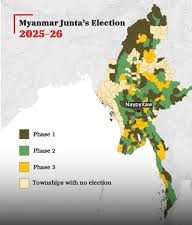
Myanmar’s military junta has conducted the long-awaited elections. This is the first general election since the military seized power in February 2021. The multi-phase ballot is intended to pave the way for a new civilian administration in 2026. However, domestic opponents and international observers have dismissed the exercise as a political façade. They feel it is designed to legitimise continued military rule rather than restore democracy.
Background. The military overthrew the elected government led by Aung San Suu Kyi on 1 February 2021. The coup triggered mass protests and a nationwide civil disobedience movement. Thousands were killed, and millions were displaced in the following crackdown. The military junta finally announced a staggered three-phase election following repeated postponements. The ballot covers only 265 of Myanmar’s 330 townships. It excludes areas largely under the control of resistance forces. This selective polling undermines any claim to a representative mandate.
Three-Phase Election. Phase one of the election took place on Dec. 28 in 102 townships. The second phase of voting took place on 11 January 2026 in around 100 townships (across Sagaing, Mandalay, Tanintharyi, Shan, Kachin, Kayah and Kayin states). The final phase was concluded in 63 townships across the country on 25 Jan. The junta claimed that turnout was about 52-55 per cent. Opposition groups and civil society organisations dispute this figure. According to them, the participation was low because many voters feared violence or coercion. Human rights groups have highlighted the impact of the junta’s new “Election Protection Law,” which criminalises criticism of the polls with penalties ranging from three years to life imprisonment. More than 300 people have reportedly been arrested for comments deemed hostile to the vote, reinforcing claims that participation has been driven by fear rather than political choice.
Fixed Results. Preliminary count shows a sweeping victory for the Union Solidarity and Development Party (USDP). This is a military-aligned party dominated by retired generals and former military officials. According to reported figures, the USDP has secured 232 of 263 contested seats in the Pyithu Hluttaw (lower house) and 109 of 157 announced seats in the Amyotha Hluttaw (upper house). Smaller ethnic parties have captured a handful of constituencies, but only six parties contested nationwide out of the 57 formally registered. The opposition National League for Democracy (NLD) was dissolved as it refused to re-register under restrictive new party laws. Aung San Suu Kyi remains imprisoned under politically motivated sentences. Myanmar’s 2008 constitution reserves 25 per cent of parliamentary seats for serving military officers. This strengthens the military hold. Combined with USDP victories, this arrangement gives the junta and its proxies a dominant supermajority regardless of popular support.
Legitimacy Challenged. Domestic opposition groups and international organisations have denounced the polls as neither free nor fair. The United Nations has warned that elections held amid mass arrests, censorship and the exclusion of millions of voters cannot be considered credible. UN human rights experts have described the process as an attempt to “manufacture legitimacy” for military rule. Human Rights Watch has called the ballot a “fraudulent claim for credibility,” citing voter intimidation, the absence of independent monitoring and the disenfranchisement of more than six million people living in conflict zones. The International Crisis Group has noted that the USDP benefits from structural advantages created by bans on rivals and by emergency laws that suppress dissent. Western governments, including members of the European Union, have said they will not recognise any administration formed through what they regard as a sham process. ASEAN, the regional bloc of which Myanmar is a member, has declined to send official observers.
Regional Reactions. Regional responses have not been that critical. China and Russia have sent observers to the polls. They prefer stability over political reform. For neighbouring Thailand, Bangladesh and India, the continuation of conflict raises fears of renewed refugee surges and cross-border instability. India has adopted a cautious approach, reiterating its support for a democratic transition. At the same time, it is engaging with the junta to address border security, refugee flows, and concerns over Chinese influence.
What Next. Under the junta’s roadmap, the newly elected parliament is due to convene in March 2026 to choose a president. The new government is expected to take office in April. Senior General Min Aung Hlaing has already passed legislation creating a consultative body that would allow him to retain influence even after a formal handover to a civilian cabinet. Analysts are sceptical that these steps will reduce violence. Resistance forces, including the PDFs and various ethnic armed organisations, are believed to control or contest large parts of the countryside and have vowed to continue fighting what they view as an illegitimate regime.
Analytical View. The elections may internally legitimise the junta’s claim to national coverage. It does not change international perceptions. The process lacks the core ingredients of a genuine democratic transition. This is because of the exclusion of major opposition parties, disenfranchisement of millions of citizens, and participation shaped by fear. The polls do not seem to resolve Myanmar’s political crisis. They appear to formalise a divided reality: a military-controlled political center with a resistant periphery. Post-elections, the hope of a return to civilian rule remains remote. The election symbolises the depth of derailment of Myanmar’s democratic experiment.
Please Add Value to the write-up with your views on the subject.
For regular updates, please register your email here:-
References and credits
To all the online sites and channels.
Pics Courtesy: Internet
Disclaimer:
Information and data included in the blog are for educational & non-commercial purposes only and have been carefully adapted, excerpted, or edited from reliable and accurate sources. All copyrighted material belongs to respective owners and is provided only for wider dissemination.