
My article was published in the Jul 25 issue of
the News Analytics Magazine
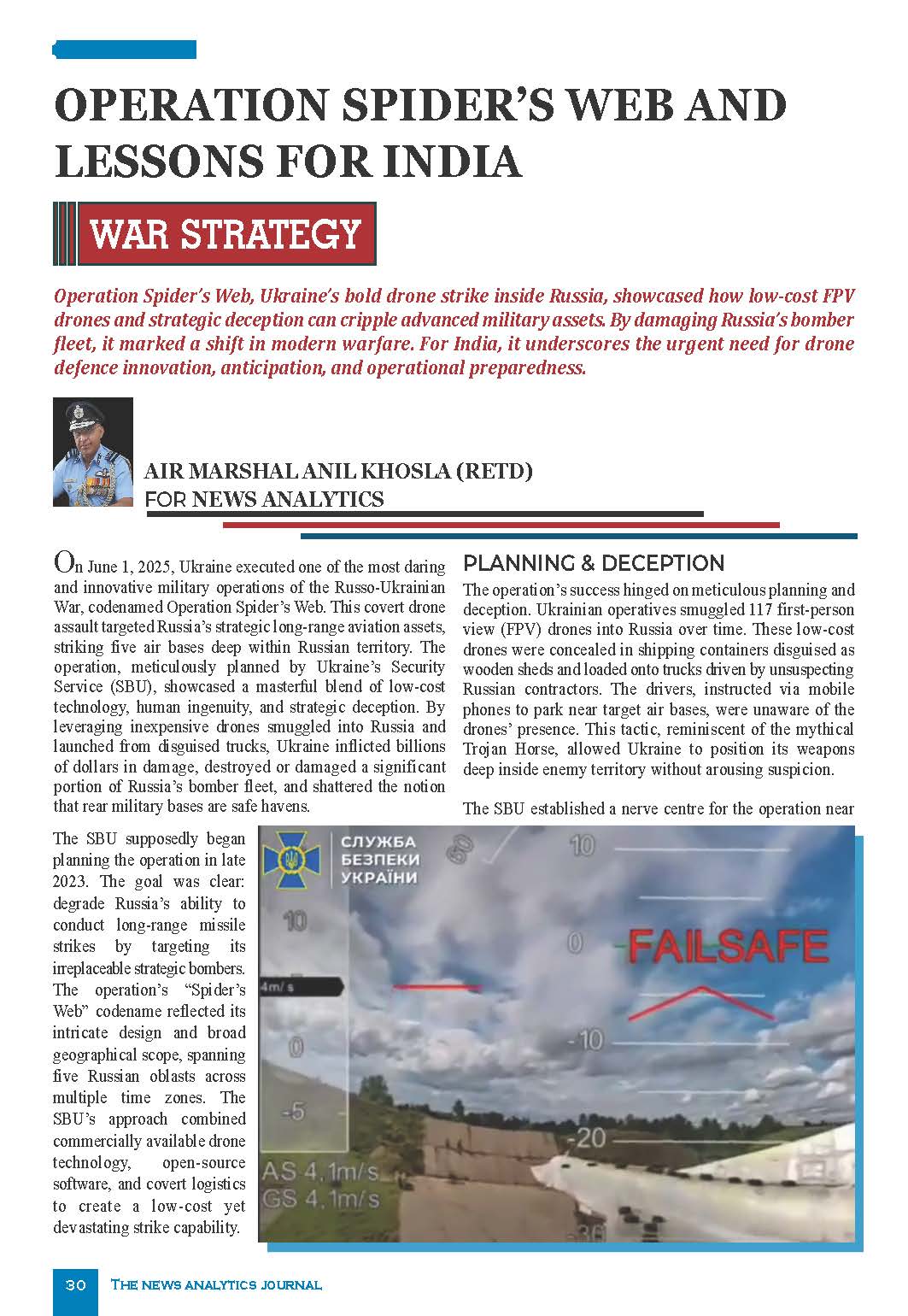
On June 1, 2025, Ukraine executed one of the most daring and innovative military operations of the Russo-Ukrainian War, codenamed Operation Spider’s Web. This covert drone assault targeted Russia’s strategic long-range aviation assets, striking five air bases deep within Russian territory. The operation, meticulously planned by Ukraine’s Security Service (SBU), showcased a masterful blend of low-cost technology, human ingenuity, and strategic deception. By leveraging inexpensive drones smuggled into Russia and launched from disguised trucks, Ukraine inflicted billions of dollars in damage, destroyed or damaged a significant portion of Russia’s bomber fleet, and shattered the notion that rear military bases are safe havens. This article explores the operation’s nuances, implications for modern warfare, and lessons for India.
The Genesis. The SBU supposedly began planning the operation in late 2023. The goal was clear: degrade Russia’s ability to conduct long-range missile strikes by targeting its irreplaceable strategic bombers. The operation’s “Spider’s Web” codename reflected its intricate design and broad geographical scope, spanning five Russian oblasts across multiple time zones. The SBU’s approach combined commercially available drone technology, open-source software, and covert logistics to create a low-cost yet devastating strike capability.
Planning and Deception: A Modern Trojan Horse.
The operation’s success hinged on meticulous planning and deception. Ukrainian operatives smuggled 117 first-person view (FPV) drones into Russia over time. These low-cost drones were concealed in shipping containers disguised as wooden sheds and loaded onto trucks driven by unsuspecting Russian contractors. The drivers, instructed via mobile phones to park near target air bases, were unaware of the drones’ presence. This tactic, reminiscent of the mythical Trojan Horse, allowed Ukraine to position its weapons deep inside enemy territory without arousing suspicion.
The SBU established a nerve center for the operation near a regional office of Russia’s FSB intelligence service in Chelyabinsk, adding a layer of audacity to the plan. Ukrainian operators used Russia’s domestic 4G/LTE networks to pilot the drones remotely, embedding control signals within civilian data traffic to evade detection. The drones were equipped with ArduPilot, an open-source autopilot software, enabling pre-programmed flight paths and precise targeting of vulnerable aircraft components, such as fuel tanks and wings. Some reports suggest AI-assisted machine vision may have enhanced strike accuracy in the drones’ terminal phase, though this remains unconfirmed.
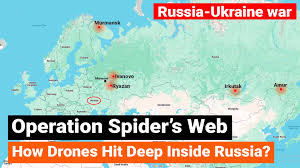
The targets were carefully selected: five air bases—Belaya, Dyagilevo, Ivanovo Severny, Olenya, and Ukrainka—housing Russia’s Long-Range Aviation fleet. These bases, located up to 4,300 kilometers from Ukraine, were critical to Moscow’s strategic bombing campaigns. The operation’s timing, coinciding with Russia’s Military Transport Aviation Day, was likely chosen to maximise psychological impact.
Execution: A Coordinated Strike across Time Zones
On June 1, 2025, Operation Spider’s Web unfolded with surgical precision. At dawn, 117 drones were launched simultaneously from their hidden truck-based platforms, targeting aircraft at the five air bases. The drones, flying in the “air littoral”—a low-altitude zone below traditional radar coverage—evaded Russia’s air defences, which were ill-equipped to counter small, low-flying threats.
The strikes were devastating. Satellite imagery and Ukrainian footage confirmed significant damage, particularly at Belaya Air Base in Eastern Siberia, where seven bombers were destroyed on the tarmac. According to Kyiv, the operation destroyed or damaged over 40 aircraft, including Tu-95s, Tu-160s, Tu-22M3s, and an A-50 airborne early-warning jet, representing roughly one-third of Russia’s long-range strike fleet and $7 billion in hardware. NATO estimates suggest 10 to 13 aircraft were destroyed, with over 40 damaged. Russian sources downplayed the losses, but independent analysts confirmed the operation’s unprecedented scale.
The attack on Belaya, 4,300 kilometres from Ukraine, marked the farthest Ukrainian strike of the war, underscoring the operation’s geographical reach. The SBU released four minutes of drone footage showing strikes on Tu-95 wings and Tu-22M3 fuselages, highlighting the precision of the attack. Russia’s Defence Ministry admitted attacks in Murmansk and Irkutsk but claimed no casualties and minimal damage, a narrative contradicted by satellite imagery and Ukrainian reports.
Operation Spider’s Web was not just a military success, but a strategic and symbolic triumph for Ukraine. The operation also had broader implications. As The New York Times noted, it marked a “defining moment in the evolution of modern warfare.” Using inexpensive drones to destroy high-value assets challenged traditional military doctrines, which assume rear bases are secure. The “air littoral” concept gained prominence as drones exploited gaps in conventional air defences. This strategy, replicable by other nations or non-state actors, could reshape how air forces protect their assets, forcing them to harden, disperse, or treat runways as front lines.
Indian Experience
On June 26–27, 2021, India faced its first terrorist drone attack at the Jammu Air Force Station. Two low-flying drones, likely modified quadcopters (possibly DJI Matrice 600 Pro), dropped IEDs with 1–1.5 kg of RDX, launched from Pakistan near the LoC. The first explosion damaged a building roof in the high-security technical area; the second detonated harmlessly on the ground. Two IAF personnel sustained minor injuries, with no critical assets harmed and attributed to Lashkar-e-Taiba, with possible Jaish-e-Mohammad and ISI involvement. This incident highlighted the potential threat of low-cost, high-impact drone attacks and prompted India to bolster its counter-drone systems, including DRDO’s laser technology and jammers.
The attacks exposed vulnerabilities to small, low-altitude drones, previously used only for smuggling. It mirrored global trends seen in ISIS and Hamas tactics. The incident prompted India to bolster counter-drone systems, including DRDO’s laser technology and jammers. This attack marked a strategic shift, highlighting drones’ low-cost, high-impact potential.
Lessons from Operation Spider’s Web for India
Ukraine’s method of smuggling kamikaze drones into Russia to strike distant targets reveals new possibilities for attacks using smuggled weapons, even outside of wartime. Consider the potential for sabotaging critical infrastructure during peacetime or assassinating key leaders and commanders with micro kamikaze drones during public events, travel, or other vulnerabilities. This threat demands robust defence systems, tailored to its unique nature and scale. Operation Spider’s Web provides vital insights for India to modernise its military strategy, advance technological innovation, and prepare for evolving warfare, especially amid regional security threats.
Emerging Threats. India’s porous borders with Pakistan are vulnerable to low-altitude drone attacks. Adversaries could deploy similar tactics to target air bases, forward posts, or critical infrastructure like dams, refineries, or cities, using inexpensive drones operated by terrorist groups or state actors.
Defence Strategies. To counter these risks, India must implement robust defences. Install counter-drone systems at strategic installations and enhance homeland security with drone surveillance and interception in key areas. Develop rapid-response units to neutralise drone threats. Disperse aircraft and assets across multiple sites to mitigate swarm attack risks, and invest in fortified shelters, decoy systems, and rapid repair facilities.
Network Security. India’s 5G expansion offers military integration potential but risks adversary exploitation. Strengthen cybersecurity to safeguard 5G infrastructure and establish secure, encrypted military communication networks.
Adopt Cost-Effective Drones. Accelerate indigenous drone programs under Make in India, focusing on affordable, scalable systems. Expand public-private partnerships to develop FPV drones with open-source software for rapid deployment in border conflicts.
Enhance Precision and AI. Integrate AI and machine vision into drones to precisely target high-value assets like missile sites—partner with tech firms to develop AI algorithms for real-time target identification in diverse terrains.
Drive Innovation. Create innovation hubs within the Indian Armed Forces and collaborate with academia through hackathons to develop next-generation warfare tools, ensuring adaptability in modern conflicts.
Conclusion
Operation Spider’s Web is pivotal in military history, showcasing drone warfare’s transformative power in redefining modern conflicts. Through a sophisticated blend of deception, technology, and precision, Kyiv delivered a strike that echoed beyond Russia’s airfields, proving no target is truly secure in the drone era. This operation holds critical lessons for India. Deploy advanced counter-drone systems at strategic sites and simulate Ukraine-style drone attacks in war games. Train Special Forces for covert drone missions and boost indigenous drone production under Make in India, prioritising swarm technology and AI. Secure 5G networks for military operations and update doctrines to embed drone warfare, focusing on asymmetry, deception, and precision. Push for global regulations to curb drone use by non-state actors. These measures will strengthen India’s defence framework, ensuring a strategic advantage in 21st-century warfare.
Please Add Value to the write-up with your views on the subject.
For regular updates, please register your email here:-
References and credits
To all the online sites and channels.
Pics Courtesy: Internet
Disclaimer:
Information and data included in the blog are for educational & non-commercial purposes only and have been carefully adapted, excerpted, or edited from reliable and accurate sources. All copyrighted material belongs to respective owners and is provided only for wider dissemination.
References:-
- Axe, David. “Ukraine’s Drones Just Redrew the Map of Modern Warfare.” The Daily Beast, June 5, 2025.
- Barnes, Julian E., and Eric Schmitt. “Ukraine’s Audacious Drone Strike Hits Russian Air Bases, Signals New Phase in War.” The New York Times, June 2, 2025.
- Gibbons-Neff, Thomas, and Marc Santora. “How Ukraine Pulled Off a Surprise Drone Attack 4,300 Kilometres Into Russia.” The New York Times, June 3, 2025.
- Hambling, David. “Operation Spider’s Web: Ukraine’s Drone Swarm Redefines Asymmetric Warfare.” Forbes, June 4, 2025.
- Kofman, Michael, and Rob Lee. “Ukraine’s Drone Strike on Russian Airfields: Strategic Implications.” War on the Rocks, June 6, 2025.
- Lendon, Brad. “Ukraine’s Deep Drone Strike: What It Means for Russia’s Air Force.” CNN, June 3, 2025.
- Mitzer, Stijn, and Joost Oliemans. “Operation Spider’s Web: Counting the Cost of Ukraine’s Drone Assault.” Oryx, June 4, 2025.
- Rogoway, Tyler. “Ukraine’s Drone Blitz on Russian Air Bases: A New Era of Warfare.” The War Zone, June 2, 2025.
- Tisdall, Simon. “Ukraine’s Drone Strike Shatters Russia’s Illusion of Safety.” The Guardian, June 5, 2025.
- Tucker, Patrick. “Ukraine’s Operation Spider’s Web: A Case Study in Drone Warfare.” Defence One, June 7, 2025.
- Center for Strategic and International Studies. “Ukraine’s Drone Strikes and the Future of Strategic Warfare.” CSIS Briefs, June 8, 2025.
- Harding, Luke, and Andrew Roth. “Russia’s Air Force Reels After Ukraine’s Drone Strike.” The Financial Times, June 4, 2025.
- Reynolds, Nick. “The Air Littoral: How Ukraine Exploited Russia’s Blind Spot.” The Conversation, June 6, 2025.