

683: FROM OSIRAK TO NATANZ: OPERATION RISING LION AS A CONTINUATION OF ISRAEL’S BEGIN DOCTRINE OF DENIAL


My Article published on “The EurasianTimes” website on 17 Jun 25. 


On June 13, 2025, Israel launched Operation Rising Lion, a bold and sophisticated military campaign targeting Iran’s nuclear facilities, missile bases, and key military personnel. The operation, which struck sites like Natanz, Fordow, and Arak, and killed high-ranking figures such as IRGC Commander-in-Chief Hossein Salami, was a direct application of the Begin Doctrine—Israel’s strategic policy of pre-emptively denying adversaries the ability to acquire nuclear weapons. Named after Prime Minister Menachem Begin, who authorised the 1981 strike on Iraq’s Osirak reactor, the doctrine has shaped Israel’s approach to regional threats for over four decades. This article examines Operation Rising Lion as a continuation of the Begin Doctrine, tracing its evolution from Osirak to Natanz, analysing its strategic execution, and exploring its implications for Israel’s security and regional stability.


The Begin Doctrine

The Begin Doctrine is a cornerstone of Israeli strategic policy, centered on the pre-emptive prevention of adversaries, particularly in the Middle East, from acquiring nuclear weapons that could pose an existential threat to Israel. Named after former Israeli Prime Minister Menachem Begin, the doctrine emerged following Israel’s airstrike on Iraq’s Osirak nuclear reactor on June 7, 1981, known as Operation Opera. It reflects Israel’s commitment to ensuring its survival in a region surrounded by hostile states, some of which have historically pursued nuclear capabilities.

Key Principles of the Begin Doctrine include the following:-

    • Pre-emptive Action. Israel reserves the right to use military force to prevent any hostile state or non-state actor from developing nuclear weapons.
    • Existential Threat Mitigation. The doctrine prioritises neutralising capabilities that could enable adversaries to produce weapons of mass destruction (WMDs), notably nuclear weapons.
    • Unilateral Action. Israel will act independently if necessary, even without international approval or coordination, to safeguard its security.
    • Deterrence and Regional Dominance. By demonstrating its willingness and ability to strike pre-emptively, Israel reinforces its military superiority and deters adversaries. Historical Context and Application.


Historical Precedents: Osirak and Orchard

Operation Opera (1981). On June 7, 1981, eight Israeli F-16s, escorted by F-15s, flew 1,100 kilometers to destroy Iraq’s Osirak reactor, a French-built facility suspected of producing plutonium for nuclear weapons. The strike was meticulously planned, relying on intelligence from Mossad and defectors. Despite international outrage, including a UN Security Council resolution condemning Israel, the operation delayed Iraq’s nuclear program significantly. It established the Begin Doctrine as a proactive strategy, emphasising Israel’s willingness to act alone to ensure its survival.

Operation Orchard (2007). On September 6, 2007, Israel struck Syria’s Al-Kibar nuclear reactor in Deir ez-Zor, believed to be a North Korean-designed plutonium facility. The operation, kept secret for months, involved precision airstrikes by F-16s and F-15s, supported by cyberwarfare and Mossad intelligence. Unlike Osirak, Orchard faced minimal international backlash, partly due to Syria’s secrecy and the operation’s surgical nature. It reinforced the Begin Doctrine’s adaptability, incorporating advanced technology and covert tactics to neutralise emerging threats.

Both operations demonstrated Israel’s ability to combine intelligence, air superiority, and strategic surprise, setting the stage for Operation Rising Lion’s complexity.


Operation Rising Lion: A Modern Application

Launched on June 13, 2025, Operation Rising Lion targeted Iran’s nuclear and military infrastructure, reflecting the Begin Doctrine’s evolution in scale, technology, and geopolitical context. Iran’s nuclear program, by 2025, posed an unprecedented challenge, with the International Atomic Energy Agency (IAEA) reporting enough enriched uranium for up to 15 nuclear bombs. Prime Minister Benjamin Netanyahu framed the operation as a “12th-hour” necessity to prevent a “nuclear holocaust,” echoing Begin’s rhetoric from 1981.

Strategic Execution. Operation Rising Lion was a multi-domain assault, integrating air, cyber, and covert operations. Over 200 Israeli aircraft, including F-35s, struck key nuclear sites, the Natanz Enrichment Complex, the Fordow Fuel Enrichment Plant, the Arak Heavy Water Facility and the Isfahan Uranium Conversion Facility. Missile bases like Asfajaabad, IRGC command centers, and air defence systems were hit. Mossad-activated drones and smuggled munitions neutralised launchers and radars, ensuring air superiority. The operation killed key figures, including IRGC leaders Hossein Salami, Mohammad Bagheri, and Amir Ali Hajizadeh, and nuclear scientists like Fereydoon Abbasi and Mohammad Mehdi Tehranchi, crippling Iran’s command and expertise. Mossad’s covert operations, including a secret drone base near Tehran and disinformation about diplomatic rifts, misled Iran’s leadership into underestimating the attack.

Scale and Impact.  Operation Rising Lion was unprecedented in scope, targeting over 100 sites with 330 munitions. Iran reported 78–128 deaths, including 20 children, and over 320 injuries, particularly in Tehran’s residential areas, sparking international criticism. The IAEA confirmed no radiation leaks, indicating precise strikes. The operation delayed Iran’s nuclear program, damaged its military infrastructure, and disrupted its chain of command, reinforcing Israel’s regional dominance.


Iran’s Response: Operation True Promise III. Iran’s Supreme Leader Ayatollah Ali Khamenei vowed “severe punishment,” describing Israel’s actions as a “doomed aggression based on a grave miscalculation.”  Iran retaliated with Operation True Promise III (Persian: Va’de-ye Sādeq III), which began on the evening of June 13, 2025, approximately 18 hours after Israel’s initial strikes. The Islamic Revolutionary Guard Corps (IRGC) led the operation, supported by Iran’s armed forces and possibly proxy groups like Hezbollah, the Houthis, and the Islamic Resistance in Iraq. Iran fired “dozens” to “hundreds” of ballistic missiles and drones, targeting Israeli military centres, airbases, and strategic sites, including the Kirya military headquarters in Tel Aviv. Specific targets included Nevatim, Hatzerim, and Tel Nof airbases, which house advanced Israeli fighter jets like F-35s and F-15s. The operation involved waves of attacks, with ballistic missiles and kamikaze drones aimed at overwhelming Israel’s multilayered air defences, including the Iron Dome and Arrow missile defence systems. While Israel’s Iron Dome and Arrow systems, aided by U.S., British, and French forces, intercepted most projectiles, some strikes caused damage in Tel Aviv, injuring 21–95 people. Iran’s Supreme Leader, Ayatollah Ali Khamenei, called the strikes a “crushing response”.

Analytical Perspectives

Continuity and Evolution of the Begin Doctrine. Operation Rising Lion reflects the Begin Doctrine’s continuity and evolution. Like Osirak and Orchard, Rising Lion was a unilateral, preemptive strike to deny an adversary nuclear capability. Israel acted without U.S. involvement, prioritising national security over international approval, and justified the operation as existential. The operation’s scale—over 200 aircraft and 100 targets—dwarfs previous strikes. It integrated advanced technologies (AI-assisted targeting, drones, cyberwarfare) and Mossad’s covert infrastructure, showcasing Israel’s technological edge. Unlike Osirak’s single-target focus or Orchard’s secrecy, Rising Lion was a broad assault on nuclear, military, and leadership targets, reflecting the complexity of Iran’s threat.

Strategic and Ethical Challenges. The Begin Doctrine’s application in Operation Rising Lion raises significant issues.

    • Strategic Success. The operation delayed Iran’s nuclear program, possibly by years, and weakened its military leadership and missile capabilities. It reinforced Israel’s deterrence, signalling to adversaries like Hezbollah and the Houthis that escalation would be costly.
    • Escalation Risks. Though limited, Iran’s Operation True Promise III underscores the potential for a broader conflict. The Houthis’ missile strike on Hebron and possible proxy involvement from Iraq and Syria highlight the regional ripple effects.
    • Ethical Concerns. Civilian casualties, including 20 children in Tehran, drew condemnation from the UN, Saudi Arabia, and Russia. Critics argue the doctrine’s preemptive nature risks disproportionate harm, complicating Israel’s international standing.
    • Limitations. Deeply buried facilities like Fordow remain resistant to conventional strikes, suggesting the doctrine’s reliance on airpower may need adaptation for future threats.

Geopolitical Impact. Operation Rising Lion has transformed the Middle East’s strategic landscape. By eliminating key Iranian leaders and damaging critical infrastructure, Israel has significantly weakened Iran’s regional influence, though its proxy groups, such as Hezbollah and the Houthis, remain active. Global oil prices have surged 8% amid fears of supply disruptions, sending ripples through international markets. The United States backed Israel’s defensive measures but called for restraint, while Russia offered to mediate and Saudi Arabia adopted a cautious approach, highlighting the region’s complex dynamics. The breakdown of scheduled U.S.-Iran nuclear talks in Oman underscores the diplomatic fallout of Israel’s Begin Doctrine.

Israel’s Strategic Blind Spot: Pakistan’s Nuclear Program.  Israel’s Begin Doctrine prioritises pre-emptive strikes against adversaries developing nuclear weapons, yet Pakistan’s nuclear program, successful by 1998, never prompted Israeli action. This stems from geopolitical and strategic factors. Unlike Iraq, Syria, or Iran, Pakistan lies outside Israel’s immediate Middle Eastern sphere of influence, reducing its perceived threat. Pakistan’s nuclear ambitions were primarily driven by rivalry with India, not hostility toward Israel. Diplomatic relations, though limited, existed indirectly, and Pakistan’s leadership, including Zulfikar Ali Bhutto and Pervez Musharraf, avoided framing Israel as a primary enemy. Israel’s intelligence, via Mossad, likely assessed Pakistan’s program as India-focused, not aimed at Tel Aviv. Additionally, U.S. influence, a mutual ally, restrained escalation, as Pakistan’s nuclear development was tacitly accepted to counter India. Thus, Israel conserved resources for proximate threats like Iran, aligning with the Begin Doctrine’s focus on existential risks.


Conclusion

From Osirak to Natanz, the Begin Doctrine has guided Israel’s strategy to prevent nuclear proliferation among its adversaries. With its unprecedented scale and technological sophistication, Operation Rising Lion represents the doctrine’s most ambitious application yet. By targeting Iran’s nuclear facilities, missile bases, and leadership, Israel reaffirmed its commitment to existential security, even at the cost of regional escalation and international criticism. However, the operation’s success in delaying Iran’s nuclear ambitions comes with challenges: fortified sites like Fordow, retaliatory risks, and ethical questions about civilian casualties. As of this date, the Israel-Iran conflict remains volatile, with the Begin Doctrine both a shield for Israel’s survival and a catalyst for regional tensions. The doctrine’s future will depend on Israel’s ability to adapt its pre-emptive strategy to an increasingly complex geopolitical landscape.


Please Add Value to the write-up with your views on the subject.


1818
Default rating

Please give a thumbs up if you  like The Post?


Link to the article on the website:-

Israel ‘Spares’ Pakistan Under Its Begin Doctrine! Why IDF Bombed Iraq, Syria & Iran’s Nuclear Facilities But Left Pakistan?

For regular updates, please register your email here:-

Subscribe


References and credits

To all the online sites and channels.

Pics Courtesy: Internet

Disclaimer:

Information and data included in the blog are for educational & non-commercial purposes only and have been carefully adapted, excerpted, or edited from reliable and accurate sources. All copyrighted material belongs to respective owners and is provided only for wider dissemination.


References:-

  1. International Atomic Energy Agency. (2025, June 12). Report on Iran’s Nuclear Program Compliance. Vienna: IAEA.
  1. United Nations. (2025, June 13). Statement by Secretary-General António Guterres on Israeli Airstrikes in Iran. New York: United Nations Press Office.
  1. Al Jazeera. (2025, June 14). “Iran Vows ‘Harsh Response’ After Israeli Strikes on Nuclear Sites.” Al Jazeera English.
  1. BBC News. (2025, June 13). “Israel Launches Operation Rising Lion: What We Know About the Strikes on Iran.” BBC World Service.
  1. Reuters. (2025, June 15). “Oil Prices Surge as Israel-Iran Tensions Escalate After Operation Rising Lion.” Reuters.
  1. The Jerusalem Post. (2025, June 13). “Netanyahu: Operation Rising Lion Prevented Nuclear Holocaust.” The Jerusalem Post.
  1. The New York Times. (2025, June 14). “Mossad’s Covert Role in Israel’s Strike on Iran Revealed.” The New York Times.
  1. Center for Strategic and International Studies. (2025, June 14). Operation Rising Lion: Assessing Israel’s Strike on Iran’s Nuclear Program. Washington, DC: CSIS.
  1. Institute for National Security Studies. (2025, June 15). The Geopolitical Fallout of Operation Rising Lion. Tel Aviv: INSS.
  1. Israel Defence Forces. (2025, June 13). Official Statement on Operation Rising Lion. Jerusalem: IDF Press Office.
  1. U.S. Department of State. (2025, June 13). Press Briefing by Secretary of State Marco Rubio on Israel-Iran Conflict. Washington, DC: U.S. Department of State.
  1. Bergman, Ronen. (2018). Rise and Kill First: The Secret History of Israel’s Targeted Assassinations. New York: Random House.
  1. Pollack, Kenneth M. (2021). The Persian Puzzle: Iran’s Strategic Challenge. Washington, DC: Brookings Institution Press.
490: NUCLEAR TRENDS, THREATS AND CHALLENGES


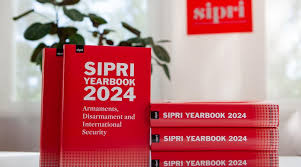
The Stockholm International Peace Research Institute (SIPRI) released its highly anticipated 55th edition of the SIPRI Yearbook 2024 on 17 June 24. This comprehensive yearbook, a cornerstone in the field, presents the institute’s annual evaluation of the state of armaments, disarmament, and international security, with a specific focus on nuclear threats and challenges.


Key findings of the SIPRI Yearbook 2024 are that the number and types of nuclear weapons in development have increased as states deepen their reliance on nuclear deterrence.


Relevant Excerpts


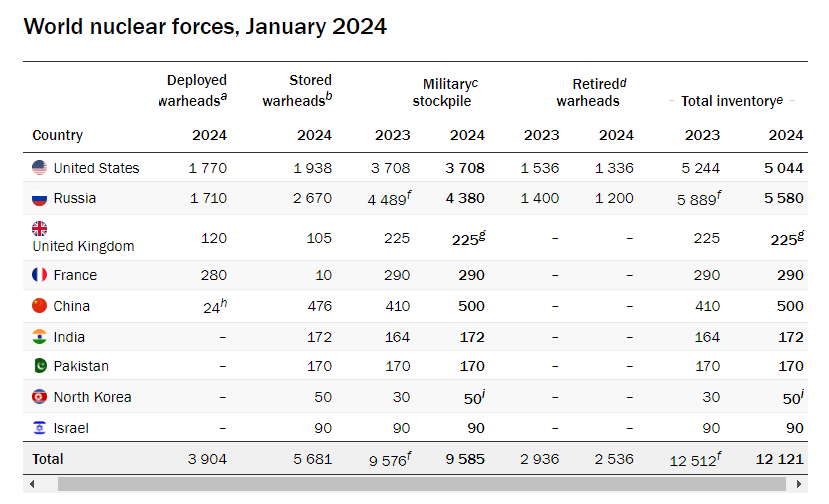
The nine nuclear-armed states are the United States, Russia, the United Kingdom, France, China, India, Pakistan, the Democratic People’s Republic of Korea (North Korea) and Israel. The nuclear countries continued modernising their nuclear arsenals, and several deployed new nuclear-armed or nuclear-capable weapon systems in 2023.


Of the total global inventory of an estimated 12,121 warheads in January 2024, about 9585 are in military stockpiles for potential use. An estimated 3904 of those warheads are deployed with missiles and aircraft; the rest are in central storage. Around 2100 deployed warheads are kept in a high operational alert on ballistic missiles. Nearly all of these warheads belonged to Russia or the USA, but for the first time, China is believed to have some warheads on high operational alert.


While the global total of nuclear warheads continues to fall as Cold War-era weapons are gradually dismantled, regrettably, there is a year-on-year increase in the number of operational nuclear warheads.


India, Pakistan, and North Korea are all pursuing the capability to deploy multiple warheads on ballistic missiles, something Russia, France, the UK, the USA and—more recently—China already have.


Russia and the USA together possess almost 90 percent of all nuclear weapons. The sizes of their respective military stockpiles (i.e., useable warheads) seem to have remained relatively stable in 2023. In addition to their military stockpiles, Russia and the USA each hold more than 1200 warheads previously retired from military service, which they are gradually dismantling.


Russia. Russia is estimated to have deployed around 36 more warheads with operational forces than in January 2023. Transparency regarding nuclear forces has declined, and debates around nuclear-sharing arrangements have increased in saliency. Notably, there were several public claims made in 2023 that Russia had deployed nuclear weapons on Belarusian territory. However, there is no conclusive visual evidence that the actual deployment of warheads has taken place.


China. SIPRI’s estimate of the size of China’s nuclear arsenal increased from 410 warheads in January 2023 to 500 in January 2024, and it is expected to keep growing. For the first time, China may also now be deploying a small number of warheads on missiles during peacetime. Depending on how it decides to structure its forces, China could potentially have at least as many intercontinental ballistic missiles (ICBMs) as either Russia or the USA by the turn of the decade. However, its stockpile of nuclear warheads is still expected to remain much smaller than the stockpiles of either of those two countries.


United Kingdom. Although the UK is not thought to have increased its nuclear weapon arsenal in 2023, its warhead stockpile is expected to grow in the future due to the British government’s announcement in 2021 that it was raising its limit from 225 to 260 warheads. The government also said it would no longer publicly disclose its quantities of nuclear weapons, deployed warheads or deployed missiles.


France. In 2023, France continued its programmes to develop a third-generation nuclear-powered ballistic missile submarine (SSBN) and a new air-launched cruise missile and refurbish and upgrade existing systems.


India. In 2023, India slightly expanded its nuclear arsenal and continued developing new nuclear delivery systems. India appears to be placing growing emphasis on longer-range weapons, including those capable of reaching targets throughout China.


North Korea. North Korea continues to prioritise its military nuclear programme as a central element of its national security strategy. SIPRI estimates that the country has now assembled around 50 warheads and possesses enough fissile material to reach a total of up to 90 warheads, both significant increases over the estimates for January 2023. While North Korea conducted no nuclear test explosions in 2023, it appears to have carried out its first test of a short-range ballistic missile from a rudimentary silo. It also completed the development of at least two types of land-attack cruise missiles (LACM) designed to deliver nuclear weapons.


Israel. Israel does not publicly acknowledge possessing nuclear weapons. It seems to be modernising its nuclear arsenal and upgrading its plutonium production reactor site at Dimona.


Global Security and Stability in Peril


The impacts of the wars in Ukraine and Gaza are visible in almost every aspect of the issues connected to nuclear, armaments, disarmament and international security.


Increasing Reliance on Nuclear Deterrence. Russia has continued to make threats regarding the use of nuclear weapons in the context of Western support for Ukraine. In May 2024, Russia carried out tactical nuclear weapon drills close to the Ukrainian border.


Setback to Nuclear Arms Control and Disarmament. Nuclear diplomacy suffered more significant setbacks in 2023.


    • In February 2023, Russia announced it was suspending its participation in the 2010 Treaty on Measures for the Further Reduction and Limitation of Strategic Offensive Arms (New START)—the last remaining nuclear arms control treaty limiting Russian and US strategic nuclear forces. The USA also suspended the sharing and publication of treaty data as a countermeasure.


    • In November, Russia withdrew its ratification of the Comprehensive Nuclear-Test-Ban Treaty (CTBT), citing ‘an imbalance’ with the USA, which has failed to ratify the treaty since it opened for signature in 1996. However, Russia confirmed it would remain a signatory and continue participating in the Comprehensive Nuclear-Test-Ban Treaty Organization (CTBTO) work.


    • An informal agreement reached between Iran and the USA in June 2023 seemed to temporarily de-escalate tensions between the two countries, which had intensified over Iran’s military support to Russian forces in Ukraine. However, the start of the Israel–Hamas war in October upended the agreement, with proxy attacks by Iran-backed groups on US forces in Iraq and Syria ending Iranian–US diplomatic efforts.


    • The war also undermined efforts to engage Israel in the Conference on the Establishment of a Middle East Zone Free of Nuclear Weapons and Other Weapons of Mass Destruction.


Comments


    • While global nuclear destructive power is stable (if not decreasing) for the time being, the increase in the number of warheads on high op alert is a cause of concern. The number of warheads deployed on missiles and aircraft shows an upward trend.


    • The capability to deploy multiple warheads on missiles would enable a rapid potential increase in deployed warheads, as well as the possibility for nuclear-armed countries to threaten the destruction of significantly more targets.


    • Several nuclear-armed states are putting new emphasis on developing their arsenal of tactical nuclear weapons. The concern is about the early use of these weapons in a conflict.


    • Given that the USA and Russia possess 90% of the total global nukes, the Ukraine conflict (Russia – NATO/West conflict in a broader sense) is not safe. Reduction in their stockpile will make the world safer.


    • China is expanding its nuclear arsenal faster than any other country. China deploying nuclear warheads on missiles on op alert indicates a strategic shift and a possible change in its nuclear policy.


    • Pakistan’s nuclear arsenal has shown no change in numbers. However, Pakistan, too, has advanced its nuclear delivery systems. Considering its internal conditions and prevailing geo-political situation, fear of its nuclear weapons falling into the wrong hands remains.


    • The gradual reductions in nuclear stockpiles that characterised the post-Cold War period are over, and the world is sliding back into nuclear competition and arms race.


    • Cold War II has enhanced nuclear capabilities, reduced nuclear transparency, and increased reliance on nuclear deterrence.


    • The world is slowly moving one step closer to the speedier initiation of a nuclear exchange.


    • Launch due to accidental firing, miscalculation, or foolhardiness is worrisome. Mutually acceptable safety measures need to be implemented on priority.


    • Adequate security measures must be instituted to avoid these launch-ready weapons falling into the hands of non-state actors.


    • Nuclear weapons are once again (like in the Cold War era) playing a prominent role in international relations. Despite two years back, leaders of the five largest nuclear-armed states jointly reaffirmed that “a nuclear war cannot be won and must never be fought”.


    • Recent developments demonstrate the fragile nature of Nuclear Arms Control and Disarmament treaties. Fresh impetus is required to maintain the relevance of measures taken for Nuclear Disarmament:-


    • Treaty on the Prohibition of Nuclear Weapons 2017 prohibits the development, testing, production, acquisition, possession, or use of nuclear weapons.


    • The Treaty on the Non-Proliferation of Nuclear Weapons (NPT) 1968 aims to prevent the spread of nuclear weapons, promote cooperation in peaceful uses of nuclear energy and achieve nuclear disarmament.


    • Comprehensive Test-Ban Treaty (CTBT), 1996, prohibits nuclear weapon tests in the atmosphere, outer space, and underwater.


    • The world is now in one of the most dangerous periods. Numerous sources of instability (political rivalries, economic inequalities, and ecological disruption) encourage and accelerate an arms race.


    • It is time for the nuclear powers and the multi-lateral organisations to step back and reflect together.


Addendum


India’s Nuclear Policy. India has adhered to a nuclear no-first-use (NFU) policy since 1999. The country’s stated doctrine from January 2003 includes a pledge not to use nuclear weapons first but with a significant caveat that nuclear weapons could be used if Indian forces are attacked with biological or chemical weapons. India reaffirmed in 2018 that it could also use nuclear forces to retaliate against attacks by non-nuclear weapons of mass destruction (WMD).


Recent Developments. In November 2019, India formally declared the operationalisation of its nuclear triad after the country’s first SSBN, INS Arihant, completed its first deterrence patrol.  In March 2024, India successfully conducted “Mission Divyastra” by launching Agni-V with multiple independently targetable re-entry vehicle (MIRV) technology. This placed India into a club of the few countries capable of delivering multiple nuclear warheads using a single missile.


Suggestions and value additions are most welcome.


1818
Default rating

Please give a thumbs up if you  like The Post?


For regular updates, please register here:-

Subscribe

References and credits

To all the online sites and channels.

  1. SIPRI Year Book 2024.
  2. Eliana Johns, “We’re Entering A New Period”, Federation of American Scientists, 17 Jun 24.
  3. https://currentaffairs.khanglobalstudies.com/sipri-yearbook-report-2024/

Disclaimer:

Information and data included in the blog are for educational & non-commercial purposes only and have been carefully adapted, excerpted, or edited from reliable and accurate sources. All copyrighted material belongs to respective owners and is provided only for broader dissemination.

401: US REPORT ON CHINA: EXCERPTS OTHER DOMAINS

ADVANCING TOWARDS AN INFORMATIZED MILITARY


  • The PLA considers information operations (IO) as a means of achieving information dominance early in a conflict and continues to expand the scope and frequency of IO in military.


  • The PLA is pursuing next-generation combat capabilities based on its vision of future conflict, which it calls “intelligentized warfare,” defined by the expanded use of AI and other advanced technologies at every level of warfare.


  • The PRC is advancing its cyberspace attack capabilities and has the ability to launch cyberspace attacks—such as disruption of a natural gas pipeline for days to weeks—in the United States.


SPACE AND COUNTERSPACE CAPABILITIES


  • The PLA views space superiority, the ability to control the space-enabled information sphere and to deny adversaries their own space-based information gathering and communication capabilities, as critical components to conduct modern “informatized warfare.”


  • The PLA continues to invest in improving its capabilities in space-based intelligence, surveillance, and reconnaissance (ISR), satellite communication, satellite navigation, and meteorology, as well as human spaceflight and robotic space exploration.


  • The PLA continues to acquire and develop a range of counterspace capabilities and related technologies, including kinetic-kill missiles, ground-based lasers, and orbiting space robots, as well as expanding space surveillance capabilities, which can monitor objects in space within their field of view and enable counterspace actions.


NUCLEAR CAPABILITIES


  • Over the next decade, the PRC will continue to rapidly modernize, diversify, and expand its nuclear forces. Compared to the PLA’s nuclear modernization efforts a decade ago, current efforts dwarf previous attempts in both scale and complexity.


  • The PRC is expanding the number of its land-, sea-, and air-based nuclear delivery platforms while investing in and constructing the infrastructure necessary to support further expansion of its nuclear forces.


  • In 2022, Beijing continued its rapid nuclear expansion, and DoD estimates that the PRC possessed more than 500 operational nuclear warheads as of May 2023—on track to exceed previous projections.


  • DoD estimates that the PRC will probably have over 1,000 operational nuclear warheads by 2030, much of which will be deployed at higher readiness levels and will continue growing its force to 2035 in line with its goal of ensuring PLA modernization is “basically complete” that year, which serves as an important milestone on the road to Xi’s goal of a “world class” military by 2049.


  • The PRC probably will use its new fast breeder reactors and reprocessing facilities to produce plutonium for its nuclear weapons program, despite publicly maintaining these technologies are intended for peaceful purposes.


  • The PRC probably completed the construction of its three new solid-propellant silo fields in 2022, which consists of at least 300 new ICBM silos, and has loaded at least some ICBMs into these silos. This project and the expansion of China’s liquid-propellant silo force is meant to increase the peacetime readiness of its nuclear force by moving to a launch-on-warning (LOW).


  • The PRC is fielding the DF-5C, a silo-based liquid-fueled ICBM armed with a nuclear warhead with a multi-megaton yield. The PRC is fielding the longer-range JL-3 SLBMs on its current JIN class SSBN, rendering them capable of ranging the continental United States from PRC littoral waters.


CHEMICAL AND BIOLOGICAL RESEARCH


  • The PRC continues to engage in biological activities with dual-use applications, which raise oncerns regarding its compliance with the Biological Weapons Convention (BWC). This includes studies at PRC military medical institutions on potent toxins with dual-use.


  • The PRC likely possesses capabilities relevant to chemical and biological warfare that pose a threat to U.S., Allied, and partner forces, military operations, and civilian populations.


  • The United States cannot certify that the PRC has met its obligations under the Chemical Weapons Convention (CWC) due to concerns regarding the PRC’s research on pharmaceutical-based agents (PBAs) and toxins with potential dual-use applications.


OPERATIONAL STRUCTURE AND ACTIVITIES ON CHINA’S PERIPHERY


  • The PRC continues to refine military reforms associated with the establishment of the Eastern, Southern, Western, Northern, and Central Theater Commands, which are organized based on the PRC’s perception of peripheral threats.


  • Under the direction of the CMC, each Theater Command has operational authority over the PLA conventional forces within the theater.


  • In August 2022, the PLA carried out large-scale joint military exercises aimed at pressuring Taiwan. The exercises included firing ballistic missiles over Taiwan’s main island, over a dozen naval patrols, and hundreds of flights into Taiwan’s claimed ADIZ.


DEVELOPMENTS IN THE SECURITY SITUATION IN THE SCS


  • The PRC states that international military presence within the SCS is a challenge to its sovereignty.


  • Throughout 2022, the PRC deployed PLAN, CCG, and civilian ships to maintain a presence in disputed areas, such as near Scarborough Reef and Thitu Island, as well as in response to oil and gas exploration operations by rival claimants within the PRC’s claimed “nine-dash line.”


  • During 2022, the PRC conducted multiple coercive actions against the Philippines in the SCS, including cutting the tow line of a Philippine Navy vessel, executing dangerous maneuvers in close proximity to Philippine vessels; and reportedly reclaiming several unoccupied land features in the SCS, which the Philippines noted contravenes the Declaration of Conduct on the South China Sea’s undertaking on self-restraint and the 2016 Arbitral Award.


DEVELOPMENTS IN THE SECURITY SITUATION IN THE TAIWAN STRAIT


  • In 2022, the PRC amplified diplomatic, political, and military pressure against Taiwan. The PLA’s increased provocative and destabilizing actions in and around the Taiwan Strait included ballistic missile overflights of Taiwan, sharply increased flights into Taiwan’s self- declared ADIZ and a series of major military exercises near Taiwan.


  • At the 20th Party Congress in 2022, Xi Jinping repeated the CCP’s longstanding public position that China seeks peaceful unification with Taiwan but would never renounce the use of force as an option.


  • The PLA practiced elements of each of its military courses of action against Taiwan during its August 2022 large-scale military exercise aimed at pressuring Taiwan, and again in April 2023 in response to Taiwan president Tsai Ing-wen’s transit of the United States.


PLA COERCIVE AND RISKY OPERATIONAL BEHAVIOR


  • Between the fall of 2021 and fall of 2023, the United States has documented over 180 instances of PLA coercive and risky air intercepts against U.S. aircraft in the region – more in the past two years than in the previous decade. Over the same period, the PLA has conducted around 100 instances of coercive and risky operational behavior against U.S. Allies and partners, in an effort to deter both the United States and others from conducting lawful operations in the region.


  • Examples of the PRC’s coercive and risky operational behavior against S. and Allied aircraft have included lasing; reckless maneuvers; close approaches in the air or at sea; high rates of closure; discharging chaff or flares in front of, or in close proximity to, aircraft; and other actions.


  • The PLA’s behavior contravenes flight safety protocols and the international maritime rules of the road, and increases the risk of a major accident, incident, or crisis, including the potential for loss of life.

THE PLA’S GROWING GLOBAL PRESENCE


  • CCP leaders view the PLA’s growing global presence as an essential part of the PRC’s international activities to create an international environment conducive to China’s national rejuvenation.


  • The CCP has tasked the PLA to develop the capability to project power outside China’s borders and immediate periphery to secure the PRC’s growing overseas interests and advance its foreign policy This has led to the PRC’s greater willingness to use military coercion— and inducements—to advance its global security and development interests.


  • In 2022, the PLA continued to normalize its presence overseas through participation UN peacekeeping operations and anti-piracy escorts in the Gulf of Aden and waters off Somalia. The also PLA restarted in-person military diplomacy in 2022 that was suspended due to COVID-19.

PLA OVERSEAS BASING AND ACCESS


  • The PRC is seeking to expand its overseas logistics and basing infrastructure to allow the PLA to project and sustain military power at greater distances. If realized, a global PLA military logistics network could disrupt S. military operations as the PRC’s global military objectives evolve.


  • Beyond the PLA support base in Djibouti, the PRC is very likely already considering and planning for additional military logistics facilities to support naval, air, and ground forces projection.


  • In June 2022, a PRC official confirmed that the PLA would have access to parts of Cambodia’s Ream Naval The PRC probably also has considered other countries as locations for PLA military logistics facilities, including Burma, Thailand, Indonesia, Pakistan, Sri Lanka, United Arab Emirates, Kenya, Equatorial Guinea, Seychelles, Tanzania, Angola, Nigeria, Namibia, Mozambique, Bangladesh, Papua New Guinea, Solomon Islands, and Tajikistan.


  • The SSF operates tracking, telemetry, and command stations in Namibia, Pakistan, Argentina, and The SSF also has a handful of Yuan-wang space support ships to track satellite and ICBM launches.


LESSONS LEARNED FROM RUSSIA’S WAR ON UKRAINE


  • The PRC almost certainly is learning lessons from the Russian war of aggression in Ukraine that are most applicable to the PRC’s goal of strengthening its whole-of-government approach to countering a perceived U.S.-led containment strategy.


  • Western sanctions against Russia almost certainly have amplified the PRC’s push for defense and technological self-sufficiency and financial resilience.


RESOURCES AND TECHNOLOGY FOR FORCE MODERNIZATION


  • The PRC’s long-term goal is to create an entirely self-reliant defense-industrial sector—fused with a strong civilian industrial and technology sector—that can meet the PLA’s needs for modern military capabilities.


  • The PRC has mobilized vast resources in support of its defense modernization, including through its Military-Civil Fusion (MCF) Development Strategy, as well as espionage activities to acquire sensitive, dual-use, and military-grade equipment.


  • In 2022, the PRC announced its official annual military budget would increase by 1 percent, continuing more than 20 years of annual defense spending increases and sustaining its position as the second-largest military spender in the world.


DEVELOPMENTS AND TRENDS IN ITS DEFENSE INDUSTRY


  • China’s hypersonic missile technologies have greatly advanced during the past 20 years and many of the PRC’s missile programs are comparable to other international top-tier producers.


  • China is developing beyond-visual-range air-to-air missiles and exploring missile capabilities that improve target-selection and make the missiles more resistant to countermeasures.


  • In 2022, China launched its first domestically designed and manufactured aircraft carrier, featuring an electromagnetic catapult launch and arresting devices. The carrier will be able to deploy up to 70 aircraft, including J-15 fighters and Z-9C anti-submarine helicopters.


ESPIONAGE ACTIVITIES SUPPORTING CHINA’S MILITARY MODERNIZATION


  • The PRC presents a sophisticated, persistent cyber-enabled espionage and attack threat to military and critical infrastructure systems through its efforts to develop, acquire, or gain access to information and advanced technologies.


  • There have also been multiple U.S. criminal indictments since 2015 involving espionage by PRC nationals, naturalized S. citizens or permanent resident aliens from the PRC, as well as U.S. citizens, for their efforts to illegally acquire information and technology to advance PLA modernization.

DEFENSE CONTACTS AND EXCHANGES IN 2022


  • In 2022, the PLA largely denied, cancelled, and ignored recurring bilateral engagements and DoD requests for communication. The PLA’s refusal to engage with DoD has largely continued in 2023.


  • The PLA’s refusal to engage in military-to-military communications with the United States, combined with the PLA’s increasingly coercive and risky operational behavior, raises the risk of an operational incident or miscalculation spiraling into crisis or conflict.


  • DoD is committed to re-opening lines of communication with the PRC to ensure competition does not veer into conflict. DoD’s objectives in opening lines of communication include ensuring crisis communications channels, reducing strategic and operational risk, and avoiding misperceptions.


COMING UP: DETAILED ANALYSIS WITH INDIAN PERSPECTIVE


Suggestions and value additions are most welcome


For regular updates, please register here

Subscribe


References and credits

To all the online sites and channels.


Disclaimer:

Information and data included in the blog are for educational & non-commercial purposes only and have been carefully adapted, excerpted, or edited from sources deemed reliable and accurate. All copyrighted material belongs to respective owners and is provided only for purposes of wider dissemination.


English हिंदी