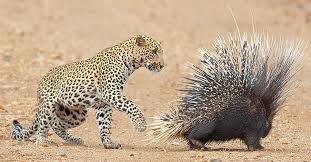
“You can’t stop the predator from attacking — but you can make sure it regrets doing so.”
In an era dominated by great-power rivalries, smaller states often face the daunting challenge of defending themselves against larger, better-equipped adversaries. The Porcupine Strategy has evolved into a logical and resilient method for deterrence and defence. It is named after the rodent whose sharp quills deter its predators. The strategy aims not to subjugate an aggressor, but to make invasion costly, protracted, and untenable. It is rooted in the principles of asymmetric warfare, adaptability, decentralisation, and resilience.
Origins. The term “porcupine strategy” entered the military lexicon through William S. Murray (a professor at the U.S. Naval War College) in 2008. It gained prominence in discussions of Taiwan’s defence policy, as the island faced mounting pressure from mainland China. However, the underlying logic of the approach (making oneself too difficult or costly to conquer) has historical precedents. Israel’s layered defences during the 1973 Yom Kippur War, and Finland’s “motti” tactics against the Soviet Union in the 1939–1940 are historical examples of a similar approach.
Conceptual Foundation. The Porcupine Strategy is built on a simple proposition: when direct confrontation is unwinnable, deterrence by denial becomes the best form of defence. Instead of trying to match a superior enemy tank-for-tank or jet-for-jet, the defender focuses on capabilities that exploit the attacker’s weaknesses—such as mobility, supply lines, and overextension. Murray formalised these ideas into a cohesive doctrine. The doctrine was for island defence (Taiwan). He theorised the concept on three pillars. These pillars are access denial, survivability through dispersion, and cost imposition.
Key Principles
The effectiveness of the Porcupine Strategy lies in its adherence to a set of interconnecting principles. These principles include asymmetry, decentralisation, resilience, and civil-military integration.
Asymmetry. Asymmetric defence recognises that smaller nations cannot win through conventional parity. Instead, they focus on low-cost, high-impact weapons and tactics. Portable anti-tank and anti-air missiles, drone swarms, and coastal defence systems are typical tools. By investing in thousands of relatively inexpensive weapons rather than a few large platforms like battleships or fighter squadrons, the defender can sustain resistance and impose continuous attrition on an invading force.
Decentralisation. Traditional militaries often depend on centralised command and control structures that can be disrupted early in a conflict. The Porcupine Strategy, by contrast, decentralises decision-making and operations. Small, autonomous units can continue fighting even if the national command structure is compromised. This approach ensures continuity of resistance. It also complicates the invader’s ability to deliver a knockout blow.
Resilience and Denial. A porcupine cannot stop a predator from attacking, but it can ensure that the experience is painful enough to deter the predator. Similarly, the Porcupine Strategy aims to deter the enemy rather than achieve a decisive victory over him. According to this concept, the defence plans rely on mobility, concealment, and attrition. The enablers of the sustained resistance include hardened infrastructure, stockpiles of ammunition, and redundant logistics networks.
Civil-Military Integration. The strategy necessitates integration of the civilian population into national defence planning. This includes reserve forces, civil defence training, cyber defence volunteers, and information resilience programs. Civilian involvement not only increases manpower and situational awareness but also reinforces national willpower—one of the most critical elements in enduring protracted conflict. In this model, every citizen becomes part of a “whole-of-society defence.”
Case Study: Taiwan’s Porcupine Strategy
Nowhere is the Porcupine Strategy more relevant today than in Taiwan, whose geographic proximity to China and democratic identity make it a potential flashpoint in global security. Facing the possibility of a large-scale amphibious invasion or blockade, Taiwan has increasingly embraced an asymmetric defence posture.
The U.S. and allied analysts have urged Taiwan to shift its focus away from high-value, easily targeted platforms—such as advanced fighter jets and large naval vessels—and toward mobile, survivable, and cost-effective systems. These include:-
- Anti-ship and coastal defence missiles (e.g., Harpoon and Hsiung Feng systems)
- Mobile air defence units using Stinger or Sky Sword systems
- Mines and unmanned aerial vehicles for area denial
- Rapidly deployable infantry and special forces for urban and guerrilla warfare
By dispersing its forces and relying on mobility rather than fixed installations, Taiwan seeks to make a full-scale invasion prohibitively difficult. Even if initial landings succeed, occupation and consolidation would face sustained resistance, both military and civilian.
Comparative Examples
Ukraine. After 2014, Ukraine’s military reforms incorporated many elements of the Porcupine theory. The country invested heavily in defensive capabilities. It also developed a strong reserve force and local defence networks. These measures played a decisive role in thwarting the initial Russian offensive in 2022. Ukraine’s experience stresses the value of distributed resistance. It also highlights the difficulty of subduing a determined population even by a superior force.
Finland. Finland’s “total defence” doctrine, developed during the Cold War, contains many aspects of the Porcupine Strategy. Finland has a strong civil defence network, with a role for every citizen in national defence. It also has an extensive reserve force and hardened infrastructure. Finland’s focus on nationwide preparedness has long served as a deterrent to potential aggressors. This approach demonstrates that the Porcupine Strategy is not limited to small island nations; it is equally applicable to continental states with strong civic cohesion.
Strategic Goals and Outcomes. The Porcupine Strategy aims to achieve four key strategic objectives. By achieving these aims, vulnerability can be easily transformed into a source of strength. The defending nation cannot match the enemy’s might, but it can erode their will and ability to achieve a decisive victory.
-
- Deterrence by Denial. Convince the aggressor that success is unlikely and prohibitively costly.
- Attrition and Delay. Force the attacker to expend vast resources for limited territorial gains.
- Survivability. Ensure the defender can continue fighting even under severe attack.
- Psychological Impact. Signal to the aggressor—and the international community—that the nation will resist to the end.
Limitations and Challenges.
The porcupine strategy is not without challenges. It requires long-term commitment, societal resilience, and political will. Stressing too much on asymmetric defence could lead to neglect of traditional military power. The opposite side could get emboldened by it. Additionally, external assistance is crucial for the strategy’s success. Assistance is required in the form of intelligence sharing, arms supply, and diplomatic support. In the absence of external support, even an exceptionally well-designed plan can become ineffective over time.
Conclusion
“Survival often depends not on outmatching the enemy, but on outsmarting them”.
In today’s world, military power is unevenly distributed. The Porcupine Strategy endorses that strength does not always lie in size. It is also dependent upon the ability to endure, resist, and make aggression costly to pursue. The Porcupine Strategy transforms vulnerability into deterrence. It is one of the adaptive and realistic defence doctrines for small and medium-sized states.
Please Add Value to the write-up with your views on the subject.
For regular updates, please register your email here:-
References and credits
To all the online sites and channels.
Pics Courtesy: Internet
Disclaimer:
Information and data included in the blog are for educational & non-commercial purposes only and have been carefully adapted, excerpted, or edited from reliable and accurate sources. All copyrighted material belongs to respective owners and is provided only for wider dissemination.
References:-
- Murray, William, “Revisiting Taiwan’s Defence Strategy”, Naval War College Review, Vol. 61, No. 3, 2008.
- Kilcullen, David, “The Accidental Guerrilla: Fighting Small Wars in the Midst of a Big One,” Oxford University Press, 2009.
- Easton, Ian, “The Chinese Invasion Threat: Taiwan’s Defence and American Strategy in Asia”, Project 2049 Institute, 2009.
- Rautio, Tuomas, “Finland’s Total Defence Concept: Whole-of-Society Preparedness”, Finnish Institute of International Affairs (FIIA), 2021.
- Trotter, William R, “A Frozen Hell: The Russo-Finnish Winter War of 1939–1940”, Chapel Hill, NC: Algonquin Books, 1991.
- RAND Corporation, “The Ukrainian Defence: Lessons in Distributed Resistance”, RAND Research Report RR-A2332-1, 2023.
- Kofman, Michael, and Ryan Evans, “Ukraine’s Defence Reforms and the Porcupine Strategy”, War on the Rocks, March 15, 2022.
- Center for Strategic and International Studies (CSIS), “Taiwan’s Defence Strategy: Countering China’s Coercion”, CSIS Asia Program Report, 2022.
- Beckley, Michael, “The Emerging Military Balance in Asia: Implications for Taiwan’s Defence Strategy.”
- Arreguín-Toft, Ivan, “How the Weak Win Wars: A Theory of Asymmetric Conflict”, Cambridge: Cambridge University Press, 2005.