
715: STRATEGIC SIGNIFICANCE OF THE RESISTANCE FRONT (TRF) BEING DESIGNATED AS A TERRORIST ORGANISATION


My Article was published on the IIRF website on 03 Aug 25.


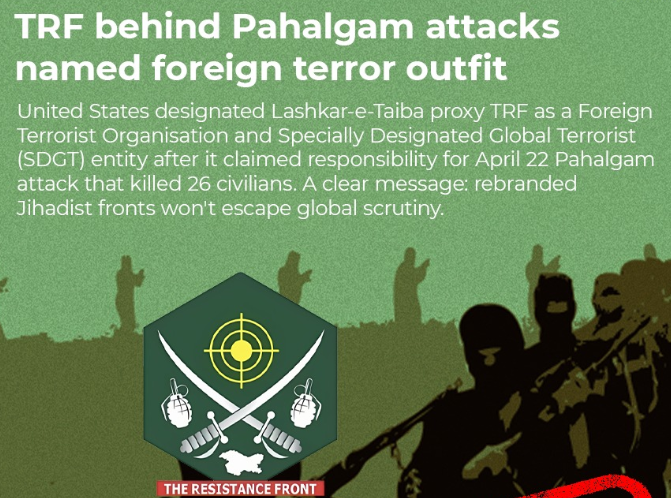
On July 18, 2025, the United States Department of State officially designated The Resistance Front (TRF) as both a Foreign Terrorist Organisation (FTO) and a Specially Designated Global Terrorist (SDGT). This move marks a significant step in the international fight against terrorism, particularly in South Asia, where cross-border terror networks have long plagued regional peace and stability.

TRF is widely recognised as a front organisation for Lashkar-e-Tayyiba (LeT), a Pakistan-based terror group responsible for numerous deadly attacks in India, including the infamous 2008 Mumbai attacks. The designation comes just months after TRF claimed responsibility for the 22 Apr 25, Pahalgam attack, which killed 26 civilians, India’s deadliest terrorist attack on civilians since 2008.

This designation is not just a symbolic gesture. The FTO and SDGT designations are potent tools in the U.S. counterterrorism arsenal. It carries serious legal, financial, and geopolitical consequences.


TRF and Its Links to Lashkar-e-Tayyiba

The Resistance Front (TRF) emerged in 2019, shortly after the revocation of Article 370 in Jammu and Kashmir. While it initially presented itself as a local resistance movement, Indian intelligence agencies and independent observers soon traced its roots to Lashkar-e-Tayyiba, an internationally designated terrorist group with known ties to the Pakistani military and intelligence establishment.

By using a new name and softer rhetoric, TRF was part of LeT’s strategy to circumvent international scrutiny, particularly as global pressure on Pakistan to curb terror financing increased. The group maintained LeT’s ideology and tactics but attempted to present a more “indigenous” front to gain legitimacy among local populations and global observers.

Over the past few years, TRF has claimed responsibility for several attacks on Indian security forces and civilians. However, the April 2025 massacre in Pahalgam, which killed 26 civilians, marked a significant escalation. It was not only the deadliest attack in over 15 years but also underscored the group’s growing capacity and intent to target soft, civilian areas to incite fear and instability.


Significance of the U.S. Designation

Disrupting TRF’s Operational Capabilities. The designation of the Terrorist Resistance Front (TRF) as a Foreign Terrorist Organisation (FTO) and a Specially Designated Global Terrorist (SDGT) imposes stringent restrictions. All TRF assets within the jurisdiction of the United States are to be frozen, and U.S. persons are thereby prohibited from engaging in any transactions with the group. Providing material support, including fundraising, recruitment, or logistical assistance, to TRF constitutes a federal offence. These actions impede access to global financial systems and foreign funding sources, thereby limiting TRF’s capacity to recruit operatives, acquire weapons, and coordinate attacks. With diminished resources, TRF would encounter difficulties in planning and executing high-impact operations. The designations serve to discourage global supporters from engaging with the group and encourage international financial institutions and governments to monitor and restrict TRF’s activities, promoting collaborative efforts to dismantle its networks. U.S. and allied law enforcement and intelligence agencies are granted increased authority to enhance surveillance and target TRF-associated operatives. By focusing on TRF’s financial and logistical infrastructure, these measures establish a constrained operational environment, thereby reducing the group’s ability to function effectively.

Exposing and countering Lashkar-e-Tayyiba’s proxy tactics. The Tactical Research Facility’s (TRF) designation as a front for Lashkar-e-Tayyiba (LeT) underscores the importance of addressing the broader ecosystem of terrorist organisations operating through proxies. By designating the TRF, the United States emphasises this strategy, conveying a clear message to LeT and similar groups that front organisations will not serve as shields against international scrutiny or consequences. This also provokes further inquiries into the role of Pakistan-based networks in supporting and sheltering such organisations. Although Pakistan denies harbouring terrorist entities, the association between TRF and Let adds to the body of evidence suggesting state complicity in harbouring extremists.

Legal and Diplomatic Precedent. The designation reinforces the legal framework within which individuals affiliated with TRF may be subject to arrest, prosecution, or extradition by United States authorities or allied nations. It additionally exerts pressure on technology companies, financial institutions, and non-governmental organisations to prevent any inadvertent support of terrorism under the pretence of social or political activism. From a diplomatic standpoint, this measure encourages other nations to reevaluate their lists of designated organisations, particularly in regions such as Europe, the Middle East, and Southeast Asia, where LeT and its affiliates have endeavoured to establish ideological or fundraising networks.

Implications for Pakistan. The TRF designation could potentially heighten scrutiny regarding Pakistan’s involvement in harbouring or tolerating terrorist infrastructure. This development may jeopardise its international diplomatic relations if Islamabad does not take decisive action against LeT and TRF-related entities. Conversely, it provides moderate factions within Pakistan with an opportunity to advocate for more substantive counterterrorism reforms. Persisting in shielding these groups may lead to increased isolation on the global stage along with further restrictions on aid, trade, and financial assistance.

Broader Message to Global Terrorist Networks. The designation of TRF conveys a comprehensive message that terrorist organisations cannot evade accountability through rebranding or the establishment of front groups. Whether in South Asia, the Middle East, or Africa, extremist networks frequently alter their names and narratives to exploit legal and political loopholes. By recognising TRF’s association with LeT, the United States affirms that the international effort against terrorism will evolve correspondingly.


Challenges and Limitations

Although the designations of FTO and SDGT are consequential, their effectiveness is contingent upon several factors. Firstly, international compliance is paramount. Nations hosting TRF operatives or financial networks are required to implement sanctions and collaborate with United States efforts to dismantle the group’s activities. This task may prove challenging in regions characterised by weak governance or where TRF operates covertly.

Secondly, the designations exert indirect pressure on Pakistan to undertake measures against LeT and its affiliates, including TRF. Considering LeT’s historical associations with entities within Pakistan, diplomatic initiatives will be essential to secure cooperation. Neglecting to address these networks at their origin could diminish the effectiveness of the designations, enabling TRF to adapt and persist in its activities under new appearances.

Ultimately, the designations must be supplemented by comprehensive counterterrorism initiatives at the operational level, encompassing intelligence activities, law enforcement operations, and initiatives aimed at countering radicalisation. While the FTO and SDGT classifications hinder TRF’s resources, they do not eradicate the ideological and operational motivations behind its violence, which necessitate ongoing regional and international efforts to effectively address.


Conclusion

The decision by the United States to designate The Resistance Front as a Foreign Terrorist Organisation and as a Specially Designated Global Terrorist entity represents a significant milestone in counterterrorism initiatives across South Asia. These designations advance the objectives of global counterterrorism efforts and promote regional stability by targeting the core of LeT’s proxy strategy. Beyond its immediate implications, this action also exemplifies the international community’s dedication to holding terrorist proxies accountable, even when they operate under different aliases or exploit regional grievances to further their agendas. In the long term, such measures contribute to a more transparent and unified global response to terrorism, emphasising civilian safety, regional stability, and adherence to the rule of law over geopolitical considerations and transient alliances. Nonetheless, the efficacy of these measures relies on international cooperation, persistent efforts to dismantle LeT’s networks, and comprehensive strategies aimed at addressing the root causes of terrorism.


Please Add Value to the write-up with your views on the subject.


1818
Default rating

Please give a thumbs up if you  like The Post?


For regular updates, please register your email here:-

Subscribe

Link to the article on the website:-

STRATEGIC SIGNIFICANCE OF THE RESISTANCE FRONT (TRF) BEING DESIGNATED AS A TERRORIST ORGANISATION by Air Mshl Anil Khosla (Retd)


References and credits

To all the online sites and channels.

Pics Courtesy: Internet

Disclaimer:

Information and data included in the blog are for educational & non-commercial purposes only and have been carefully adapted, excerpted, or edited from reliable and accurate sources. All copyrighted material belongs to respective owners and is provided only for wider dissemination.


References:-

  1. U.S. Department of State. (2025). “Designation of The Resistance Front as a Foreign Terrorist Organisation and Specially Designated Global Terrorist.” Press Release, July 18, 2025.
  1. U.S. Department of State. (2023). “Country Reports on Terrorism 2022.” Bureau of Counterterrorism.
  1. Byman, Daniel. (2019). Road Warriors: Foreign Fighters in the Armies of Jihad. Oxford University Press.
  1. Riedel, Bruce. (2011). Deadly Embrace: Pakistan, America, and the Future of the Global Jihad. Brookings Institution Press.
  1. Tankel, Stephen. (2013). Storming the World Stage: The Story of Lashkar-e-Taiba. Columbia University Press.
  1. The Times of India. (2025). “Pahalgam Attack: 26 Civilians Killed in Deadliest Assault Since 2008 Mumbai Attacks.” April 23, 2025.
  1. South Asia Terrorism Portal (SATP). (2025). “The Resistance Front (TRF): Group Profile.”
  1. Congressional Research Service. (2024). “Foreign Terrorist Organisations: Designation and Implications.” Updated January 15, 2024.
  1. Fair, C. Christine. (2018). In Their Own Words: Understanding Lashkar-e-Tayyiba. Hurst Publishers.
  1. BBC News. (2024). “TRF Claims Responsibility for Attacks on Indian Security Forces in Kashmir.” October 12, 2024.
  1. U.S. Treasury Department. (2023). “Sanctions Programs and Country Information: Counter Terrorism Sanctions.”
  1. Chaudhuri, Pramit Pal, and Rudra Chaudhuri. (2023). “India’s Counterterrorism Strategy: Challenges and Opportunities.” Carnegie India.
  1. Jamestown Foundation. (2025). “The Resistance Front: LeT’s New Proxy in Kashmir.” Terrorism Monitor, Volume 23, Issue 6.
  1. United Nations Security Council. (2022). “ISIL (Da’esh) and Al-Qaida Sanctions Committee: Narrative Summaries of Reasons for Listing – Lashkar-e-Tayyiba.”
  1. Indian Express. (2025). “U.S. Designates The Resistance Front as Terrorist Organisation After Pahalgam Attack.” July 19, 2025.
685: OP SINDOOR: PUNITIVE DETERRENCE –  TARGETING TERROR CAMPS


My article published on the IIRF website on 19 Jun 25.


India’s policy of punitive deterrence is a strategic doctrine aimed at dissuading Pakistan from sponsoring cross-border terrorism by imposing credible costs through calibrated military responses. Rooted in the need to break the cycle of provocation and restraint, this policy combines political resolve, precision strikes, and international diplomatic engagement to establish red lines. As exemplified by earlier responses, it marks a shift from reactive to proactive counter-terrorism. This framework underscores India’s intent to reshape adversary behaviour, strengthen national security, and reinforce deterrence without escalating into full-scale war, thereby maintaining strategic stability in South Asia.

Operation Sindoor was a series of precision strikes conducted by the Indian Armed Forces against the terror infrastructure in Pakistan. On May 7, 2025, nine terror camps in Pakistan and Pakistan-occupied Jammu and Kashmir (PoJK) were hit in retaliation for the 22 April 25, terror attack at Pahalgam that killed 26 civilians.

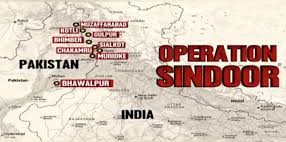
Geographic Distribution of Terror Camps and Their Strategic Importance. The nine targeted camps were critical nodes in the terror infrastructure of Jaish-e-Mohammed (JeM), Lashkar-e-Taiba (LeT), and Hizbul Mujahideen (HuM). These groups have been responsible for major attacks on Indian soil, including the 2008 Mumbai attack, 2016 Uri attack, 2019 Pulwama attack, and the 2025 Pahalgam attack. The camps served as hubs for recruitment, training, indoctrination, logistics, and infiltration, often with logistical support from Pakistan’s military and ISI. Three camps (Bahawalpur, Muridke, Sialkot) were located in mainland Pakistan, 5–200 km from the International Border. Six camps (including Muzaffarabad, Kotli, Bhimber) were closer to the Line of Control, 9–15 km, reflecting their role as infiltration and staging points. Camps near the IB/LoC (e.g., Sialkot, Kotli, Bhimber, Muzaffarabad) were critical for immediate infiltration and logistics, posing direct threats to Jammu and Kashmir. Deep inland camps (e.g., Bahawalpur, Muridke) served as ideological and operational headquarters.


Extent of Overall Damage.

Indian sources reported the destruction of all nine camps, with over 100 terrorists killed, including high-value targets like Yusuf Azhar, Abdul Malik Rauf, and Mudasir Ahmed, linked to the IC-814 hijacking and the Pulwama attack. Satellite imagery confirmed extensive damage, with key facilities like Markaz Subhan Allah (Bahawalpur) and Markaz Taiba (Muridke) reduced to rubble. The operation reportedly used SCALP cruise missiles, HAMMER precision-guided bombs, and loitering munitions, ensuring minimal civilian casualties and no targeting of Pakistani military installations.

Pakistani Claim.  Pakistan claimed 26–31 civilian deaths and damage to mosques and residential areas, labelling the strikes an “act of war.” These claims remain unverified by independent sources, and India refuted them, asserting that no civilian infrastructure was targeted.

Indian Perspective. The strikes were described as “focused, measured, and non-escalatory,” targeting only terror infrastructure with no civilian or military targets hit. Indian officials provided satellite imagery and videos to substantiate claims of precision and extensive damage to terror camps.


Message through Operation Sindoor.

Operation Sindoor was not just a tactical military response; it was a calibrated strategic message from India to Pakistan, signalling a decisive shift in how India intends to respond to cross-border terrorism. It sent a powerful message that India would strike precisely when provoked and where it hurts most. It reframed the India-Pakistan dynamic from reactive defence to assertive offence, clarifying that India will no longer play by the rules written in Rawalpindi.

Zero Tolerance for Cross-Border Terrorism. India conveyed that state-sponsored terrorism will no longer be met with diplomatic restraint or reactive defence, but with proactive and pre-emptive military action. By hitting deep into Pakistan and PoK, India underscored that terror safe havens will be treated as legitimate military targets.

Deterrence by Punishment. Rather than relying solely on deterrence by denial (defensive security), Operation Sindoor shifted to deterrence by punishment, raising the cost of using terrorism as an instrument of state policy.

Strategic and Tactical Escalation Control Lies with India. India emphasised that the strikes were “focused, measured, and non-escalatory,” targeting only terror infrastructure and avoiding Pakistani military or civilian sites. By choosing the time, location, and scale of the strikes, India seized escalation dominance, demonstrating that it can punish terror proxies without triggering a full-scale war. The precision and speed of the operation signalled India’s ability to strike hard while managing strategic escalation.

Deep-Strike Capability and Political Will. The strikes were more profound and extensive than previous cross-border operations, such as the 2016 surgical strikes or the 2019 Balakot airstrikes. This conveyed India’s enhanced ISR (Intelligence, Surveillance, Reconnaissance), strike capabilities, and, more importantly, a firm political will to act on them.

Terror Infrastructure Will Not Be Tolerated. By targeting Terror organisation headquarters, training camps, launch pads, and logistical nodes, India conveyed that no location, whether in PoK or even close to Pakistan’s heartland, is beyond reach if it harbours anti-India terror operations. By striking deep into Pakistan’s Punjab province (e.g., Bahawalpur, Muridke, Sialkot) and PoJK (e.g., Muzaffarabad, Kotli, Bhimber), India demonstrated its military reach and resolve to target terrorist sanctuaries regardless of location. The message was clear: “No place is beyond India’s reach,” challenging the sense of impunity enjoyed by terror groups.

Global Signalling: From Victim to Enforcer. India sent a signal not just to Pakistan, but to the worldwide community—that it is no longer content with merely being seen as a victim of terrorism. India now positions itself as an active enforcer of its national security, willing to act unilaterally when international pressure fails to deter terror networks.

A Warning for the Deep State and Proxy Groups. India’s message was also aimed at the Pakistani military-intelligence complex (ISI). If you continue to support terrorist groups like Jaish-e-Mohammed (JeM) and Lashkar-e-Taiba (LeT), the cost will be imposed not only on your proxies but on your assets and territory.


Conclusion

Operation Sindoor marks a watershed in India’s counter-terrorism doctrine—an audacious assertion of sovereign resolve against cross-border terrorism. By targeting deep-rooted terror hubs across both Pakistan-occupied Jammu and Kashmir and mainland Pakistan, the operation showcased India’s enhanced surveillance, precision strike capability, and political will to act decisively. Each of the nine camps held operational and symbolic relevance—from the ideological headquarters of Lashkar-e-Taiba in Muridke to suicide bomber training camps in Kotli and pre-infiltration staging points in Sialkot. The comprehensive destruction of these facilities, verified through satellite imagery and on-ground assessments, sent a clear message: India will not hesitate to dismantle the terror infrastructure at its source, regardless of geographical or political boundaries. The strikes redefined the contours of Indian deterrence, shifting from reactive defence to offensive punishment, and conveyed a strong message to the Pakistani establishment and the global community alike. India has demonstrated that it is no longer a passive recipient of terror but a proactive enforcer of its national security imperatives.


List of Terror Camps Targeted

  1. Markaz Subhan Allah, Bahawalpur (Pakistan) – Jaish-e-Mohammed (JeM).

Location and Relevance. Bahawalpur, Punjab, is approximately 150–200 km from the international border with India (near the Rajasthan or Punjab border). Located in Pakistan’s Punjab heartland, far from the LoC, this was a strategic, ideological and operational hub, making it a deep-strike target. Considered the ideological and operational headquarters of JeM, a major anti-India terror group and served as a recruitment, training, and indoctrination center for JeM operatives. Historically, it hosted senior cadre training sessions linked to major attacks, including the 2019 Pulwama attack and reportedly financed by Osama Bin Laden with rupees one crore for constructing a mosque and a guest house within the complex.

Extent of Damage: Satellite imagery showed significant destruction, with the mosque’s dome collapsed, widespread debris, and surrounding buildings reduced to rubble. Before-and-after visuals confirmed substantial structural damage, leaving the hub in ruins.


  1. Markaz Taiba, Muridke (Pakistan) – Lashkar-e-Taiba (LeT).

Location and Relevance. Muridke, Punjab, Pakistan. Approximately 30–40 km from the International Border (near Wagah, Punjab, India). Situated near Lahore, this 200-acre facility was close to the IB, making it a high-priority target due to its proximity and role in training for major attacks like the 2008 Mumbai attack. A 200-acre compound serving as the operational and ideological heart of LeT, known as Pakistan’s “terror nursery.” Used for indoctrination, logistics, and planning major attacks, including the 2008 Mumbai attack, where terrorists like Ajmal Kasab were trained. Key infrastructure for training and coordinating terror activities against India.

Extent of Damage. Satellite imagery revealed extensive destruction, with buildings reduced to rubble. Videos and images showed rescuers searching through debris, indicating severe structural damage. The Indian military confirmed the destruction of command centers and training facilities.


  1. Syedna Bilal Camp, Muzaffarabad (PoJK) – Jaish-e-Mohammed (JeM)

Location and Relevance. Muzaffarabad, Pakistan-occupied Jammu and Kashmir, approximately 10–15 km from the Line of Control. A key infiltration point in PoJK, its proximity to the LoC made it critical for cross-border terror activities targeting Kashmir. A key infiltration point and training facility for JeM sleeper cells. Linked to attacks in Sonmarg, Gulmarg (October 2024), and Pahalgam (April 2025). Served as a logistics and transit point for terrorists infiltrating into Indian-administered Kashmir.

Extent of Damage. Destroyed at 1:04 AM on May 7, 2025, OSINT imagery confirmed significant damage to infrastructure with minimal civilian impact.


  1. Shawai Nala Camp, Muzaffarabad (PoJK) – Lashkar-e-Taiba (LeT)

Location and Relevance. Shawai Nala, Muzaffarabad, Pakistan-occupied Jammu and Kashmir, approximately 10–12 km from the Line of Control. Another Muzaffarabad-based camp, close to the LoC, is used for training and staging infiltrators for attacks in Jammu and Kashmir. A major LeT center for training terrorists involved in attacks on Sonmarg, Gulmarg (October 2024), and Pahalgam (April 2025). Used as an infiltration point and staging facility for cross-border terror activities.

Extent of Damage. Destroyed, with UAV reconnaissance and OSINT imagery confirming the elimination of training facilities and arms depots.


  1. Abbas Terrorist Camp, Kotli (PoJK) – Lashkar-e-Taiba (LeT)

Location and Relevance. Kotli, Pakistan-occupied Jammu and Kashmir, approximately 13 km from the Line of Control. A nerve center for suicide bomber training, its proximity to the LoC made it a significant threat for infiltration into India.

Extent of Damage. Satellite imagery confirmed that the camp was reduced to rubble.


  1. Markaz Abbas, Kotli (PoJK) – Jaish-e-Mohammed (JeM)

Location and Relevance. Kotli, Pakistan-occupied Jammu and Kashmir, approximately 13 km from the Line of Control. A hub for suicide bomber training and weapons distribution for PoJK-based terrorists. Facilitated by Pakistan’s Special Services Group for logistics and training.

Extent of Damage. UAV surveillance confirmed the elimination of key infrastructure, with precision strikes targeting training and logistical centers.


  1. Sarjal/Tehra Kalan, Sialkot (Pakistan) – Jaish-e-Mohammed (JeM)

Location and Relevance. Tehra Kalan, Sialkot, Punjab, Pakistan, approximately 6 km from the International Border (near Jammu, India). A pre-infiltration camp located within a primary health center premises, its proximity to the IB made it a key staging ground for infiltration and logistics coordination, established in the late 1990s and linked to the March 2025 attack in Kathua, Jammu, where four J&K police personnel were killed.

Extent of Damage. Satellite imagery confirmed its destruction, showing significant damage to infrastructure.


  1. Mehmoona Joya Facility, Sialkot (Pakistan) – Hizbul Mujahideen (HuM)

Location and Relevance. Sialkot, Punjab, Pakistan, approximately 5–7 km from the International Border. A facility for Hizbul Mujahideen, a pro-Pakistan separatist group founded in 1989, was used for training and planning attacks in Indian-administered Kashmir.

Extent of Damage. Destroyed in the strikes, with the elimination of key infrastructure.


  1. Markaz Ahle Hadith, Barnala, Bhimber (PoJK) – Lashkar-e-Taiba (LeT)

Location and Relevance. Barnala, Bhimber, is in Pakistan-occupied Jammu and Kashmir, approximately 9 km from the Line of Control. A logistics and training hub for LeT, its strategic location near the LoC supported cross-border operations. It is used for training in weapons, improvised explosive devices (IEDs), and jungle survival.

Extent of Damage.  Destroyed, with satellite imagery confirming the elimination of logistical and training facilities.


Please Add Value to the write-up with your views on the subject.


1818
Default rating

Please give a thumbs up if you  like The Post?


For regular updates, please register your email here:-

Subscribe


References and credits

To all the online sites and channels.

Pics Courtesy: Internet

Disclaimer:

Information and data included in the blog are for educational & non-commercial purposes only and have been carefully adapted, excerpted, or edited from reliable and accurate sources. All copyrighted material belongs to respective owners and is provided only for wider dissemination.


Link to the article on the website:-

OP SINDOOR: Punitive Deterrence – Targeting Terror Camps

References:-

  1. Ministry of Defence, Government of India. (2025, May 8). Press Briefing on Counter-Terror Strikes: Operation Sindoor.
  1. Indian Air Force. (2025, May 9). Statement on Precision Air Strikes Against Terror Infrastructure, May 7, 2025.
  1. South Asia Terrorism Portal (SATP). (2025). Profiles of Terrorist Groups and Training Camps in Pakistan. Institute for Conflict Management.
  1. WION News. (2025, May 8). India’s Operation Sindoor: A Deep Dive into the Strikes on Terror Camps.
  1. BBC News. (2025, May 8). India Strikes Terror Camps in Pakistan: What We Know So Far.
  1. The Hindu. (2025, May 9). Nine Terror Camps Targeted in India’s Precision Air Strikes: Official Sources.
  1. Daily Excelsior. (2025, May 8). Operation Sindoor: India Targets Terror Camps in PoJK, Pakistan.
  1. India Today. (2025, May 8). Operation Sindoor: India’s Precision Strikes Hit 9 Terror Camps in Pakistan, PoJK.
  1. ORF Occasional Paper No. 396. (2021). The Terror Infrastructure in Pakistan: The Role of JeM and LeT. Observer Research Foundation.
  1. Singh, A. (2020). India’s Cross-Border Strikes and Strategic Signalling: The Doctrine of Deterrence by Punishment. Carnegie India.
  1. Bhatnagar, G. (2019). Terrorist Training Camps in Pakistan: Locations, Capabilities and Patterns. Centre for Land Warfare Studies (CLAWS).
  1. CSIS Transnational Threats Project. (2018). Pakistan-Based Militancy and the Role of the ISI. Center for Strategic and International Studies.
  1. Sethi, M. (2025). India’s Offensive Deterrence Post-Balakot and Operation Sindoor: A Strategic Shift?. Manohar Parrikar Institute for Defence Studies and Analyses (MP-IDSA).
  1. Jane’s Defence Weekly. (2025, May 10). Analysis of Satellite Imagery Confirms Targeted Destruction of Militant Infrastructure in PoJK and Punjab, Pakistan.
  1. NDTV. (2025, May 8). India Used SCALP, HAMMER and Loitering Munitions in Operation Sindoor.
  1. GlobalSecurity.org. (2024). JeM, LeT, and HuM Training Facilities: Historical Patterns and Tactical Analysis.
  1. Maxar Technologies. (2025, May). Satellite Imagery of Bahawalpur, Muridke, Muzaffarabad Before and After May 7 Strikes.

674: CLAWS Seminar on Operation Sindoor


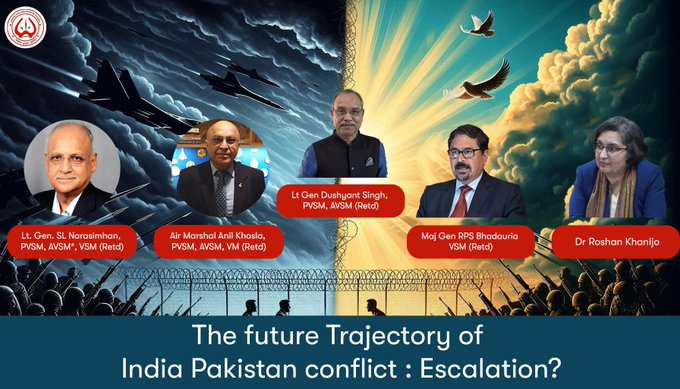
CLAWS conducted a Seminar on  “Operation Sindoor”  on 08 May 25.


Link to the webinar:-

Please Add Value to the subject with your views and Comments.


1818
Default rating

Please give a thumbs up if you  like The Post?


For regular updates, please register your email here:-

Subscribe

References and credits

To all the online sites and channels.

Pics Courtesy: Internet

Disclaimer:

Information and data included in the blog are for educational & non-commercial purposes only and have been carefully adapted, excerpted, or edited from reliable and accurate sources. All copyrighted material belongs to respective owners and is provided only for wider dissemination.

English हिंदी