Information and data included in the blog are for educational & non-commercial purposes only and have been carefully adapted, excerpted, or edited from reliable and accurate sources. All copyrighted material belongs to respective owners and is provided only for wider dissemination.
Presented my views on the subject during a discussion on CNBC News Channel
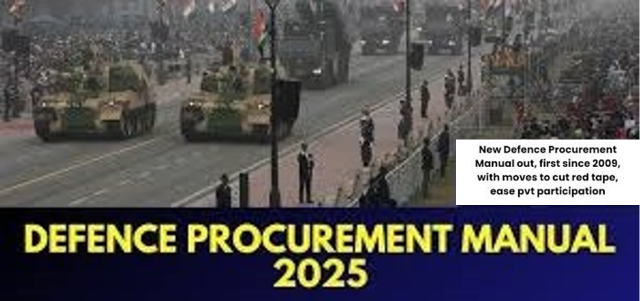
The Defence Procurement Manual (DPM) 2025 has been approved by Raksha Mantri Shri Rajnath Singh, replacing the 2009 manual. It aims to streamline and simplify revenue procurement processes for the Ministry of Defence, aligning with modern warfare needs and promoting self-reliance under Aatmanirbhar Bharat. The DPM 2025 governs ₹1 lakh crore in revenue procurements for FY 2025, and incorporates technology, fairness, and accountability to meet contemporary public procurement standards. Highlights according to the press release include:-
Enhanced Self-Reliance. A new chapter promotes innovation and indigenisation, encouraging collaboration with private industries, MSMEs, startups, academia, and DPSUs to develop defence items/spares in-house.
Ease of Doing Business. Simplified processes, relaxed penalties (e.g., minimal 0.1% Liquidity Damages post-prototype, capped at 5-10%), and supportive financing options address industry concerns, fostering participation.
Expedited Procurement. Empowers Competent Financial Authorities (CFAs) at lower levels to facilitate faster decision-making, timely payments, and flexibility in extending delivery periods or bid dates, thereby boosting participation.
Support for Innovation. Assured orders for up to 5-10 years, technical support, and handholding for suppliers to ensure successful development.
Operational Efficiency. Allows 15% upfront provision for repair/refit/maintenance to reduce equipment downtime and provisions for limited tendering (up to ₹50 lakh) and proprietary item procurement.
Transparency & Fairness. Aligns with Ministry of Finance guidelines, promotes competitive bidding by removing DPSU No Objection Certificate requirements, and streamlines Government-to-Government procurement.
Jointness & Preparedness. Facilitates coordination among the Armed Forces, ensuring timely resource availability at optimal costs to maintain military readiness.
Repercussions of Key Changes
Assured guarantee of orders in terms of quantity, up to five years and beyond that, up to another five years in exceptional circumstances: This provides long-term financial predictability for vendors, encouraging investments in production capacity, technology, and workforce. For the industry, it lowers entry barriers for private firms and MSMEs, boosting confidence to participate in defence contracts and fostering sustained supply chains. It could accelerate indigenisation by enabling economies of scale, potentially reducing costs over time. However, it might lock the government into commitments if requirements change, though the special circumstances clause adds flexibility. Overall, this enhances defence readiness by ensuring the timely availability of spares and equipment, reducing procurement uncertainties.
Requirement of obtaining NOC from some DPSUs before open bidding has been dispensed with & tenders will be awarded purely on a competitive basis: By removing the NOC barrier, this levels the playing field between public (DPSUs) and private entities, promoting fair competition and potentially driving down costs through broader bidding. For private industry, it increases opportunities to win contracts, encouraging more participation from startups and non-traditional players, which could spur innovation and efficiency. DPSUs may face heightened competition, pushing them to improve performance but possibly eroding their traditional advantages. The repercussion on procurement is faster and more transparent processes, reducing bureaucratic hurdles. This supports defence readiness by diversifying suppliers and mitigating risks from over-reliance on a few entities, though it could initially lead to adjustment challenges for DPSUs.
Upfront provision of 15% in growth of work to be allowed in maintenance of various aerial & naval platforms to reduce equipment downtime: This flexibility accounts for evolving maintenance needs, such as increased complexity or fleet expansions, allowing contracts to adapt without renegotiation. It directly improves operational readiness by minimising downtime for critical assets like aircraft and ships, ensuring higher availability during missions. For the industry, it provides revenue stability and encourages specialised service providers to invest in skills and infrastructure. Potential downsides include slightly higher upfront costs for the government, but the focus on efficiency could offset this through reduced long-term disruptions. This change aligns with modern warfare demands, enhancing the armed forces’ agility.
Liquidated Damages will not be levied during the development phase: Eliminating penalties in the early R&D stage reduces financial risks for developers, particularly startups and innovators experimenting with new technologies. This encourages bolder participation in prototype development, fostering innovation and accelerating indigenisation efforts. For the procurement process, it shifts focus from punishment to collaboration, potentially shortening development timelines by removing fear of harsh repercussions. However, it might lead to laxity if not monitored, though overall it boosts industry confidence and supports defence readiness by speeding up the introduction of advanced systems.
Minimal liquidated damages of 0.1% will be levied post-development of the prototype: This lenient post-prototype penalty (far below typical rates) incentivises vendors to prioritise quality over rushed delivery, while still maintaining some accountability. It makes contracts more attractive to industry players, especially smaller firms, by minimising financial exposure during scaling-up phases. Repercussions include enhanced innovation through reduced risk, but it could slightly prolong timelines if vendors exploit the leniency. For defence readiness, it ensures reliable prototypes transition smoothly to production, contributing to better-equipped forces without excessive delays.
Maximum liquidated damages to be levied have been lowered to 5% & in case of inordinate delays, a maximum penalty of 10% will be levied: Capping penalties at 5% (with 10% only for extreme cases) protects vendors from crippling financial losses, making defence contracts more viable and encouraging broader industry involvement. This could lower overall bid prices as risks decrease, benefiting procurement efficiency. Implications for innovation are positive, as firms can invest more in R&D without fearing disproportionate penalties. However, it might weaken deterrence against delays, potentially affecting timelines if not paired with strong oversight. On defence readiness, it ensures continuity in supply chains, prioritising long-term partnerships over short-term punitive measures.
In summary, these changes collectively aim to streamline procurement, reduce delays, and promote self-reliance, with broad positive repercussions for private industry growth and military efficiency. They could transform India’s defence ecosystem by attracting more domestic players, though careful implementation will be key to balancing leniency with accountability.
Historical Evolution of the DPM
The Indian government’s defence procurement policies have evolved significantly since the introduction of the Defence Procurement Procedure (DPP-2002), driven by the need to streamline military hardware acquisition and enhance self-reliance. This evolution, spurred by post-Kargil War recommendations, reflects a shift toward indigenous design, development, and manufacturing, aligning with initiatives such as ‘Make in India’ and ‘Aatmanirbhar Bharat’. The policies have progressed from DPP-2002 to the Defence Acquisition Procedure (DAP-2020) and the Defence Procurement Manual (DPM-2025), with each iteration emphasising transparency, efficiency, and indigenisation.
Early History and DPP-2002. Following the Kargil War, the Group of Ministers recommended a structured procurement process, leading to the DPP-2002. This policy aimed to ensure the timely, transparent, and competitive acquisition of equipment for the Armed Forces while fostering self-reliance in defence manufacturing.
Evolution and Revisions. The DPP was revised multiple times (e.g., DPP-2005, DPP-2013) to address practical challenges and emerging needs. A significant milestone was DPP-2016, which replaced DPP-2013 and prioritised indigenous design, development, and manufacturing (IDDM) to reduce dependence on imports.
Defence Acquisition Procedure (DAP-2020). In October 2020, DPP-2016 was superseded by DAP-2020, which further emphasised self-reliance. Developed through consultations with foreign and domestic industries, DAP-2020 streamlined procurement processes and reinforced the focus on indigenous manufacturing.
Defence Procurement Manual (DPM). The DPM-2009 was the first comprehensive manual to guide procurement, offering flexibility while aligning with government regulations. Updates, including DPM-2010, followed it. The latest, DPM-2025, approved in September 2025, introduces a dedicated chapter to promote self-reliance through innovation, indigenisation, and collaboration with industries, academia, and public/private sectors. It also provides assured orders to support long-term development.
Key Trends in Policy Evolution
Self-Reliance. The ‘Aatmanirbhar Bharat’ initiative has been central, with policies increasingly prioritising domestically produced defence systems.
Indigenisation. Emphasis on IDDM systems has grown, encouraging private sector participation and reducing reliance on imports.
Streamlined Processes. Continuous efforts have been made to simplify procedures, reduce delays, and enhance responsiveness to the Armed Forces’ needs.
This progression from DPP-2002 to DAP-2020 and DPM-2025 reflects India’s commitment to building a robust, self-reliant defence ecosystem through innovation, collaboration, and efficient procurement practices.
Please Add Value to the write-up with your views on the subject.
For regular updates, please register your email here:-
Information and data included in the blog are for educational & non-commercial purposes only and have been carefully adapted, excerpted, or edited from reliable and accurate sources. All copyrighted material belongs to respective owners and is provided only for wider dissemination.
References:-
Ministry of Defence, Government of India. (2025). “Defence Procurement Manual 2025: Official Release.”
The Times of India. (2025). “Defence minister approves new manual to streamline procurement, boost indigenisation.”