Article published in the December edition of the
News Analytics Journal.
Asia is the world’s biggest and most dynamic continent, but it is also the most unstable. Stretching from the oil-rich Persian Gulf to the stormy Pacific, it is home to several of the planet’s most dangerous flashpoints. On the continent, ancient rivalries clash with modern weapons, great powers vie for control, and every small skirmish carries the risk of global repercussions. The region’s hotspots include the Strait of Hormuz, the South China Sea, Taiwan Strait, Korean Peninsula, and the Himalayan region. Any miscalculation in one of these areas could spark a major conflict.
Flash Points
The Persian Gulf and the Indian Ocean: Asia’s Energy Lifeline. In this region, the narrow Strait of Hormuz (only about 40 kilometres wide) is one of the most crucial shipping lanes. Around one-fifth of all the oil traded globally passes through this chokepoint every day. The tankers moving through it feed factories, power plants, and cars all over the world. If the Strait were to close for some reason, the impact would be felt worldwide. The oil prices would skyrocket immediately. Iran sits at the centre of this area and often threatens to block the Strait. The Iran-backed Houthis in Yemen continue to target Saudi, UAE, and commercial shipping interests in the Red Sea. These attacks cause significant disruptions to global trade. Asian countries are diversifying their supply chain routes to prepare for future crises. The Gulf remains a reminder that Asia’s security problems exist on its energy routes.
The South China Sea: The Maritime Powder Keg. In the east are the world’s busiest and most dangerous seas. The South China Sea carries roughly one-third of all global maritime trade. Beneath its waters lie rich fisheries and untapped gas reserves. Six governments (China, the Philippines, Vietnam, Malaysia, Brunei, and Taiwan) claim overlapping parts of it. China claims almost the entire area of the South China Sea as its own. The international tribunal ruled in 2016 that the Chinese claim had no legal basis. However, Beijing has disagreed with the ruling. China is further militarising the artificial islands created by it on the shoals and reefs. These islands have become permanent military outposts of China, extending its reach deep into Southeast Asia. Every day, ships and planes from different nations cross paths here. Chinese coast guard vessels and civilian fishing boats (controlled by its maritime militia) swarm the contested areas and try to assert control. Other countries are upgrading their navies and pushing back by carrying out exercises and patrols. The result is a “grey-zone” conflict (neither war nor peace) where any confrontation could spiral into crisis. The South China Sea is a testing ground for the future of maritime law and regional order. If rules fail here, they could fail anywhere.
The Taiwan Strait: The Most Dangerous Flashpoint. The 100-mile-wide Taiwan Strait separates China from the island of Taiwan. In Asia, it carries the greatest risk of major war. China considers Taiwan its “breakaway province.” China’s leaders have vowed to reunify Taiwan, peacefully or by force if required. Taiwan is a thriving democracy with its own government and military. With its growing sense of national identity, Taiwan rejects Beijing’s claim. The U.S. helps Taiwan arm itself, but maintains a policy of “strategic ambiguity” regarding its direct intervention in the event of a Chinese invasion. Chinese military pressure has increased lately. Fighter jets and bombers cross into Taiwan’s air defence zone almost every day. Warships circle the island during drills simulating blockades and amphibious assaults. Beyond the military danger, the strait is an economic fault line. Over 60 per cent of the world’s semiconductors are made in Taiwan. This includes the most advanced chips that power smartphones, AI systems, and fighter jets. A war or blockade here would disrupt the global supply chains, devastating the industries worldwide. Every year, the rising tension here increases the likelihood of a misstep that could cause a global crisis.
The Korean Peninsula: Frozen Conflict, Nuclear Threats. The Korean Peninsula is one of the world’s most militarised and tense places. The Korean War never officially ended; it only paused with an armistice. Since then, North Korea has built a considerable nuclear arsenal. It continues to test missiles that can reach all of Asia and beyond. South Korea, maintains a strong defence posture with the assistance from the U.S. Japan is also strengthening its defences and increasing military cooperation with its allies. China and Russia support North Korea and protect it from international sanctions. South Korea is concerned about its long-term security. A deliberate hostile act or a miscalculation can disrupt the fragile peace in the region.
The Himalayas: India–China-Pakistan Triangle. Another tense front runs along the world’s highest mountains. India and China share a 3,400-kilometer Line of Actual Control that is not clearly defined. In 2020, troops from both sides engaged in a deadly hand-to-hand battle in the Galwan Valley. Since then, both have deployed troops and heavy weapons all along the LAC. The border is heavily militarised, increasing the chances of a confrontation. Hostility between India and Pakistan also keeps the region simmering. Pakistan-sponsored proxy attacks and frequent cross-border military exchanges occur at frequent intervals. Collusion between China and Pakistan further exacerbates the matter.
Iran-Israel proxy warfare. The long-standing rivalry between Iran and Israel has escalated through a series of direct and proxy attacks. Iran’s support for non-state actors like Hamas and Hezbollah continues to destabilise the region. The recent Israel-Hamas war has ravaged the region for two years. These regional ripples heighten fears of a broader conflagration.
Analytical Perspective
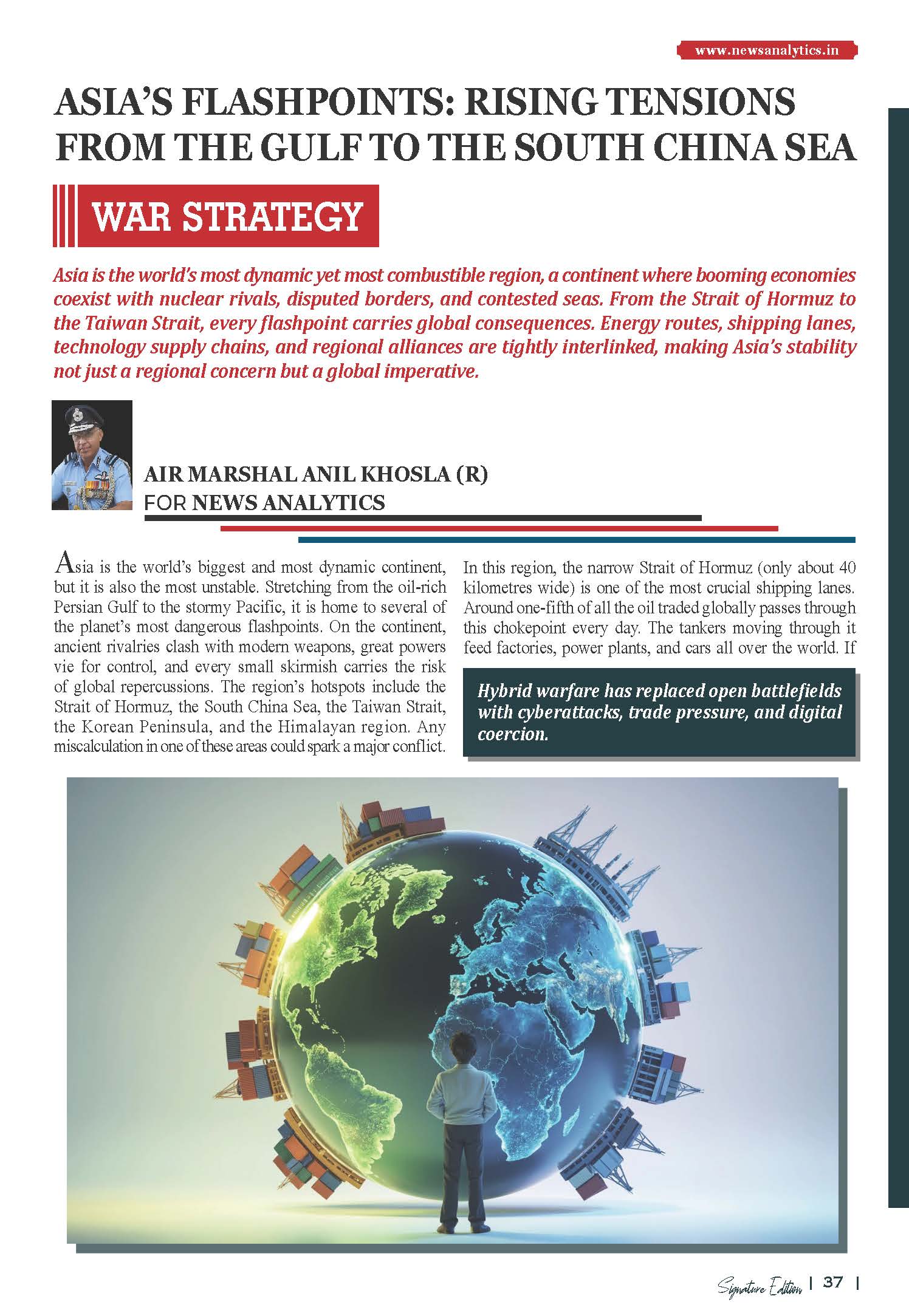
Hybrid Warfare: Conflict without Battlefields. Modern conflict rarely begins with conventional weapons. Instead, it creeps in through cyberattacks, fake news, trade pressure, and legal manipulation. This is hybrid warfare—where military, economic, and informational tools blend together. China uses its maritime militia in the South China Sea. It is a type of hybrid warfare that utilises a civilian organisation for military objectives. Iran uses drones for kinetic attacks along with non-kinetic cyber attacks against its rivals across the Gulf. North Korea uses cryptocurrency to fund its weapons programs. Infrastructure projects (like China’s Belt and Road Initiative) are being used for both economic outreach and strategic leverage. Even data is being used as a weapon. Control over semiconductors, undersea cables, and 5G networks shapes who holds power in the digital age. The battle for influence now runs through screens, supply chains, and satellite networks as much as through militaries. This invisible fight makes managing conflict harder.
Shifting Alliances. Asia’s security map is like a chessboard. The United States remains a key power and player. It has a military presence all over the region. It supports alliances and partnerships in the area. These groupings are mainly to counter China’s expanding influence. China, the other major power, is investing heavily in military modernisation. It is deepening ties with Russia, Iran, Pakistan, and North Korea. Caught between these two rivals, many Asian countries struggle to remain neutral and navigate the regional geopolitics. The result is not a simple Cold War divide, but a tangled web of overlapping alliances.
Regional Skirmishes with Global Consequences. These tensions are not local problems, but have global repercussions. A missile attack in the Gulf can double fuel prices in Europe. A clash in the South China Sea can block the shipping routes that carry goods to Africa and America. A war over Taiwan could destroy the global semiconductor industry. A crisis in the Himalayas could pit two nuclear powers against each other, putting the entire world at risk. Asia is also home to more nuclear-armed states than any other region and has the fastest-growing defence budgets. As military and cyber capabilities proliferate, the risk of military miscalculation multiplies. Yet Asia’s deep economic interdependence also encourages restraint: no one wants to destroy the markets that make them rich.
Path toward Stability. Avoiding catastrophe will require both deterrence and dialogue. Countries need to maintain open lines of communication with each other. A well-defined code of conduct can prevent incidents from blowing into larger conflicts. Regional organisations should develop mutually acceptable frameworks for conflict prevention and resolution. Hybrid threats need to be countered by building resilience in the digital and information domains. Above all, International laws need to be followed in letter and spirit by all countries. Resolving disputes through rules rather than force would be beneficial for all parties involved.
Conclusion: Asia’s Century
Asia is standing at a crossroads. The region offers both the danger of destruction and the opportunity for growth. It holds immense promise, with a young population and booming economies. But it also carries deep risks of major conflicts. If managed wisely, competition and cooperation could coexist within workable frameworks for peace. If mismanaged, a spark in any one of these zones could ignite a fire that engulfs the globe. Asia is already shaping the 21st century. Whether it becomes a century of prosperity or peril depends on how its leaders handle these flashpoints.
Please Add Value to the write-up with your views on the subject.
For regular updates, please register your email here:-
References and credits
To all the online sites and channels.
Pics Courtesy: Internet
Disclaimer:
Information and data included in the blog are for educational & non-commercial purposes only and have been carefully adapted, excerpted, or edited from reliable and accurate sources. All copyrighted material belongs to respective owners and is provided only for wider dissemination.
References:-
- Cordesman, Anthony H. Iran, the Gulf, and Strategic Competition: The Challenges of Deterrence and Escalation. Washington, DC: Center for Strategic and International Studies, 2020.
- Katzman, Kenneth. “Iran’s Threats to the Strait of Hormuz: Background and U.S. Policy.” Congressional Research Service, 2023.
- Mallick, Samir. “Maritime Security and Energy Transit Vulnerabilities in the Western Indian Ocean.” Journal of Indian Ocean Studies 29, no. 1 (2023): 45–62.
- Hayton, Bill. The South China Sea: The Struggle for Power in Asia. Revised ed. New Haven: Yale University Press, 2022.
- Cole, J. Michael. Convergence or Conflict in the Taiwan Strait: The Illusion of Peace? London: Routledge, 2023.
- Panda, Ankit. Kim Jong Un and the Bomb: Survival and Deterrence in North Korea. London: Hurst & Company, 2020.
- Joshi, Manoj. Understanding the India–China Border: The Line of Actual Control and the Future of Sino-Indian Relations. New Delhi: Observer Research Foundation, 2023.
- Eisenstadt, Michael, and Charles Thepaut. “The Iran-Israel Shadow War.” Policy Focus 164, Washington Institute for Near East Policy, 2024.
- Lin, Bonny, & Gross, David C. Taiwan’s Semiconductor Dominance and Global Supply-Chain Risk. RAND, 2024.
- Small, Andrew. The China–Pakistan Axis: Asia’s New Geopolitics. Oxford UP, 2021 (updated 2024).
- Ostovar, Afshon. Iran, Israel, and the United States: The Shadow War. Georgetown UP, 2025.