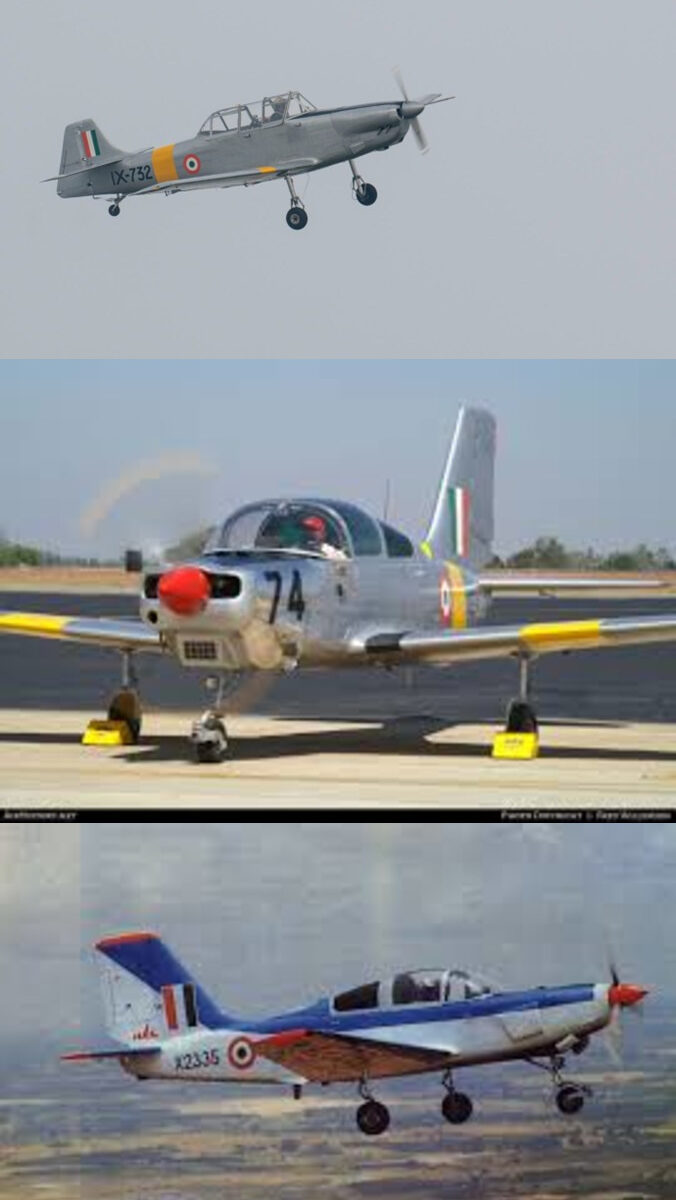
My Inputs on HT-2 Aircraft to Atul Chandra in an Interview.
Excerpts from the Article on the CAPSS (Center For Air Power and Strategic Studies) Website published by him.
A History of Partnership: The Indian Air Force and Growth of Indigenous Basic Trainer Production
Mr Atul Chandra
Research Scholar, Unni Kartha Chair of Excellence
Introduction
The Indian Air Force (IAF) has a proud legacy of undertaking basic flight training in South India. IAF air bases and training establishments located in the region, have made it the ‘cradle’ of military flight training in India. Since Independence, the IAF’s requirements for basic trainer aircraft have also aided in the growth of aeronautical manufacturing in Southern India. Since 1948, a total of three indigenous basic trainer aircraft, the HT-2, HPT-32 and more recently, the HTT-40 have been developed and manufactured in India. While the latter two basic trainers were vitally important in the growth of India’s nascent domestic aeronautical design and development capability, the completion of design and development of the HTT-40 signals the maturity of the nation’s domestic aerospace and defence ecosystem, which is today producing fighter aircraft, trainer aircraft, utility and attack helicopters. The deliveries of the HTT-40 to the IAF are now slated to begin in Q1 2026.
As we strive towards the goal of ‘Atmanirbhar Bharat’ and self-sufficiency in defence production, it is important to note that the IAF, from 1948 till now, continues to drive the growth of India’s aeronautical industry and will continue to do so.
Piston Pioneer
Following in the footsteps of the HT-2, in 1975 HAL began preliminary work on the development of a new basic trainer for the IAF. The Government sanctioned the design and development of a new basic trainer aircraft in 1976 at a cost of INR 5.53 crores. The requirement was for a total of 161 trainer aircraft and work was proceeding in earnest by 1977.
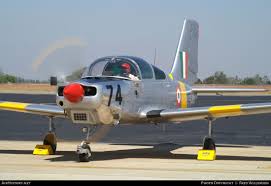
The design of the Hindustan Piston Trainer 32 (HPT-32). proceeded swiftly, with the first 1st HPT-32 prototype (X 2157) making its maiden flight in Bangalore on 6th January 1977, piloted by Wg Cdr Inder Chopra, HAL’s Chief Test Pilot (CTP). The second HPT-32 prototype made its maiden flight in March 1979, incorporating several modifications. The third and last prototype made its maiden flight on 31st July 1981 and was representative of the final production version and significantly lighter than the first two prototypes.
The HPT-32 is a cantilever, low-wing monoplane and of all-metal construction. Unlike the HT-2, the HPT-32 was a nose wheel aircraft with side-by-side seating for two persons under a rearward sliding jettisonable framed canopy. The HPT-32 also had the provision for a seat behind the instructor and trainee, along with space for some luggage. This was due to the fact that HAL had also planned to offer the aircraft to undertake liaison roles. The aircraft had a non-retractable tricycle type landing gear. The aircraft was powered by a Textron Lycoming AEIO-540-D4B5 flat-six 260 hp engine, driving a Hartzell two-blade constant-speed metal propeller. Fatigue life was quoted as 6.500 hours.
The IAF went on to place an initial production order for the new basic trainer in 1981, ordering 40 aircraft with an additional requirement for 100-150. At the time, the cost of each aircraft was estimated at INR 19.25 lakh.
The HPT-32 was inducted into the Indian Air Force in March 1984. The trainer aircraft was used for Stage 1 flight training providing pupils with 65AIAF hours of flying.
HAL completed the delivery of 40 HPT-32s by March 1987. Just as it was with the HT-2, the Navy also acquired the HPT-32, ordering nine aircraft. INAS 550-B Flt at Kochi which was equipped with Islander aircraft in 1976, went on to induct the HPT-32 in January 1986. The squadron completed basic flying training on the HPT-32 in October 1987, for the first batch of six naval pilots. However, training on the HPT-32 was discontinued soon after, and the squadron ceased further basic flying training on the type.
The IAF placed three additional orders for the HPT-32 in August 1988, January 1990 and March 1992 for 40, 30 and 24 additional aircraft respectively. In total, the IAF placed orders for 134 HPT-32s.
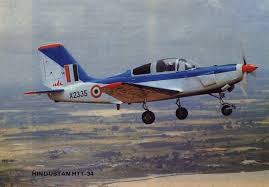
A turboprop version of the HPT-32, called as the HTT-34 took to the air for the first time on 17th June 1984 piloted by Wg Cdr Ashok and another pilot. “The aim was to enhance its performance, while also overcoming the nagging supply problems of high-octane fuel. A turboprop engine uses turbine fuel (refined kerosene). “The more powerful engine on the HTT-34 gave the aircraft excellent performance,” Wg Cdr P Ashoka (retd)” said in his autobiography. HTT-34 prototype was in fact the HPT-32 third prototype which was modified.
However, despite the HTT-34s improved performance, HAL never received any orders for it.
The HTT-34 was also demonstrated as a trainer aircraft at the Farnborough (UK) and Paris Airshows in 1984 and 1985 respectively. “Later we (HAL) took it to Nigeria and Ghana in Africa on a marketing mission. Our aerobatic displays were greatly appreciated and some of the foreign pilots who flew the aircraft, were also duly impressed. Unfortunately, this did not result in any sales, probably for financial reasons,” Wg Cdr Ashoka added.
Troubled Trainer
The HPT-32 took over the basic training role (Phase I) in the IAF in entirety from 1988 onwards, following the retirement of the HT-2. According to a CAG report released in 2019, the HPT-32 aircraft was besieged with difficulties related to reliability and safety including engine failure, poor glide characteristics and absence of an ejection seat.
Due to a large number of accidents, the entire HPT-32 fleet was grounded in July 2009. This decision followed the crash of an HPT-32 on 28th July 2009 due to engine failure.
A High-Power Study Team (HPST) was constituted by Air HQ and HAL’s Transport Aircraft Division in Jul 2009 to undertake an in-depth analysis of maintainability and reliability of HPT-32 aircraft and its engine. The HPST was tasked to undertake technical investigation to find out the cause of engine failures and suggest remedial measures
However, in August 2009, the IAF decided to discontinue flying of the HPT-32 fleet till the finalization of HPST report. The HPST report released in December 2009 stated that the HPT-32 aircraft was designed and developed in the early 1980s and did not meet present day standards (at the time). The technical investigation carried out by HAL was inconclusive in its findings.
As per a CAG report released in 2013, it observed that engine cut-off issues had resulted in 189 incidents/accidents on HPT-32 aircraft. Originally slated for retirement in 2014, the HPT-32 fleet was grounded in 2009 and resulted in HAL’s HJT-16 Kiran Intermediate Jet Trainer (IJT) being used for Stage I training from 2010 to 2013. In June 2012, the IAF opted not to return its HPT-32 fleet back into service, which at the time numbered approximately 116 aircraft.
In total when combining the HT-2 and HPT-32, 300 trainers were produced by HAL. The HPT-32 remained in service only for 25 years as compared to the HT-2, which remained in service for 34 years. Despite the trials and tribulations with the development of indigenous basic trainers, it would not be out of place, to say that the HT-2 and HPT-32 set the stage for the development of a new, modern and state-of-the-art basic trainer for the future.
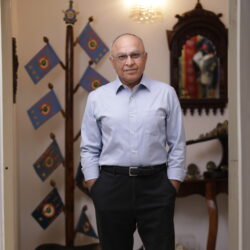
Air Marshal Anil Khosla retired from the Indian Air Force as Vice Chief of the Air Staff. He was commissioned into the Indian Air Force in December 1979.
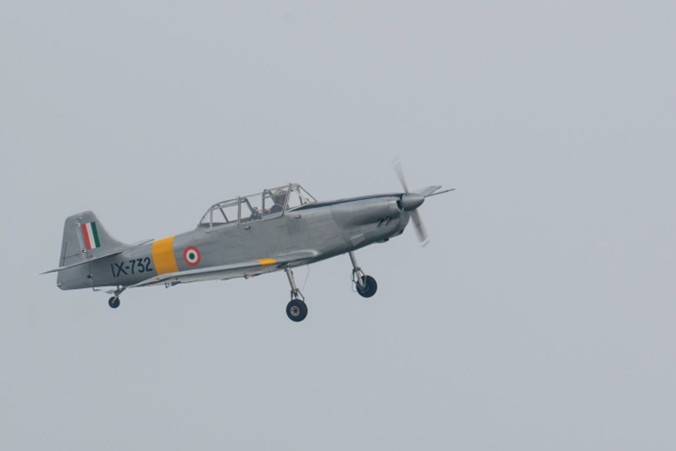
My very first impression of the HT-2 as a cadet was that it looked simple and almost modest, yet purposeful. As a young flight cadet in the Indian Air Force during the 1970s, my first encounter with the HT-2 was both exhilarating and a bit intimidating. The aircraft was a sleek, all-metal design with tandem seating and it was simple yet robust. The controls were responsive, but it demanded precision right from the start; a sloppy approach could lead to a bumpy landing on those narrow landing gear.
In total I flew a total of 215 hours on the HT-2. This included 40 hours of ab-initio training, 65 hours during the Flying Instructors’ Course, and 110 hours during instructing at Flying Instructors School (FIS) Tambaram. At FIS Tambaram I instructed on the HT-2 teaching young IAF pilots how to become instructors.
My abiding memories are vivid and multifaceted. I remember the distinctive sound of the engine starting up. I Remember the smell of gasoline during stall turns. One unforgettable sortie for me, was my second solo flight, during which, after take-off, I had an engine failure and had to force-land the aircraft.
The HT-2 was considered challenging to fly, however, it had many attributes that made it such a long-serving basic trainer in the Air Force. The HT-2 earned its reputation as challenging aircraft to fly as it tended to swing on the ground on landing. It required total concentration and focus to prevent over-controlling, especially in crosswinds. It was known to be somewhat unforgiving if mishandled, especially in the stall/spin regime.
Yet, these very challenges made it an excellent trainer for basic flying skills. It remained in service for over three decades (from the 1950s until the late 1980s), with over 120 aircraft produced.
Its attributes included: –
-
- Ruggedness.
- Easy to maintain (indigenously available spare parts).
- Excellent visibility from the front (in the air).
- Low operating Cost.
- Indigenous production with no dependency on foreign OEM.
The aspects of the HT-2 that I liked and disliked were many.
Likes:
- Handling and Stability—perfect for building confidence.
- The response to controls was direct, making it great for learning flying.
- The bubble canopy and raised instructor’s seat provided panoramic view.
- The engine was smooth and powerful enough for basic trainer.
- Execution of aerobatic manoeuvres gave a lot of satisfaction and a boost to the confidence.
Dislikes:
- The narrow-track undercarriage made landings tricky as it was prone to swinging on the ground.
- The seats weren’t the most ergonomic for extended sessions, causing back aches during prolonged flying.
- The seat was fixed without height or position adjustment.
- The parachute strapped to the pilot was not very comfortable or easy to bail out.
Disclaimer: The views and opinions expressed in this article are those of the author and do not necessarily reflect the position of the, Centre for Aerospace Power and Strategic Studies [CAPSS]
This work is licensed under Creative Commons Attribution – Non-Commercial – No Derivatives 4.0 International License.
Centre for Aerospace Power and Strategic Studies | @CAPSS_India |Centre for Aerospace Power and Strategic Studies |
Notes:
1 Global Security Org, “content” https://www.globalsecurity.org/military/world/india/hpt-32.htm accessed on August 25, 2025
2 Vijay Seth, The Flying Machines of the Indian Air Force 1933 – 1999 (New Delhi: Seth Communications, 2000), p. 41,
3 Indian Navy NIC, “content” https://indiannavy.gov.in/content/dorniers-2
4 Wg Cdr P Ashoka, Riding the Wind (New Delhi: Viji Books, 2011), p. 140.
5 Vayu Aerospace Review 1984
6 ibid
7 Performance Audit Report of the Comptroller and Auditor General of India on Capital Acquisition in Indian Air Force, Report No. 3 of 2019
8 Performance Audit Report of the Comptroller and Auditor General of India on Capital Acquisition in Indian Air Force, Report No. 3 of 2019
9 PIB.GOV.IN, “content”, https://www.pib.gov.in/newsite/PrintRelease.aspx?relid=75579®=3&lang=2 accessed on Oct 1, 2025.
10 Audit Report of the Comptroller and Auditor General of India on Capital Acquisition in Indian Air Force, Audit Report No. 34 of 2014
11 Performance Audit Report of the Comptroller and Auditor General of India on Capital Acquisition in Indian Air Force, 2017