
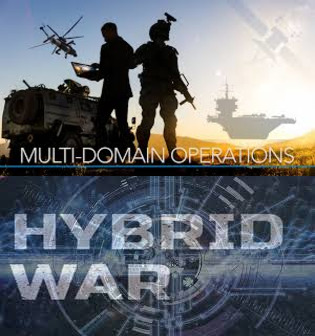
Victory belongs to the side that converges fastest and most effectively.
- Hybrid threats are the new normal: No clear distinction between peace and war—conflict today spans land, sea, air, cyber, space, and the cognitive/information domain.
- Recent global and regional conflicts show that economic pressure, cyberattacks, disinformation, and proxy actors can be as decisive as kinetic force.
- For India, the challenge is amplified by:
- Long borders, contested domains, and grey-zone competition
- Rapid digitisation and dependence on networks
- Aatmanirbharta is not just about weapons—it’s about resilience across domains.
Multi-Domain Hybrid Threats
These threats exploit gaps between institutions, systems, and policies—not just military weaknesses.
- Uniqueness of Multi-Domain Hybrid Threats:
- Simultaneous use of military and non-military tools
- Ambiguity in attribution and intent
- Designed to stay below traditional thresholds of war
- Domains involved:
- Physical: land, maritime, air & space
- Virtual: cyber
- Cognitive: information warfare, perception management, narrative control
The Core Challenge: Lack of Convergence
Without convergence, even advanced systems remain reactive instead of proactive.
- India has capabilities, but more often in silos:
- Services more often operate in parallel
- Civil-military-industry-academia linkages remain fragmented
- Compatibility Issues: Using disparate foreign systems makes it difficult to “talk” to one another (interoperability).
- Dependency Risks: Dependence on foreign Original Equipment Manufacturers (OEMs) for software updates or critical components creates a “kill switch” risk during a hybrid conflict.
- Hybrid threats demand:
- Speed of response
- Shared situational awareness
- Joint decision-making
Achieving Convergence
Convergence is not only jointness, but also the deliberate orchestration and synchronisation of capabilities across domains to create effects greater than the sum of parts, imposing multiple simultaneous dilemmas on the adversary.
- Without convergence, the responses are fragmented, allowing the adversary to exploit seams between domains.
- Convergence creates windows of advantage, collapses adversary decision cycles, and maintains superiority even against numerically/ technologically superior foes.
It is integration across four layers.
Strategic & Institutional Convergence
- Whole-of-government and whole-of-nation approach
- Seamless coordination between:
- Armed Forces
- Intelligence agencies
- Ministries, regulators, and strategic industries.
- Indigenous ecosystems must align with national security priorities, not just commercial success.
Operational Convergence
- True multi-domain operations:
- Real-time data sharing across services and agencies
- Common operational picture integrating sensors, platforms, and cyber inputs
- Indigenous command-and-control, ISR, and decision-support systems are critical.
Technological Convergence
- Indigenous development must focus on systems-of-systems, not standalone platforms.
- Priority areas:
- AI-enabled analytics
- Cyber-secure networks
- Space-based surveillance and communications
- Avoiding vendor lock-in and foreign black boxes is a strategic imperative.
Cognitive & Information Convergence
- Hybrid warfare targets public perception, morale, and trust.
- Defence preparedness today includes cognitive security.
- Indigenous capabilities in:
- Information monitoring
- Narrative analysis
- Strategic communication
Role of Indigenous Defence Ecosystems
Indigenous ecosystem: It enables trusted integration across domains (critical for convergence).
- Aatmanirbharta is not a luxury; it is a strategic necessity. It ensures:
- Sovereign control over design, development, upgradation, and maintenance.
- Rapid customisation to the Indian threat environment.
- Uninterrupted supply in contested scenarios.
- Assured availability during crises
- Faster upgrades and adaptation
- Security of data and algorithms
- Indigenous ecosystems should be:
- Collaborative, not service-specific
- Dual-use, leveraging civil innovation (startups, academia, MSMEs)
- Initiatives like iDEX and Make in India must evolve toward mission-oriented innovation, not isolated products.
Building an Integrated Response: The Way Forward
- Move from platform-centric thinking to capability-centric planning
- Encourage:
- Joint problem statements from the Armed Forces
- Early user involvement in indigenous R&D
- Invest in:
- Talent pipelines in cyber, AI, space, and EW
- Indigenous C4ISR backbone: C4I2SR (Command, Control, Communications, Computers, Intelligence, Information, Surveillance, and Reconnaissance).
- Data Fusion: Using AI/ML to process massive data from satellites, drones, and social media into actionable insights.
- Cyber-Physical Security: Protecting critical infrastructure (grids, ports) alongside military hardware.
- Electronic Warfare (EW): Developing indigenous jammers and decoy systems to blind adversary sensors. Indigenous testbeds and simulation environments
- Space & counter-space capabilities: Indigenous satellites, ASAT, space domain awareness.
- Cognitive/information domain mastery: Indigenous tools to counter disinformation, build narrative resilience.
- Unmanned & autonomous systems: Swarm drones, UUVs, loitering munitions — all indigenously designed for multi-domain synergy.
- Cultivate the Ecosystem
- Plug-and-Play Architecture: Encourage the development of “Open Standards” so a startup’s AI algorithm can easily integrate with a major defence platform.
- Civil-Military Fusion: Leverage India’s private sector IT prowess to build defensive cyber-moats.
- Testing and Iteration: Create “Sandboxes” where indigenous tech can be tested against simulated hybrid threats in real-time.
- Prioritise indigenous tech in acquisition.
- Invest heavily in R&D ecosystems: Deep tech fund, long-term loans, tax incentives for startups.
- Build resilience & redundancy: Multiple indigenous sources for critical components.
- Foster international partnerships: Only where they complement (not substitute) indigenous capability.
- Measure success not by import substitution alone, but by operational effectiveness in contested, multi-domain scenarios.
Closing Thought
- Hybrid threats are designed to exploit disunity and delay.
- Convergence is the force multiplier, and Aatmanirbharta is the necessary enabler.
- Building indigenous defence capability is ultimately about: Ensuring India can think, decide, and act independently across all domains—at the speed of modern conflict.
Please Add Value to the write-up with your views on the subject.
For regular updates, please register your email here:-
References and credits
To all the online sites and channels.
Pics Courtesy: Internet
Disclaimer:
Information and data included in the blog are for educational & non-commercial purposes only and have been carefully adapted, excerpted, or edited from reliable and accurate sources. All copyrighted material belongs to respective owners and is provided only for wider dissemination.