
Article published in the CLAWS Yearbook 2025.
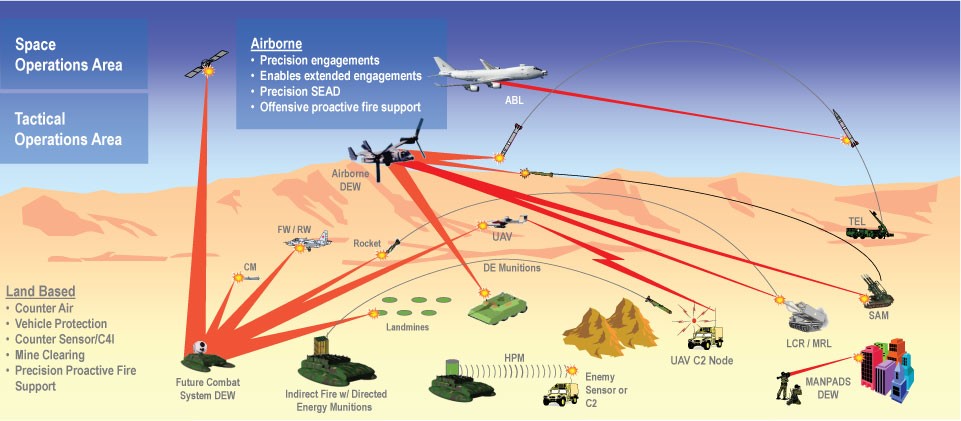
Directed Energy Weapons (DEWs), including high-energy lasers (HELs), high-power microwaves (HPMs), and particle beams, represent a transformative leap in military technology. Offering precision, speed, and cost-effectiveness compared to kinetic systems, DEWs engage targets at the speed of light with minimal collateral damage. As global militaries face evolving threats like drone swarms and hypersonic missiles, the strategic importance of integrating DEWs into naval, ground, air, and space platforms cannot be overstated. This article explores DEW integration’s technical, operational, strategic, and ethical dimensions, drawing on recent advancements and addressing challenges, global programs, and future implications.
Directed Energy Weapons: Technical Fundamentals. DEWs emit focused energy, such as lasers, microwaves, or particle beams, to damage or disable enemy equipment, personnel, or facilities. Unlike conventional weapons, DEWs require no projectiles and engage targets at the speed of light. High-energy lasers focus photons to deliver thermal energy to burn through materials or disable sensors. High-power microwaves disrupt electronic circuits and communications by inducing currents in circuits. Though less developed, particle beams accelerate charged particles to damage targets at the molecular level. These systems are valuable against fast, low-cost, or swarm threats like drones, rockets, and small boats.[i]
Strategic Imperatives: DEW Integration. The rise of asymmetric threats—drone swarms, hypersonic missiles, and low-cost unmanned systems—drives DEW adoption. Traditional kinetic interceptors are often too slow or costly to counter these threats effectively. DEWs provide a layered defence, complementing kinetic systems to enhance resilience and flexibility. For example, lasers can neutralise drones while missiles engage larger threats, optimising resource allocation. Additionally, DEWs enhance deterrence by offering rapid, precise responses, reducing logistical burdens in sustained conflicts.
Technical Challenges of Integration. Integrating DEWs into platforms designed for kinetic munitions presents significant hurdles. These challenges vary by platform but share common themes, addressed through innovations like solid-state lasers, modular power kits, and AI-driven targeting.
-
- Power and Thermal Management. The primary technical challenge is power generation. DEWs demand significant electrical energy, often in tens to hundreds of kilowatts for lasers and megawatts for microwaves, far beyond what existing vehicles or vessels were designed to provide. For instance, a 100 kW-class laser needs power and cooling infrastructure that challenges small air or ground platform integration.[ii] The platforms must have upgraded power generation systems, thermal management modules, hybrid power units or capacitor-based energy storage.
-
- Beam Control and Targeting. Precision targeting is crucial for DEWs to be effective. Beam control is another critical factor. DEWs must maintain precision across long distances, compensating for atmospheric distortion, vibration, and platform movement. Atmospheric disturbances (for lasers) or electromagnetic interference (for HPMs) can degrade performance. Beam control systems must adapt dynamically, especially on mobile platforms or in contested electromagnetic environments.[iii] Advanced fire control radars, electro-optical/infrared sensors, and machine learning-based tracking algorithms are being developed to enhance the targeting and engagement cycles.
-
- Size, Weight and Vibration Constraints. Airborne platforms present special problems due to vibration and limited space. Aircraft like fighter jets or UAVs must host compact DEW systems that can function reliably under dynamic conditions.
Platform Integration.
Integration into Naval Platforms. Naval vessels, such as destroyers and aircraft carriers, are prime candidates for DEW integration due to their robust power generation and deck space. Lasers enhance defence against anti-ship missiles, small boats, and drones, offering near-infinite shots compared to finite missile magazines. The U.S. Navy’s High Energy Laser with Integrated Optical-Dazzler and Surveillance (HELIOS, 60 kW) on destroyers exemplifies this, countering aerial and surface threats. India is exploring laser systems for warships to secure the Indian Ocean trade corridor. Challenges include retrofitting electrical grids, managing heat dissipation, and ensuring compact designs for smaller vessels.
Integration into Ground Platforms. On land, DEWs counter drones and loitering munitions, critical in asymmetric warfare seen in conflicts like Ukraine. The U.S. Army’s Directed Energy-Manoeuvre Short-Range Air Defence (DE-MSHORAD) mounts 50 kW lasers on Stryker vehicles, while India’s Mk-II(A) 30 kW laser, tested in April 2025, neutralised drone swarms at 5 km. Integration requires compatibility with networked systems, ruggedised optics for dust or extreme temperatures, and modular power solutions to maintain mobility.
Integration into Air Platforms. Airborne DEWs, designed for fighter jets or UAVs, counter incoming missiles at standoff distances. The U.S. Air Force’s Self-Protect High Energy Laser Demonstrator (SHiELD) equips jets with laser pods, while India envisions lasers on aircraft to counter regional missile threats. Challenges include limited onboard power (e.g., F-35’s 400 kW engine splits power across systems), heat dissipation without drag, and beam stability amid turbulence. With solar or hybrid power, UAVs may become ideal DEW platforms for long-endurance missions.
Integration into Space Platforms. Space-based DEWs, still nascent, hold potential for missile defence and satellite protection. Lasers could disable enemy satellites or intercept ballistic missiles during the boost phase. The U.S. Space Force explores megawatt-class Space-Based Lasers (SBL) powered by solar arrays. India’s satellite-mounted laser concepts aim to safeguard space assets. Challenges include power generation in compact designs, radiative cooling in vacuums, and targeting across long ranges. Legal concerns under the Outer Space Treaty, which prohibits weapons of mass destruction, limit deployment, though non-lethal applications like sensor dazzling may be permitted.[iv]
Global DEW Projects
Numerous countries are researching and developing these weapons, each with unique projects and strategic goals.[v] DEW development is a global race, with key players advancing unique projects:
United States. The US is a leader in DEW development. Besides Leonidas, the Department of Defence (DOD) and agencies like DARPA, the Air Force Research Laboratory, and the Naval Research Laboratory are researching DEWs to counter ballistic missiles and hypersonic cruise missiles. The U.S. Navy has been a frontrunner in DEW integration. The Laser Weapon System (LaWS) was deployed on the USS Ponce in 2014.[vi] Subsequently, the U.S. Navy’s High Energy Laser with Integrated Optical Dazzler and Surveillance (HELIOS) system was tested on the USS Preble in 2022. Its integration into the Aegis Combat System demonstrates the feasibility of combining DEWs with existing sensor suites.[vii] The U.S. Army’s Directed Energy-Manoeuvre Short-Range Air Defence (DE-MSHORAD) program aims to mount 50-kilowatt lasers on Stryker vehicles, but integration requires overcoming power and weight limitations.[viii] The US Army is exploring modular power kits, which combine batteries and compact turbines, to meet DEW demands without sacrificing mobility. The U.S. Air Force’s Airborne High Energy Laser (AHEL) program seeks to equip platforms like the AC-130 gunship and F-35 fighter with lasers for precision strikes and missile defence. Tests in 2024 showed progress, with a 20-kilowatt laser successfully integrated onto a testbed aircraft.[ix] For special operations, lasers on AC-130s could provide silent, precise strikes, reducing reliance on munitions.[x]
China. China is making rapid strides in DEW development, focusing on high-energy lasers and microwave systems. State media and manufacturers have released images of handheld and vehicle-mounted laser systems, including the LW-30, a 30kW road-mobile high-energy laser (HEL). Their efforts extend to counter-space applications, with ground-based DEWs potentially targeting satellites. China’s military also solicits would-be suppliers for a new airborne laser weapon. Airborne laser pods are expected to be mounted on Chinese warplanes such as the Shenyang J-15 “Flying Shark” carrier-based fighter.
Russia. Russia has been developing DEWs for decades, with the Peresvet laser weapon system entering experimental combat duty in 2018 and claiming operational use during the 2022 invasion of Ukraine. A more advanced version, “Zadira,” can incinerate targets up to three miles away within five seconds. Russia is also working on EMP cannons and microwave guns for anti-drone applications.
Ukraine. [xi]Ukraine has unveiled a new laser weapon called “Tryzub” (Ukrainian for “trident”), which can shoot down aircraft over a mile away. During a defence conference, Colonel Vadym Sukharevskyi, Ukraine’s Unmanned Systems Forces commander, announced the weapon’s capabilities.
United Kingdom. The UK’s Ministry of Defence (MOD) is investing heavily in DEWs, with projects like DragonFire, a laser-directed energy weapon (LDEW) that achieved its first high-power firing against aerial targets in January 2024 at the Hebrides Range. DragonFire is expected to be deployable by 2027. Additionally, the Radio Frequency Directed Energy Weapon (RFDEW) is nearing service by 2026, focusing on countering unmanned systems.
France and Germany. France and Germany are key players in European DEW development, often through multinational collaborations. France is involved in projects like the TALOS-TWO, involving 21 partners across eight EU nations. Germany is focusing on integrating DEWs into defence platforms. These efforts aim for operational deployment by 2030, emphasising cost-effective counter-drone and missile defence systems.
Israel. Israel is advancing the Iron Beam laser-based DEW, designed to complement its Iron Dome system. A contract signed in October 2024 for operational service within a year reflects its cost-effectiveness. The US has allocated $1.2 billion for Iron Beam procurement.
Iran and Turkey. Iran and Turkey claim DEWs in active service, adding controversy to global assessments. Iran has announced developments in laser air defence systems, while Turkey claims the ALKA DEW was used in combat in Libya in 2019. However, specifics and verification are scarce, with claims often met with scepticism due to limited transparency.
South Korea, Japan, and Australia. South Korea and Japan possess advanced technological capabilities, with South Korea developing laser-based systems for counter-drone applications, though not as prominently as major powers. Japan emphasises nuclear and space technologies, featuring limited public DEW projects. Australia is also investing in DEW technology, particularly for countering drones, which was highlighted by a £13 million deal with QinetiQ for a prototype defensive laser.
India’s DEW Programs.
India’s Defence Research and Development Organisation (DRDO) is actively pursuing DEWs, with projects like the Directionally Unrestricted Ray-Gun Array (DURGA II), a 100-kilowatt lightweight DEW set for integration with land, sea, and air platforms. Other initiatives include the KALI (Kilo Ampere Linear Injector), a particle accelerator and a 1 kW laser weapon for counter-IED operations, with plans for 25 kW and 100 kW systems.
DURGA Program. [xii]The DURGA initiative, spearheaded by the Defence Research and Development Organisation (DRDO), is dedicated to creating laser-based directed energy weapons (DEWs) to bolster India’s multi-tiered defence framework. This program focuses on developing laser systems to intercept and neutralise enemy missiles at various flight phases, enhancing India’s Ballistic Missile Defence (BMD) capabilities. Additionally, it aims to counter unmanned aerial systems (UAS) by deploying tactical laser weapons to disable drones threatening critical infrastructure and military assets. These weapons are designed for integration across land, air, and sea platforms, providing operational versatility in diverse environments. Public reports indicate that prototype laser-based DEWs under the DURGA program are currently being tested, with power levels ranging from 10 to 100 kilowatts, suitable for tactical and strategic purposes.
KALI Program. [xiii]Initially launched by the Bhabha Atomic Research Centre (BARC) with DRDO support, the KALI program began as a research effort into high-energy particle acceleration but has since evolved into a defence project focused on electronic warfare and non-lethal weaponry. The KALI system produces powerful electromagnetic pulses (EMPs) to disable enemy electronic systems, including radar, communication, and missile guidance systems. It also explores particle beam technology to neutralise targets without explosives, with potential applications such as disabling enemy satellites. The system’s scalability allows it to be used in both tactical operations and strategic deterrence, enabling non-lethal incapacitation of enemy equipment while preserving physical structures.
On April 13, 2025, [xiv] India successfully tested its first high-energy laser weapon, the Mk-II(A) Laser-Directed Energy Weapon (DEW), at the National Open Air Range in Kurnool, Andhra Pradesh. Developed by DRDO, this 30-kilowatt laser system demonstrated precise neutralisation of fixed-wing aircraft, drone swarms, and surveillance sensors at ranges up to 5 kilometers. Operating at the speed of light, the laser causes structural damage or destroys warheads, offering a cost-effective alternative to conventional munitions with minimal collateral impact. This achievement positions India alongside nations like the US, China, and Russia in advanced laser weaponry. DRDO aims to deploy the land-based system within two years, with plans for enhanced versions offering greater range and integration on ships, aircraft, and satellites. A 300-kilowatt “Surya” laser, capable of targeting high-speed missiles and drones up to 20 kilometers away, is also in development.
Strategic Operational and Doctrinal Implications
Integrating DEWs is a technical and doctrinal challenge that will reshape operational doctrines and force structures. Military planners must consider new rules of engagement, escalation risks, and interoperability with allied forces. Doctrinally, militaries are evolving from a kinetic-dominant mindset to one in which DEWs play complementary and sometimes primary roles, especially in contested and electronically dense environments.
Their low cost per shot and scalability enable sustained engagements, reducing logistical burdens. DEWs also enhance deterrence by providing rapid, precise responses to emerging threats like hypersonic missiles. However, DEWs introduce strategic risks. Adversaries may develop countermeasures, such as reflective coatings or electronic hardening, reducing their effectiveness. Proliferation of DEW technology could also destabilise conflicts, as non-state actors gain access to low-cost, high-impact weapons.[xv]
Operationally, DEWs require new training and tactics. Operators must understand beam propagation, power management, energy thresholds, atmospheric effects, engagement timelines and protocols, which differ from kinetic systems.
Moreover, AI and autonomous systems are increasingly paired with DEWs to handle target acquisition and prioritisation in real-time, particularly in drone swarm scenarios. Cybersecurity is also critical, as DEWs rely on networked sensors and software, making them vulnerable to hacking or electronic warfare.[xvi]
DEWs, especially dazzlers and HPMs, exist in a grey area of international law. The Protocol on Blinding Laser Weapons (Protocol IV) of the UN’s Convention on Certain Conventional Weapons (CCW) prohibits lasers specifically designed to cause permanent blindness.[xvii] However, systems designed for sensor blinding or equipment disablement are permitted.
Future of DEW-Enabled Battlefield
Future advancements will focus on scaling power output, improving efficiency, and reducing size. Solid-state lasers, which are more compact than chemical lasers, are driving this trend. Research into hybrid DEW-kinetic systems, where lasers complement missiles, could bridge capability gaps. Artificial intelligence will also play a role in optimising beam control and target prioritisation in complex environments. Looking ahead, several trends will define the future of DEW integration:
-
- Hybrid Platforms. Future platforms will likely feature integrated DEW and kinetic options, with AI-driven decision-support systems guiding engagement choices.
-
- Miniaturisation and Modularity. Advances in solid-state lasers, cooling, and power systems will allow smaller, modular DEW units suitable for a broader array of platforms.
-
- Network-Centric Operations. DEWs will be part of larger sensor-to-shooter networks, leveraging battlefield data to optimise energy weapon use in multi-domain operations.
-
- Export and Proliferation Risks. As DEW technologies become more widely available, concerns about proliferation and their use by non-state actors or rogue states will increase, requiring robust export control and countermeasure policies.
Conclusion
Directed Energy Weapons mark a paradigm shift in warfare, offering precision, cost-effectiveness, and scalability. Their integration on military platforms (naval, ground, air, and space) poses unique challenges. India should focus on incorporating Directed Energy Weapons (DEWs) into its military systems to strengthen its defence capabilities. This involves expediting the deployment of DURGA II (100 kW) across naval, air, and ground platforms, enhancing power and cooling systems on warships and aircraft such as the Tejas, developing AI-based targeting for accuracy in challenging environments, and integrating DEWs with existing integrated air defence systems. Partnering with allies on solid-state laser technology will ensure operational effectiveness.
Please Add Value to the write-up with your views on the subject.
For regular updates, please register your email here:-
References and credits
To all the online sites and channels.
Pics Courtesy: Internet
Disclaimer:
Information and data included in the blog are for educational & non-commercial purposes only and have been carefully adapted, excerpted, or edited from reliable and accurate sources. All copyrighted material belongs to respective owners and is provided only for wider dissemination.
References:-
[i] J. R. Wilson, “Directed-Energy Weapons: Technologies, Applications and Implications,” Military & Aerospace Electronics, August 2021.
[ii] John Keller, “Power and Cooling Are Key Challenges in Directed-Energy Weapons,” Military & Aerospace Electronics, March 2023, 14-18.
[iii] Philip Ewing, “The Pentagon’s New Laser Weapon Blinds and Burns,” NPR, July 3, 2020.
[iv] Joan Johnson-Freese, Space Warfare in the 21st Century: Arming the Heavens (London: Routledge, 2016), 112-115.
[v] Khosla Anil, “LEONIDAS BY EPIRUS_ STAR TREK STYLE SHIELD OF DIRECTED ENERGY WEAPON”, The EurasianTimes, 29 Mar 25.
[vi] Sam LaGrone, “Navy Deploys Laser Weapon Prototype USS Ponce,” USNI News, December 10, 2014.
[vii] U.S. Navy, “HELIOS System Successfully Tested on USS Preble,” Naval News, August 2022, https://www.navalnews.com/naval-news/2022/08/helios-system-successfully-tested-on-uss-preble/.
[viii] Jen Judson, “Army’s DE-MSHORAD Prototype Zaps Drones in Latest Test,” Defense News, October 2023, https://www.defensenews.com/land/2023/10/05/armys-de-mshorad-prototype-zaps-drones-in-latest-test/.
[ix] Valerie Insinna, “Air Force Tests Airborne Laser on Testbed Aircraft,” Air Force Magazine, February 2024, https://www.airforcemag.com/air-force-tests-airborne-laser-testbed-aircraft/.
[x] Brian W. Everstine, “Lasers on AC-130s Could Redefine Special Operations,” Aviation Week, March 2023, 34-36.
[xi] Khosla Anil. “UKRAINE UNVEILS TRYZUB_ A GAME-CHANGING DIRECTED ENERGY WEAPON”, Air Marshal’s Perspective, 17 Feb 25.
[xii] Khosla Anil, “Edit Post “DURGA AND KALI_ INDIA’S DIRECTED ENERGY WEAPONS PROGRAM”, Air Marshal’s Perspective, 29 Apr 25.
[xiii] Ibid
[xiv] Khosla Anil, “INDIA ENTERS THE LASER AGE_ MK-II(A) DEW USHERS IN A NEW ERA OF DEFENCE TECHNOLOGY”, Air Marshal’s Perspective, 16 Apr 25.
[xv] Paul Scharre, Army of None: Autonomous Weapons and the Future of War (New York: W.W. Norton, 2018), 201-205.
[xvi] Freedberg, “Lasers, Microwaves, and Particle Beams.”
[xvii] United Nations, “Protocol IV on Blinding Laser Weapons,” Convention on Certain Conventional Weapons, 1995.