My article was published on the Indus International Research Foundation website on 30 Jun 25.
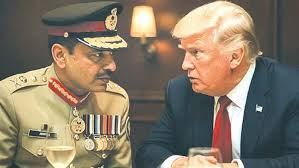
On June 18, 2025, U.S. President Donald Trump hosted a rare and controversial meeting with Pakistan’s Chief of Army Staff, General Asim Munir, at the White House. The two-hour lunch, which took place without any representatives from Pakistan’s civilian leadership, triggered widespread geopolitical debate. The phrase “you scratch my back, I scratch yours” has surfaced in online discourse. While the meeting was presented as a gesture of gratitude for Pakistan’s role in de-escalating recent India-Pakistan tensions, the circumstances, tone, and implications of the event go far beyond mere diplomacy. Potential fallout of this bizarre engagement could signal a reconfiguration of regional alliances and a confirmation of Trump’s transactional diplomacy.
Analytical Perspective
Context: Post-War De-escalation and Unorthodox Diplomacy. The Trump–Munir meeting comes just weeks after a volatile conflict between India and Pakistan that erupted in early May 2025. For several tense days, both nations exchanged missile and drone attacks, raising fears of a full-scale war between two nuclear-armed neighbours. In the June 18 lunch, Trump publicly credited General Munir for helping to prevent a full-blown war between India and Pakistan. This approach reflects Trump’s foreign policy style, which prioritises deal-making, personal connections, and pragmatic alliances over institutional norms or long-term strategic planning.
Unprecedented Format. This was not an ordinary diplomatic meeting. For the first time, a U.S. president hosted a foreign military leader at the White House without including any civilian government officials from that country. Pakistani Prime Minister Shehbaz Sharif and Foreign Minister Ishaq Dar were conspicuously absent. Their exclusion drew immediate criticism from both within Pakistan and abroad, highlighting the enduring imbalance between Pakistan’s military and civilian institutions. By engaging directly with Munir, Trump sent a clear message that he considers the Pakistani military, and not its elected leadership, as the country’s true center of power. This is not a new perception, but such overt validation from a major global power (that champions and supports democratic values worldwide) is rare and diplomatically risky.
Pakistan: Military Strengthened, Civilian Leadership Marginalised. In Pakistan, the reaction was mixed. Supporters of the military celebrated the meeting as a diplomatic win and a sign that General Munir is elevating Pakistan’s global profile. However, many others viewed the event as a glaring example of the country’s persistent “military-first” governance model. Political commentators and opposition figures criticised Prime Minister Shehbaz Sharif for being sidelined and described the episode as humiliating. Some accused the military of bypassing civilian institutions in foreign policy and seeking direct international legitimacy. The episode has further strained civil-military relations within Pakistan, with fears that the military is consolidating even more power at the expense of democratic norms and constitutional roles.
Undermining Civilian Institutions. The overt exclusion of Pakistan’s civilian leadership from a meeting of this magnitude may set a dangerous precedent. It sends a signal, not just to Islamabad but to other nations, that direct engagement with military leaders is not only acceptable but perhaps preferable. This undermines the principle of democratic civilian oversight and can weaken global efforts to promote governance reforms in countries with fragile democratic institutions.
U.S.–Pakistan Rapprochement. Just months ago, U.S.–Pakistan relations were marked by scepticism, primarily due to lingering mistrust over Islamabad’s historical links to extremist groups, as well as its close ties to China. However, this meeting suggests a dramatic shift. Trump praised Pakistan’s intelligence services for capturing the perpetrator of the 2021 Kabul airport bombing, a symbolic gesture indicating renewed U.S. trust in Pakistan’s counterterrorism efforts. Pakistan’s military, in its official statement, highlighted that the conversation also covered trade, economic cooperation, cryptocurrencies, artificial intelligence, energy resources, and rare-earth minerals. These are key sectors for a future-oriented partnership, suggesting that both parties are looking beyond traditional military and security cooperation.
The Iran Angle. An equally important but more understated aspect of the meeting was its potential connection to rising tensions in the Middle East, specifically between Israel and Iran. Trump reportedly remarked that “Pakistan knows Iran very well,” and indicated that Islamabad could play a key role in future diplomatic or covert operations involving Tehran. This is particularly significant as the U.S. appears to be exploring regional support for managing, or possibly confronting, Iran. Given Pakistan’s geographic proximity, historical ties to Iran, and deep intelligence networks, it is plausible that Washington sees Islamabad as a useful intermediary or asset in this context. For Trump, such a partnership would align with his transactional style: if Pakistan helps the U.S. manage Iran, the U.S. could reciprocate by offering economic or political rewards to Pakistan.
Strategic Implications
Transactional Realignment, Not Strategic Partnership. While the meeting suggests a thaw in U.S.–Pakistan ties, the underlying dynamic appears transactional rather than strategic. Trump is known for valuing short-term gains and personal relationships over long-term institutional alliances. In this case, the “mutual back-scratching” attitude reflects a deal-based mindset: Pakistan helps with Iran’s intelligence sharing, and the U.S. acknowledges its role and discusses potential economic partnerships. Such diplomacy can deliver quick results, but it often lacks the staying power that is based on democratic values or mutual trust.
Potential Iran Confrontation Strategy. By engaging Pakistan now, the U.S. could be preparing for a broader containment strategy against Iran. If tensions between Israel and Iran re-escalate into direct conflict, the U.S. may look to regional partners for logistical support, intelligence sharing, or diplomatic mediation. Pakistan, with its strategic location and regional experience, becomes a valuable partner in this context. However, such an alignment carries risks. Iran and Pakistan share a border, and any overt Pakistani support for U.S. actions against Iran could destabilise Baluchistan and strain Islamabad’s internal security.
India: Strategic Alarm. In India, the Trump–Munir lunch was met with alarm and criticism. Defence Secretary Rajesh Kumar Singh labelled the event “an embarrassment” for Pakistan’s civilian government. Indian officials were quick to reject Trump’s claim of him helping avert war, insisting that the May ceasefire was a direct call from Pakistan, asking for a ceasefire with no U.S. involvement. Shashi Tharoor, senior Congress leader, reminded observers about Pakistan’s past harbouring of Osama bin Laden and cautioned the U.S. against viewing Pakistan as a trustworthy long-term partner. The general sentiment in Indian strategic circles is that the meeting signifies an unbalanced U.S. approach that undermines democratic institutions in the region and encourages military dominance in Pakistan.
Conclusion
The Trump–Munir meeting represents a symbolic moment in U.S.–Pakistan relations and South Asian geopolitics. It highlights Trump’s characteristic deal-making style, the enduring dominance of Pakistan’s military in foreign affairs, and the shifting focus of U.S. strategic interests toward rapid, transactional engagements. For the U.S., this may be a way to quickly regain influence in South Asia and prepare for broader conflicts in the West Asia. For Pakistan, it is a short-term diplomatic victory that risks further marginalising civilian institutions. For India, this is a cause for concern and a call to monitor the shifting U.S. priorities closely. The long-term consequences will depend on whether this meeting marks the beginning of a more profound realignment or is simply another small move in the ever-evolving saga of geopolitical chess.
Please Add Value to the write-up with your views on the subject.
Link to the article on the website:-
The Trump-Munir Meeting: Transactional Diplomacy Or A Geopolitical Quid Pro Quo?
For regular updates, please register your email here:-
References and credits
To all the online sites and channels.
Pics Courtesy: Internet
Disclaimer:
Information and data included in the blog are for educational & non-commercial purposes only and have been carefully adapted, excerpted, or edited from reliable and accurate sources. All copyrighted material belongs to respective owners and is provided only for wider dissemination.
References:-
- The Guardian. (2025, June 19). The thawing of relations between Pakistan and the US raises eyebrows in India.
- Times of India. (2025, June 19). ‘Must be an embarrassment’: Defence secretary’s jibe at Shehbaz Sharif over Trump–Munir lunch; warns of China-Turkey nexus.
- India Times. (2025, June 18). Donald Trump hosts General Asim Munir for a White House lunch, credits him with ending the India–Pakistan war; here’s what we know.
- Dawn News. (2025, June 18). The military confirms that General Munir meets with Donald Trump to discuss strategic cooperation and regional stability.
- Al Jazeera. (2025, June 19). US-Pakistan talks signal shifting alliances in South Asia amid tensions with Iran.
- Reuters. (2025, June 18). Trump thanks Pakistan Army chief for avoiding war with India, eyes trade ties. Retrieved from
- NDTV. (2025, June 20). India rejects US mediation claims, stating that the ceasefire was a bilateral agreement reached between the parties.
- BBC News. (2025, June 18). Trump meets General Munir: What it means for Pakistan’s democracy.
- “Trump Hosts Pakistan Army Chief Asim Munir at White House, Discusses India-Pakistan Tensions.” Hindustan Times, June 19, 2025.
- “Unorthodox White House Lunch: Trump and Munir Talk Trade and Peace.” The News International, June 19, 2025.
- “Trump’s Transactional Diplomacy: A Look at His Foreign Policy Style.” Foreign Affairs, January 202