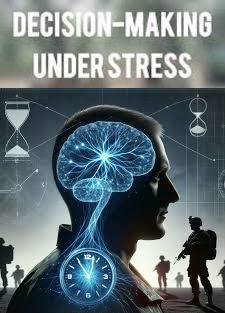
Had a very lively chat with Anmol. We talked about a variety of topics, ranging from personal life to life in the air force. The chat included aspects related to motivation, stress management, decision making, air power, deterrence, new domains of war, Info warfare and a whole lot of other issues. One of the best podcasts.
Link to the podcast:-
Comments, views and suggestions are most welcome.
For regular updates, please register your email here:-
Information and data included in the blog are for educational & non-commercial purposes only and have been carefully adapted, excerpted, or edited from reliable and accurate sources. All copyrighted material belongs to respective owners and is provided only for wider dissemination.
Military decision-making under stress is an intricate dance of cognitive, psychological, and environmental dynamics that determine consequences in high-stakes situations. Under the combat scenario, commanders, under intense pressure of time, obscured situation awareness, and cognitive overload, must make decisions in a matter of seconds that can make or break mission success or herald catastrophic failure. The challenges of being unique—spanning from the fog of war to sleep deprivation and environmental disarray—require adaptive approaches balancing speed, accuracy, and resilience. It is necessary to examine military decision-making under stress dynamics, scrutinising the psychological and technological aspects that impact performance. Explore frameworks such as the OODA Loop, Recognition-Primed Decision-Making, and decentralised command, and training practices including stress inoculation and scenario-based wargaming.
Frameworks for Effective Decision-Making
Military operations rely on tried templates to make decisions under stress easier:-
OODA Loop (Observe, Orient, Decide, Act). Colonel John Boyd developed the model based on rapid cycling through the processes of observation (information gathering), orientation (assessing the environment), decision, and action to surpass the foe.
Recognition-Primed Decision-Making (RPD). Good leaders draw on prior experience to recognise patterns and react automatically.
Decentralised Command. By giving authority to subordinates, units are able to stay flexible.
Military Decision-Making Challenges
Military operations create a crucible for decision-making, characterised by unique challenges that test human limits:-
Time Pressure. Combat decisions are usually made in seconds or minutes. For example, a commander of a unit will have to make a decision to engage an approaching force or not, without sufficient time for detailed examination. Under time pressure, this could lead to premature decisions, as had been the case in simulated combat manoeuvres where subjects under time pressure had lower adaptability.
High Stakes. Errors have catastrophic consequences, including death, mission failure, or tactical losses. The weight of such consequences magnifies stress, which feeds on itself in a self-reinforcing spiral in which concern further disables cognition. Research on combat stress suggests that it impairs memory, attention, and reasoning, which has a direct consequence on tactical decisions.
Ambiguity and Incomplete Information. Commanders rarely have the entire picture of the battlefield. Fog of war—ignorance regarding enemy positions, terrain, or intentions—mandates reliance on incomplete information. It is exacerbated in high-risk incidents, where systematic examinations reveal how uncertainty creates dynamic, evolving decisional environments.
Cognitive Load. Pressure overloads working memory, narrowing attention and causing tunnel vision, with people focusing on immediate threats at the expense of overall situational awareness. Psychological research indicates that under pressure, decision-makers are bound to experience decision conflict, which has negative consequences for agility and adaptability. In military commanders, it can happen in the form of indecision at critical moments.
Environmental Turmoil. Disastrous weather, noise, fatigue, and unknown situations worsen cognitive and affective stress, making rational thinking difficult. Sleep deprivation, common in extended operations, degrades performance even further and causes major impairments in decision-making ability.
Information Overload. Sensor, drone, and intelligence data can swamp decision-makers. Battlefield management systems help sort out this data, but the untrained user might be swamped; hence, the need for balanced dependence. Stress decision-making is improved by how the overload is handled to facilitate clear thinking.
Military Strategies in Decision-Making under Pressure
The military responds to these needs using disciplined practices that develop effectiveness and resilience:-
Standard Operating Procedures (SOPs). SOP-based organised responses reduce mental load by automating critical processes. For example, pilots employ pre-standardised processes to handle emergencies so that rapid response in battle is possible.
Mission Command Philosophy. This philosophy encourages junior leaders so that they can make rapid, adaptable decisions without needing orders from their superiors. It encourages flexibility in dynamic environments, such as in counterinsurgency warfare.
Stress Inoculation Training. Simulations, either live (e.g., live-fire training) or virtual (e.g., virtual reality), mimic the stress of battle. Training for combat prepares combatants to recognise physiological responses (e.g., heart rate increase) and utilise coping strategies to stay focused. Techniques such as controlled stressor exposure build resilience and improve tactical performance under stress.
Wargaming and Scenario-Based Training. These discussions aim to build mental sharpness and pattern recognition. A good example is tabletop exercises that simulate the strategy of likely enemies in anticipation of uncertainty in actual situations. Cognitive resilience research supports this, with an example of how training raises adaptation in tactical athletes.
After-Action Reviews (AARs)/Debriefs. Debriefing following every mission deconstructs failure and success, fostering group knowledge. AARs ensure that lessons from one operation are utilised to drive future decisions.
Technology Integration. Support systems, including real-time battlefield management software, filter enormous amounts of data from sensors and drones. Too much dependency can be too much for users, and training is required to achieve a balance between human judgment and technology.
Key Takeaways for Effective Stress Decision-Making
Prior Preparation is Key. Stress-like training builds toughness and ability, enabling troops to perform when under pressure. Mindfulness and breathing exercises as part of mental resilience training contribute towards clearer decision-making.
Streamline Decisions. SOPs and frameworks like OODA reduce cognitive load, allowing faster, more accurate decisions.
Enable Decentralised Leadership. Delegating authority provides flexibility because junior leaders can respond to changing situations in real time.
Foster Psychological Safety and Confidence. Resilient people, with high self-efficacy, produce higher-quality decisions in uncertain situations.
Balance Instinct with Analysis. Stress combat prefers intuitive choices, but training makes instincts reliable, moderated by experience and pattern recognition. Combat stress studies shed light on the interaction with decision-making processes, suggesting integrated coping strategies.
Conclusion
Stress decision-making in military operations depends on preparation, toughness of mind, and a formalised process. Through training, frameworks like OODA and RPD, and effective team structures, members of the military work in chaotic environments effectively. Historical examples highlight flexibility, trust, and open communication. These rules—concerned with clarity, agility, and preparedness—are not confined to the battlefield but offer solutions for any high-stress scenario. Pilots utilise OODA-loop approaches in crisis situations in aviation; surgeons are aided by stress inoculation in medicine. The military remedy demonstrates that stress cannot be eliminated, but can be channelled via systems and training to allow for sound judgment, assuring success under pressure. In the end, comprehension of these dynamics promotes improved results across the board, transforming potential weaknesses into strengths.
Please Add Value to the write-up with your views on the subject.
For regular updates, please register your email here:-
Information and data included in the blog are for educational & non-commercial purposes only and have been carefully adapted, excerpted, or edited from reliable and accurate sources. All copyrighted material belongs to respective owners and is provided only for wider dissemination.
References:-
Cannon-Bowers, J. A., & Salas, E. (1998). Making Decisions Under Stress: Implications for Individual and Team Training. American Psychological Association.
Endsley, M. R. (1995). Toward a Theory of Situation Awareness in Dynamic Systems. Human Factors: The Journal of the Human Factors and Ergonomics Society, 37(1), 32–64.
Klein, G. A. (1993). A Recognition-Primed Decision (RPD) Model of Rapid Decision Making. In G. A. Klein, J. Orasanu, R. Calderwood, & C. E. Zsambok (Eds.), Decision Making in Action: Models and Methods (pp. 138–147). Ablex Publishing.
Matthews, M. D. (2014). Head Strong: How Psychology is Revolutionising War. Oxford University Press.
Salas, E., Driskell, J. E., & Hughes, S. (1996). The Study of Stress and Human Performance. In J. E. Driskell & E. Salas (Eds.), Stress and Human Performance (pp. 1–45). Lawrence Erlbaum Associates.
Zsambok, C. E., & Klein, G. (Eds.). (1997). Naturalistic Decision Making. Lawrence Erlbaum Associates.
Driskell, J. E., & Johnston, J. H. (1998). Stress exposure training. In J. A. Cannon-Bowers & E. Salas (Eds.), Making decisions under stress: Implications for individual and team training (pp. 191–217). American Psychological Association.
Staal, M. A. (2004). Stress, cognition, and human performance: A literature review and conceptual framework (NASA/TM-2004-212824). NASA Ames Research Centre.
Information and data included in the blog are for educational & non-commercial purposes only and have been carefully adapted, excerpted, or edited from reliable and accurate sources. All copyrighted material belongs to respective owners and is provided only for wider dissemination.